


Dayton man found guilty of failure to comply; Judge: 'I don't think I've ever seen a guiltier person than this'
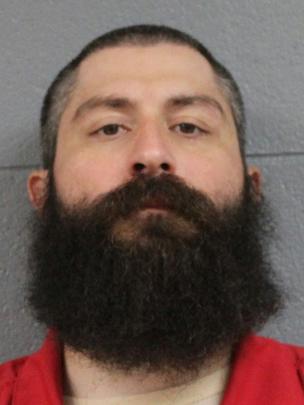
Jerry Harner Jr. (Highland County Sheriff's Office mugshot)
A Dayton man was sentenced to the maximum penalty of five years in prison Monday, Nov. 9, after a jury seated in Highland County Common Pleas Court found him guilty of failure to comply with the order or signal of a police officer.
As previously reported, Jerry W. Harner Jr., 33, was indicted by a Highland County grand jury on the third-degree felony charge in August.
It took Highland County Prosecutor Anneka Collins roughly an hour to try the case, followed by another hour of jury instructions and closing arguments by Collins and defense attorney Jeffery Blosser. The jury deliberated for approximately 20 minutes before returning a guilty verdict, as Highland County Common Pleas Court Judge Rocky Coss later said he didn’t “think I've ever seen a guiltier person than this.”
In her opening statement, Collins told the jury that Highland County Sheriff’s Deputy Traevon Williams was stationed in Allensburg on the night of July 10 when he observed a vehicle traveling on U.S. Route 50 at “a high rate of speed,” which Williams estimated to be approximately 100 mph in a 55 mph zone.
Collins said Williams attempted to make a stop on the vehicle, but it continued to travel at a high speed east on U.S. 50 toward Hillsboro.
“During the chase down U.S. 50 toward Hillsboro, the suspect vehicle passed about 10 other cars, going in the same direction, many times in a no-passing zone,” Collins said.
Collins said that onlookers at a U.S. 50 restaurant observed the chase as the cars entered Hillsboro. From there, the suspect car ran a red light at the intersection of U.S. 50 and Oak Street and crashed into a vehicle turning onto U.S. 50.
Collins continued that after the crash, the suspect driver “jumped out of the car and took off running up between the houses,” at which point Williams’ K-9 partner, Argo, was released from the sheriff’s cruiser and commanded to seize the suspect.
“Argo does this immediately, takes off up the hill and tackles the person that ran from the driver's seat,” Collins said. “That person is the defendant. Deputy Williams caught up to Argo, where he had the defendant on the ground, and when other officers arrived, making it safe for Deputy Williams and Argo, Deputy Williams took Argo off of this defendant, and he was taken.
“Now, it took Argo only seconds to apprehend the suspect when they stopped and Deputy Williams let him out, and when he did, Deputy Williams recognized this defendant when he approached him as Jerry Harner Jr.”
In his opening statement, Blosser asked the jury to “listen carefully to all the evidence.
“Your task is not simply to decide whether you disapprove of the driving described here, the collision or anything of that nature,” Blosser said. “Your task is to decide whether state proves a particular charge against Mr. Harner beyond a reasonable doubt.
“As the judge will explain at the appropriate time, the questions will include whether Mr. Harner received a police signal to stop, whether he then willfully fled or eluded the officer.”
Deputy Williams was the first witness called by the state. He testified that on July 10 at approximately 9:45 p.m., he was stationed in a marked patrol car in the 5000 block of U.S. 50 West, facing traffic, when he could hear the “engine of a roaring loud car” approaching, traveling “eastbound toward Hillsboro.
“Initially, I heard the sound,” Williams said. “I observed the vehicle coming from west to east toward Hillsboro at a high rate of speed. As the vehicle got in front of me, I visually estimated the vehicle going at about 100 miles an hour in a 55 mile-per-hour zone.”
Collins asked what Williams did as “the vehicle drove past you,” and he testified that he “immediately pulled out and turned my lights and sirens on.”
Testifying about the pursuit into Hillsboro, Williams said that the suspect vehicle “was in the middle of the roadway, straddling the center lines” and passing four other vehicles.
“When you pulled out behind the car, what speed did you have to reach in order to stay with the vehicle?” Collins asked
“At one point, I was traveling over 115, 120 miles an hour,” Williams said.
Williams continued that he “counted that we had passed 10 vehicles traveling in the same direction as us” and “one vehicle that was coming in the opposite direction as the fleeing vehicle was in that lane of travel” during the pursuit. When the accident inside the Hillsboro city limits occurred, Williams said the other driver was turning onto U.S. 50 when the suspect driver “swerved toward the back of the truck and struck the truck, and then came to a stop, I mean, almost immediately, after that.”
Williams then reviewed and answered questions regarding maps of the route of the pursuit. Collins asked Williams if he could identify the driver in the courtroom, and he identified Harner as such.
After asking several questions about what would be shown, Collins moved to publish the body-worn camera footage of the apprehension of Harner.
“When you get to Argo and the defendant in the middle of the video, you don't immediately pull Argo off. Why is that?” Collins asked.
“Anytime we deploy [Argo], it's usually a high-risk situation, and I knew that there was other officers nearby, so it's safer for not just me but him as well to wait for another officer to get there so that I can control the dog while they handcuff [Harner], take him into contro.,” Williams said.
Williams then reviewed photos of Harner’s vehicle as well as records of Harner’s inmate activity, as Collins said “the person Argo caught in the video looks a little different from the man you identified today” as the defendant. Williams confirmed that Harner received a haircut during his time in the Highland County Jail.
During cross examination, Blosser asked if Williams’ “emergency lights and sirens [were] activated during your initial observation” of the suspect vehicle.
“As in, when the vehicle was approaching me?” Williams asked. “No.”
“And when you pulled out behind the [suspect vehicle], did you activate your emergency lights and siren at that time?” Blosser asked.
“Yes, sir,” Williams said.
Williams also agreed that “the initial” approximation of the suspect vehicle’s speed was a “visual estimation.” Blosser asked about Williams catching up to the suspect vehicle “from a stop, a stationary position.”
Blosser also asked about an error in the crash report that misidentified the driver of the truck involved in the crash. Williams agreed that he made an error, but during redirect examination, he also testified that the crash investigation was handled by a different police officer.
The second witness called was the victim of the crash. He testified that he and his brother-in-law were in a truck at the intersection of Oak Street and West Main Street, and that he “looked both ways three times, saw no headlights, no other vehicles, no red and blues, nothing,” before turning onto U.S. 50.
“Next thing I know all I heard was a roar of a motor and impact — no headlights, high rate of speed,” the victim said. “A smaller Honda sedan spun my truck 90 degrees.”
The victim said he observed the suspect driver “jump out and take off running,” followed by the K-9 officer.
“I attempted to back my truck off the street, but the impact was so hard it knocked the rear axle clear out of my truck and totaled it,” the victim said.
The victim reviewed photos of the suspect vehicle and confirmed that it was the “vehicle that hit” his truck, as he also said the suspect vehicle had no headlights on at the time of the accident.
The victim testified that although he was not injured in the crash, the truck was totaled, resulting in “around $53,000” from the insurance company.
Under cross examination, Blosser asked if the victim could “say when the driver audibly received the signal from the police officer,” which the victim said he could not, and whether the victim “saw any flashing red and blue lights,” to which the victim also said no. During redirect examination, the victim testified that there are “dips” in the road and that it is “pretty dark” in the area.
The third witness was an individual who had been eating at a U.S. 50 restaurant, facing the route, on the night of July 10. She testified that she could see the red and blue lights coming toward Hillsboro, and when the vehicles approached, she realized there was also “a car in front of” the sheriff’s cruiser.
“I don't remember seeing any like headlights or interior lights [in the suspect vehicle],” she said. “I was kind of confused because it's not something you see every day.”
In response to another question from Collins, the witness testified that she would agree the vehicles were traveling fast. After watching the vehicles pass the restaurant, the witness testified that she and her companion headed in the same direction and came upon the crash, where they stopped to check on the victim and spoke with Williams.
“Did you see any other vehicle come around the cop car and that car?” Collins asked.
“No,” the witness said.
“Prior to that, did you see any other vehicle flying by you?” Collins asked.
“No,” the witness said.
During cross examination, the witness agreed that she “did not see when the pursuit began,” nor did she “witness the actual collision.”
The fourth and final witness was the companion of the third witness, who also observed the pursuit from the U.S. 50 restaurant.
“I saw red and blue lights,” he testified. “I just thought it was a cop just going somewhere. I look up, I see a car with no headlights going faster than usual, and I didn't think anything of it.”
In response to a question from Collins, the witness said the cruiser was “right behind” the other vehicle with no headlights. The witness testified that he and his companion later stopped at the scene of the crash and filled out a witness statement. He also testified that he did not see any other car pass the suspect vehicle and cruiser.
After that witness’s testimony, the state rested, and Coss dismissed the jury for “an early lunch” at 11:25 a.m. During the break, Blosser made a motion for a Rule 29 acquittal.
“While the state establishes that the deputy activated his emergency equipment or the sirens and the lights, the missing requirement is the receipt of the signal by the operator that does not come into evidence,” Blosser said. “The state has not supplied the factual basis from which a rational fact finder could find beyond a reasonable doubt that the defendant has committed the offense alleged in this case.”
Coss overruled the motion.
Following the break, Blosser said that the defense would be resting as well, as Harner elected not to testify in his own defense. Blosser did renew his Rule 29 motion, which was again overruled by Coss, after which the jury heard their first round of instructions.
In her first closing argument, Collins pointed out that “the elements of this crime are very simple” and “the law is easy to follow and understand.
“I told you this morning that the state would present the testimony and evidence that would prove that Jerry Harner Jr. failed to comply with the order or signal of a police officer while operating a motor vehicle, and in doing so, he created a substantial risk of serious physical harm to persons or property,” Collins said. “That is the evidence and the testimony that has been presented today, and based on that evidence and the testimony, the only conclusion is that this man, Jerry Harner Jr., is guilty of failure to comply with the order or signal of a police officer, and because he refused to comply with Deputy Williams’ signal to stop, he caused serious physical harm to [the victim’s] truck when he struck it. He totaled his truck when he crashed into it.”
Blosser reminded the jury that their “verdict has to answer specific questions,” including “whether the state proved everything that it was required to prove.
“Consider the evidence that was brought out by the witnesses here,” Blosser said. “In fact, that's the only evidence that was brought out. We saw the body camera video.
“We got testimony of the deputy saying that he had his pursuit lights. He had his takedown lights. There was an audible, visual signal. That's his testimony. Can't testify, however, that that was received, and there is some, I guess, question, at least in the mind of what I heard, about how close the patrol vehicle was to the vehicle, and there's some conflicting testimony.”
Blosser raised questions about whether “the signal was activated, number one, and was it received, and then was there an attempt afterward to flee and elude?
“Evidence of the collision, while it bears on dangerous operation, risk involved — that in and of itself does not establish when the driver received the police signal, nor whether or not he was intentionally fleeing after receiving it,” Blosser said.
In her final closing argument, Collins disagreed, saying “there is no conflicting testimony about the distance between” the cruiser and suspect vehicle.
“The difference is where everyone was located when they saw it,” she said.
Collins recapped the testimony of the four witnesses, as well as their credibility. She argued that Williams “simply relayed the facts to you just as they happened” and that his testimony “perfectly matches the body cam video evidence,” so the jury knows “his version of events is truthful.” The victim also “has no interest or bias,” while the other two witnesses were “completely unrelated bystanders” who happened to see the events unfolding.
Collins then reviewed all of the elements of the offense as charged. She said “most of these elements actually can be proven” from the body cam footage alone” — portions of which she replayed during her closing argument — but she also went over the testimony from the trial in relation to all of the elements.
“The proof is here,” Collins told the jury. “The proof is in the maps, the proof is in the testimony, and the proof is on video that this defendant committed this crime.
“Was Harner fleeing and eluding? Yes. Did he run from the cops after the cops tried to get him to stop, and did he cause a crash that totaled someone's truck? Yes, he did all of that, and because he did that, he is guilty. Did Harner fail to comply with the order or signal of a police officer? Well, yes. We've proven each element of this case beyond a reasonable doubt.”
After hearing their final set of instructions, the jury deliberated for roughly 20 minutes before returning a verdict of guilty, with the additional finding “that the operation of the motor vehicle by the offender did cause a substantial risk of serious physical harm to persons or property,” as read by Clerk of Courts Ike Hodson.
Coss said he would proceed with sentencing, as he noted this was Harner’s “fourth conviction for failure to comply” since 2014, including another Highland County case and one each in Brown and Clinton counties.
“This is a five-year maximum penalty for this crime,” Collins said. “We would ask the court to sentence closer to the max rather than the minimum. I would note that the defendant is currently on PRC [post-release control].
“That was actually for failure to comply with the order or signal of a peace officer that he was on PRC, so we would ask the court to sentence the defendant according not only to his prior criminal history and the fact that he was already on PRC when he committed this crime and was wanted for the same crime, but the damage that he caused. I would note that he is extremely lucky that he didn't kill anyone that night.”
Blosser said that “despite the verdict of the jury, I know that Mr. Harner does maintain his innocence and will indicate an intention to file notice of appeal at the appropriate time.”
Harner declined to speak prior to sentencing.
Coss told Harner that in his “literally thousands of criminal cases over the 50 years-plus” of Coss’s legal career, “I don't think I've ever seen a guiltier person than this.
“You turned what would have been probably a reckless operation misdemeanor into a felony,” Coss said. “The longer I go, the more I realize some of the things that were brought back to me about my youth. My dad, from the time I was an early teenager, saying, ‘you know, you better be careful about that. That might come back to bite you in the [rear],’ and in this case, that happened not just literally but figuratively.
“You got bit by the dog because they chased you because you ran, and it's going to happen figuratively as well, because when a person has committed his fourth fleeing and eluding in a little over 12 years, or a little less than 12 years, there's no other appropriate sentence than the maximum to make sure that you don't get out on the highway and kill somebody.”
Coss sentenced Harner to the full 60 months in prison, plus the balance of his post-release control on his previous Clinton County failure to comply case, for an additional 913 days (two and a half years) to run consecutively to the five-year sentence. Harner had 122 days of jail time credit.
Coss additionally suspended Harner’s driver’s license “for your lifetime.
“Not that I imagine it makes much difference. I imagine you didn't have one at the time anyway,” Coss said.