


Daniels, Rosenberger discuss state funding cuts, economic development with area constituents WATCH THE VIDEO
Lead Summary
By
Brandy Chandler-brandychandler@gmail.com
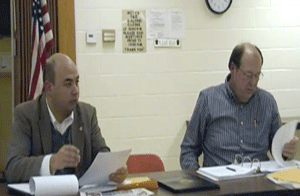
Ohio 17th District Sen. David Daniels (R-Greenfield) and 86th District Rep. Cliff Rosenberger (R-Clarksville) held a joint open-door session Friday in the basement meeting room of the Highland County Administration Building, and discussed the pending state budget, funding for local programs, and economic growth with area constituents.
Daniels said that it will be practically impossible for local government and social service agencies to avoid significant cuts in state funding this year, but that regarding economic development and jobs, "I have been more and more encouraged in the past four to six months that we're going to see some activity."
Heather Gibson, of the Help Me Grow program of Highland County spoke about the funding issues the agency is facing, while dealing with an influx of clients, particularly children suffering the effects of parents addicted to drugs.
"I just really wanted to make you aware of what Highland County is facing with the budget cuts," Gibson said. "
The agency, which provides Ohio's expectant parents, newborns, infants and toddlers with health and developmental services, will have a difficult time meeting state and federal mandates with the funds they are allotted, particularly in the areas of home visits.
"When I look at Highland County, the automatic cut, we're going to lose $42,000 right off the top (when stimulus funds) are done June 30," Gibson said.
The current budget is approximately $300,000, she said, with funds carried over from last year, $47,000 from federal funds, and the rest coming from state funds.
"When I look to see, 'our we going to be able to make up this $42,000 we are are going to lose in Medicaid' the first thing I see is that we are extremely low in home visiting in this area," Gibson said. "Primarily (Medicaid) Part C. Last year we had 252 referrals that we processed. Out of that, 50 of those were home visits. The other 200 of Part C kids. If you look at 200 Part C kids, and the $53,000 we'll get from the federal government to cover those kids, you can't make those numbers work. I mean there's just no way of making $53,000 stretch across 200 kids."
Gibson said that in Highland County, if the families can't get the services through Help Me Grown, there are no other local agencies they can turn to.
Additionally, Gibson said that the county has had tremendous growth in the number of patrons they are serving, particularly with children who comes from families with drug issues.
"We've had such an influx of babies that are born addicted to drugs that it really is taxing the whole community," Gibson said.
According to Highland County Children Services, she said, in the last six months, they have had 97 referrals of children due issues with parents and drugs.
"That is much more case intensive for us, because oftentimes they are placed with foster parents, or a lot of times, relative placement, and they have no idea how to deal with these kids," Gibson said. "I mean a baby born addicted to drugs is unlike any other. And each one of those is different, depending on when abuse began in pregnancy, and how often, what type of drug, and all those kinds of things. So we're really trying locally to address the issues, but the funding cuts are really going to hurt us, because we're not going to be able to make up that difference where some of the bigger counties can with the Medicaid money."
Gibson said she wanted Daniels and Rosenberger to be aware of how large a portion of their clientele were Part C.
"The same is true for Clinton County, Adams County, Brown County, when we all (meet regionally) we talk about how home visiting is great, we believe in it, we know it works, but our primary focus, though, is always Part C because that is where all of our referrals are," she said.
Daniels said said he was glad to hear Gibson report that social service agencies, among themselves, have attempted to eliminate redundancies in services in order to help stretch dollars.
"As a result of some past law changes, a lot of those local funds, discretionary funds, that are used to kind of fill in the gaps in some of the funding sources out there have been diverted to help with Medicaid match," Daniels said. "If there were some relief for local dollars - and I understand that not every county has local dollars to spend - do you think there would be some availability of funds through other resources that might help fill any kind of a funding gap or funding cut that may very well come ... Well, that will come as a result of our deliberations in the state budget this year?"
Gibson said that in the eight years she has worked with Help Me Grown they have never operated off of local dollars. They will not be able to carry over dollars in the budget, as it is a biennium, and funds will be lost if they are not spent. That will result in a cash flow issue for the agency, as there is also a gap between when funds are spent, and when they are reimbursed by the state.
"And to be honest with you, we're the ones everyone else calls in to deal with these babies," Gibson said. "We're the ones who have the experience ... We're saving babies at a smaller gestation than ever before, so we're getting 23-week-old babies that no one else can really deal with. Children Services calls us in with the drug babies because they don't have any advice for those parents. They don't know what to do developmentally. As far as medically, the local hospital, their therapy list, there is such a waiting list. I've had kids on there for over a year and haven't been seen yet. The resources are so small, and there's really no one in the county, outside of our agency and the medical field, that can support the family's need. I mean, we're talking about babies that cry 23 out of 24 hours in the day sometimes, just because they are going through withdrawal."
Gibson also told Daniels and Rosenberger that Highland County, for many years, has ranked number four in teen pregnancy in the state.
Daniels thanked Gibson for bringing the issue to their attention, but didn't have good news to offer.
"We understand the challenges you're facing on the local level," Daniels said. "We really do. And as much as I hate to say it, I'm probably going to tell you that there's probably going to be very few state programs that don't see some reduction in funding available this year. We'll try to keep it in mind as it goes through, and believe you me, I understand, from the district I'm from, I understand that not all counties are created equal, and there are resource gaps in a lot of our small rural counties. Not only are we going to be looking at a reduction of dollars that are going into these programs, but also we're going to try to find ways to help local people deal with it."
Daniels said that the local people who deal with the issue every day, who make the budgets work despite cuts, know the situation better than anyone, and "if you have any kind of advice or any ideas that would help us find solutions for you with fewer dollars, we're going to be extremely open to listen through this budget process."
Rosenberger said he agreed with Daniels and said the best way was to work with the state legislators "to show us ways we can help you be innovative for regulatory issues to help curtail costs."
Terry Mikkelsen, a Hillsboro resident and candidate for Hillsboro mayor, asked Daniels about the state budget.
"We're hearing some preliminary discussion," Daniels said, though hard figures are expected by mid-March. "But we haven't seen a number yet. I think everyone is pretty convinced that number (that must be cut) is somewhere between $7 billion to $9 billion. We are seeing a little bit of an uptick in state revenue, but it is less than a half percent. It's not very much at all. So we know we're going to have this problem that we're going to be dealing with ... But there is ample opportunity for public participation."
Daniels said that the best way for Ohio residents to make their voices heard is to call or email their state leaders. Daniels said that he reads every email that comes into his office from an actual individual, but sometimes emails get filtered out.
"I encourage people to ship us off an email," Daniels said. "I can't say that every legislator looks at theirs, but I look at mine."
Rosenberger said he reads his, as well.
Daniels can be reached by calling (614) 466-8156, and by emailing SD17@senate.state.oh.us.
Rosenberger can be reached by calling (614) 466-3506 and by emailing district86@ohr.state.oh.us.
Gibson asked Rosenberger and Daniels if they were seeing any progress for economic development for the area.
"There are people looking at our area all the time," Daniels said.
It took time to build up the number of jobs that were supplied to the area by the Wilmington Air Park, he said, "and it's going to take quite a period of time to rebuild to that point. But I can tell you that in the last two years we have actively spoke to a number of different companies that are looking at this area of Southern Ohio. Some of them are companies that would like to move here. Some of them are start-up companies that are looking for assistance. Those things are not quick processes. But I am encouraged. I have been more and more encouraged in the past four to six months that we're going to see some activity. It isn't going to be huge. But there are people that are looking at us.
Rosenberger said that he is also encouraged.
"Just within the month (that he has been in office) the discussions that have been going on, I am very encouraged by the attention and the folks that are looking at this area, and all southwest Ohio. It's a good place to want to come," he said.
Ohio 17th District Sen. David Daniels (R-Greenfield) and 86th District Rep. Cliff Rosenberger (R-Clarksville) held a joint open-door session Friday in the basement meeting room of the Highland County Administration Building, and discussed the pending state budget, funding for local programs, and economic growth with area constituents.
Daniels said that it will be practically impossible for local government and social service agencies to avoid significant cuts in state funding this year, but that regarding economic development and jobs, "I have been more and more encouraged in the past four to six months that we're going to see some activity."
Heather Gibson, of the Help Me Grow program of Highland County, spoke about the funding issues the agency is facing while dealing with an influx of clients, particularly children suffering the effects of parents addicted to drugs.
"I just really wanted to make you aware of what Highland County is facing with the budget cuts," Gibson said.
The agency, which provides Ohio's expectant parents, newborns, infants and toddlers with health and developmental services, will have a difficult time meeting state and federal mandates with the funds they are allotted, particularly in the area of home visits.
"When I look at Highland County, the automatic cut, we're going to lose $42,000 right off the top (when stimulus funds) are done June 30," Gibson said.
The current budget is approximately $300,000, she said, with funds carried over from last year, $47,000 from federal funds, and the rest coming from state funds.
"When I look to see, 'are we going to be able to make up this $42,000 we are going to lose in Medicaid,' the first thing I see is that we are extremely low in home visiting in this area," Gibson said. "Primarily (Medicaid) Part C. Last year we had 252 referrals that we processed. Out of that, 50 of those were home visits. The other 200 of Part C kids. If you look at 200 Part C kids, and the $53,000 we'll get from the federal government to cover those kids, you can't make those numbers work. I mean there's just no way of making $53,000 stretch across 200 kids."
Gibson said that in Highland County, if the families can't get the services through Help Me Grow, there are no other local agencies they can turn to.
Additionally, Gibson said that the county has had tremendous growth in the number of patrons they are serving, particularly with children who come from families with drug issues.
"We've had such an influx of babies that are born addicted to drugs that it really is taxing the whole community," Gibson said.
According to Highland County Children Services, she said, in the last six months, they have had 97 referrals of children due to issues with parents and drugs.
"That is much more case intensive for us, because oftentimes they are placed with foster parents, or a lot of times, relative placement, and they have no idea how to deal with these kids," Gibson said. "I mean, a baby born addicted to drugs is unlike any other. And each one of those is different, depending on when abuse began in pregnancy, and how often, what type of drug, and all those kinds of things. So we're really trying locally to address the issues, but the funding cuts are really going to hurt us because we're not going to be able to make up that difference where some of the bigger counties can with the Medicaid money."
Gibson said she wanted Daniels and Rosenberger to be aware of how large a portion of their clientele were Part C.
"The same is true for Clinton County, Adams County, Brown County, when we all (meet regionally) we talk about how home visiting is great, we believe in it, we know it works, but our primary focus, though, is always Part C because that is where all of our referrals are," she said.
Daniels said that he was glad to hear Gibson report that social service agencies, among themselves, have attempted to eliminate redundancies in services in order to help stretch dollars.
"As a result of some past law changes, a lot of those local funds, discretionary funds, that are used to kind of fill in the gaps in some of the funding sources out there have been diverted to help with Medicaid match," Daniels said. "If there were some relief for local dollars - and I understand that not every county has local dollars to spend - do you think there would be some availability of funds through other resources that might help fill any kind of a funding gap or funding cut that may very well come ... Well, will that come as a result of our deliberations in the state budget this year?"
Gibson said that in the eight years she has worked with Help Me Grow, they have never operated off of local dollars. They will not be able to carry over dollars in the budget, as it is a biennium, and funds will be lost if they are not spent. That will result in a cash flow issue for the agency, as there is also a gap between when funds are spent, and when they are reimbursed by the state.
"And to be honest with you, we're the ones everyone else calls in to deal with these babies," Gibson said. "We're the ones who have the experience ... We're saving babies at a smaller gestation than ever before, so we're getting 23-week-old babies that no one else can really deal with. Children Services calls us in with the drug babies because they don't have any advice for those parents. They don't know what to do developmentally. As far as medically, the local hospital, their therapy list, there is such a waiting list. I've had kids on there for over a year and haven't been seen yet. The resources are so small, and there's really no one in the county, outside of our agency and the medical field, that can support the family's need. I mean, we're talking about babies that cry 23 out of 24 hours in the day sometimes, just because they are going through withdrawal."
Gibson also told Daniels and Rosenberger that Highland County, for many years, has ranked number four in teen pregnancy in the state.
Daniels thanked Gibson for bringing the issue to their attention, but didn't have good news to offer.
"We understand the challenges you're facing on the local level," Daniels said. "We really do. And as much as I hate to say it, I'm probably going to tell you that there's probably going to be very few state programs that don't see some reduction in funding available this year. We'll try to keep it in mind as it goes through, and believe you me, I understand, from the district I'm from, I understand that not all counties are created equal, and there are resource gaps in a lot of our small rural counties. Not only are we going to be looking at a reduction of dollars that are going into these programs, but also we're going to try to find ways to help local people deal with it."
Daniels said that the local people who deal with the issue every day, who make the budgets work despite cuts, know the situation better than anyone, and "if you have any kind of advice or any ideas that would help us find solutions for you with fewer dollars, we're going to be extremely open to listen through this budget process."
Rosenberger said he agreed with Daniels and said the best way was to work with the state legislators "to show us ways we can help you be innovative for regulatory issues to help curtail costs."
Terry Mikkelsen, a Hillsboro resident and candidate for Hillsboro mayor, asked Daniels about the state budget.
"We're hearing some preliminary discussion," Daniels said, though hard figures are expected by mid-March. "But we haven't seen a number yet. I think everyone is pretty convinced that number (that must be cut) is somewhere between $7 billion to $9 billion. We are seeing a little bit of an uptick in state revenue, but it is less than a half percent. It's not very much at all. So we know we're going to have this problem that we're going to be dealing with ... But there is ample opportunity for public participation."
Daniels said that the best way for Ohio residents to make their voices heard is to call or email their state leaders. Daniels said that he reads every email that comes into his office from an actual individual, but sometimes emails get filtered out.
"I encourage people to ship us off an email," Daniels said. "I can't say that every legislator looks at theirs, but I look at mine."
Rosenberger said he reads his, as well.
Daniels can be reached by calling (614) 466-8156, and by emailing SD17@senate.state.oh.us.
Rosenberger can be reached by calling (614) 466-3506 and by emailing district86@ohr.state.oh.us.
Gibson asked Rosenberger and Daniels if they were seeing any progress for economic development for the area.
"There are people looking at our area all the time," Daniels said.
It took time to build up the number of jobs that were supplied to the area by the Wilmington Air Park, he said, "and it's going to take quite a period of time to rebuild to that point. But I can tell you that in the last two years we have actively spoke to a number of different companies that are looking at this area of Southern Ohio. Some of them are companies that would like to move here. Some of them are start-up companies that are looking for assistance. Those things are not quick processes. But I am encouraged. I have been more and more encouraged in the past four to six months that we're going to see some activity. It isn't going to be huge. But there are people that are looking at us."
Rosenberger said that he is also encouraged.
"Just within the month (that he has been in office) the discussions that have been going on, I am very encouraged by the attention and the folks that are looking at this area, and all southwest Ohio. It's a good place to want to come," he said.
[[In-content Ad]]