


City administrators, dog park association president spar at Hillsboro council meeting
Lead Summary
By
Caitlin Forsha-crforsha@gmail.com
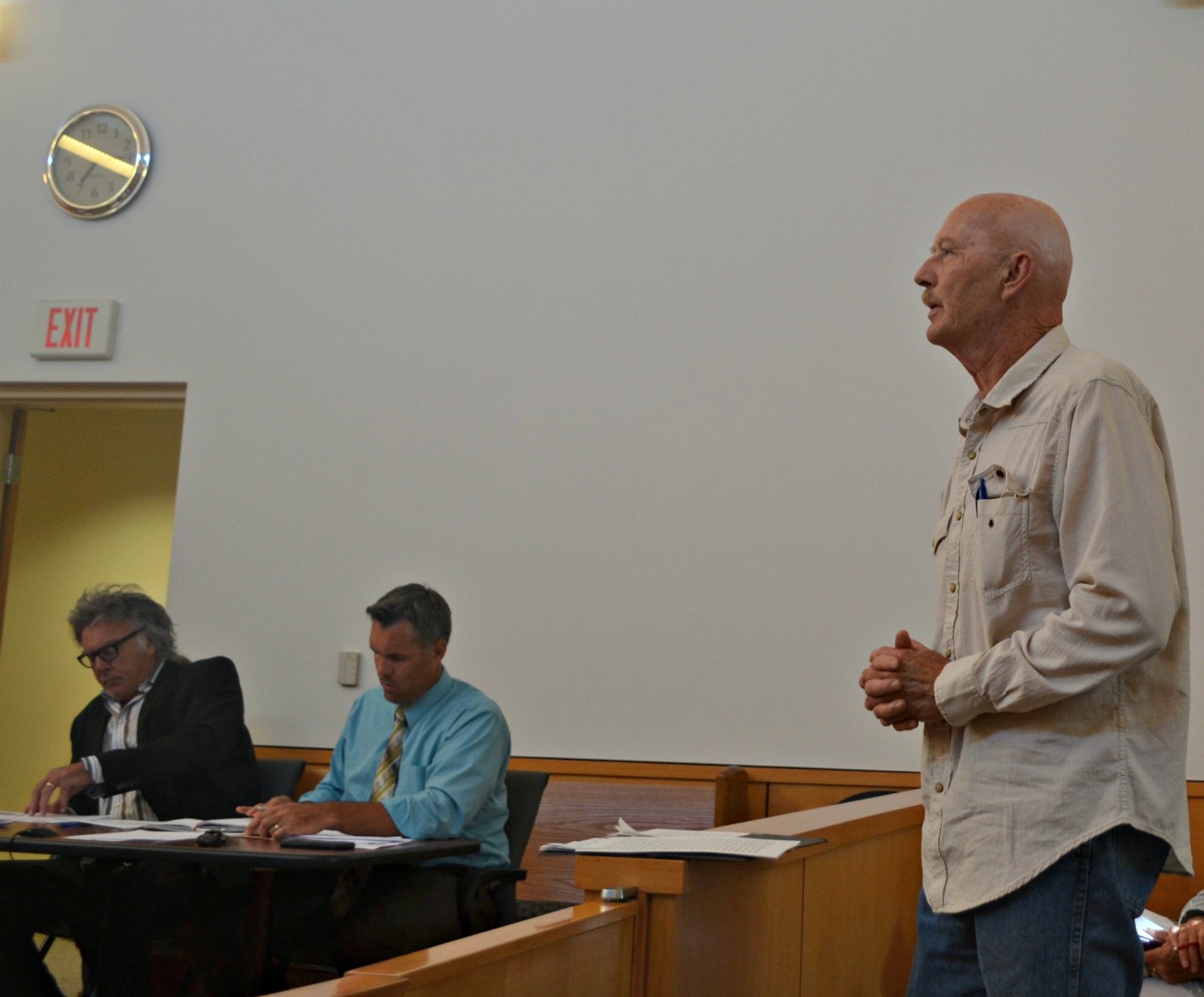
Hillsboro city council members heard from Ken Rentz, president of the Hillsboro Dog Park Association, at their June council meeting, with Rentz speaking out against the city’s involvement in plans for the proposed dog park and asking to be “disassociated” from the project.
In September 2014, Rentz approached council to discuss plans for a dog park, answering council members’ questions and presenting a complete proposal. Following discussions by the property maintenance and restoration committee, council unanimously agreed to move forward with the proposal, voting at their October 2014 meeting.
On Monday night, Rentz told council that Hillsboro mayor Drew Hastings had agreed that the city would provide the space for the park and basic maintenance, with the Dog Park Association expected to raise funds for the implementation of the plan.
“Over the next year and a half or so, the association did everything we could to raise money,” Rentz said. “Even with all our hard work, I could see this would take much longer, but undeterred, I kept searching for funds.”
Rentz said that he discovered an Ohio Department of Natural Resources grant for $49,300, for which the dog park project qualified.
“We couldn’t apply for it,” Rentz said. “It had to be a government entity of some kind. I then approached the mayor with this great opportunity, and he agreed the city should apply for it.”
Rentz said that the city hired Stantec Engineering to apply for the grant “because they didn’t know how or [didn’t have] the time, and Stantec was experts at filling out the forms.”
(Safety and service director Todd Wilkin later clarified that the city does know how to write grants but that “we don’t all have an infinite amount of time.”)
“I thought this odd, paying out for this, but was told ‘don’t worry about it,’” Rentz said. “There was plenty of grant money to cover it and still have a nice park, so I didn’t worry about it. I was being naive.”
After the city received the grant, Rentz said that things became “convoluted.”
“I didn’t know once big money got involved, things were going to be twisted and convoluted,” Rentz said.
The initial design for the park by Stantec “was made by a man who admitted at the start he knew nothing about dog parks, and it showed,” according to Rentz.
“There were no water stations, tables or benches or trash containers inside the dog park,” Rentz said.
Rentz said that he emailed his own plan to the engineer at Stantec and showed council members his rendering.
“I’ve been researching this subject for over three years, so I was aware of what was needed,” Rentz said.
Rentz said that Stantec submitted a new design that included most of Rentz’s suggestions, “except not to concrete the line posts, but rather to drive nine-foot post tubes four foot into the ground.”
While the issue of the concrete was his main concern, Rentz also criticized that the grant “includes a pavilion at Harmony Lake” and a water station for the dog park “that’s not freeze-proof,” as well as expressing concerns that the grant is “under the complete control of Stantec as contracted by the city.”
“I thought the law director drew up the contracts between the city and whoever,” Rentz said. “I asked to see the contract that Fred [Beery] drew up between the city and Stantec, and they couldn’t produce it or wouldn’t produce it [today].
“Bewildered, but still thinking at the end of this Hillsboro will have a dog park, I accepted another ‘don’t worry,’ but the city is still refusing to concrete the line posts. So I go about compiling a mountain of evidence, which they refuse to look at, of why the posts should be concreted. As expected, I found that every chainlink manufacturer, every fence wholesaler, every fence contractor, every do-it-yourself guide recommends to set the posts in concrete. Even a novice knows a driven post can drift out, especially when the ground is wet.”
Rentz said a meeting held with Hastings and Wilkin on Monday to insist on concrete was unsuccessful.
“I was told this was a city project, run by Stantec, and the Hillsboro Dog Park Association had no say whatsoever about the dog park project,” Rentz said. “After this one last attempt to reason with the mayor fell on deaf ears, the association is giving notice that the association is dissociating itself from the city and Stantec’s substandard dog park project.
“We also want the $5,000 that was compiled through all our hard work and the generous citizens to be returned without delay. The city and Stantec may use the $49,300 grant money the association filed for any way they like, but they are not entitled to spend the $5,000 of association money any way they want. We are sorry it’s come to this but feel we had no choice.”
Rentz thanked council members for their “past support for what I’ve tried to do and for what others have tried to do.”
Hastings told council that he and Wilkin, along with Beery and executive administrative assistant Debbie Sansone, met today following their meeting with Rentz. The administration will return the $5,000 to the Hillsboro Dog Park Association after making “sure it was not a condition of the grant, that the $5,000 was somehow encumbered. If not, we will pay the association back their money, and we would then contact ODNR and take on another project at Liberty Park,” Hastings said.
“Why would their $5,000 be in any way tied to the grant?” council member Rebecca Wilkin asked.
“I don’t know,” Hastings said. “I never saw the grant. I never had a meeting – beyond my meeting with Ken when he first came two years ago, I’ve never been involved with this.
“Oftentimes, as I recall, you’re given a grant because there’s been an in-kind or cash donation that the grantee, or in this case ODNR, counts as part of that grant.”
Council member Tracy Aranyos said that she was “really disappointed” that the association and city could not reach an agreement.
“So am I,” Rentz said. “It’s ridiculous, isn’t it?”
“I know a lot of people were really excited and looking forward to it,” Aranyos said. “I’d like to see us be able to come to an agreement.”
“I was hoping council would have some type of persuasion,” Rentz said.
“I think Ken found the grant to begin with,” council member Ann Morris said. “The dog park was going to be at the old city park, and then something happened where this grant came along and they said that it had to be at Liberty Park.”
“I’ll tell you what happened,” Rentz said. “The city did not want to spend $49,300 at the city park. They wanted the dog park to be at Liberty.”
“The old city park was going to be a better avenue, which is what the people donated the money for, and then all of a sudden they’re like ‘oh, it’s going to be at Liberty,’” Morris said.
“Where did the Stantec place come into play?” Rebecca Wilkin asked.
“Stantec was brought into the equation because it’s more than a dog park,” Todd Wilkin said. “It’s improvements at Liberty Park, so as Ken was alluding to, there is a pavilion out there as well. To build a pavilion, to build a dog park, they all go together. It’s all part of the same grant.”
“Can I interrupt you?” Rentz asked. “Is a pavilion a glorified shelter house?”
“Sure,” Wilkin said.
“What’s that got to do with anything?” city auditor Gary Lewis asked.
“Let me just interject,” Hastings said. “I think there’s a pattern coming from Mr. Rentz, which is a pattern of ‘may I interrupt,’ ‘may I interject,’ ‘let me clarify a point,’ and the bottom line is that’s been the attitude. The dog park is going to be built his way, or it’s not going to be built.
“Part of what it came down to today is Mr. Rentz decided he wanted fence posts put in for the fencing that were to be set in concrete. They absolutely had to be in concrete, and if they weren’t going to be in concrete, he did not want the park built. But as I pointed out to Ken, that’s not up to Ken. If every citizen who was a taxpayer who donated money to something then came back and told us how to build a street or do this or do that, you can’t have that. He said that our engineer was full of it, and the engineer should not be doing this, and that he essentially should be designing it. We can’t do that.”
Wilkin said that the city had to meet the criteria and guidelines set forth by ODNR and added that the city’s relationship with Stantec to date has been “pretty successful.”
“We’re happy that we came across and have been able to solidify a good relationship with someone who does have the best interest of the city involved,” Wilkin said.
“If the dog park did come to fruition and we didn’t use concrete on the fence, and the fence just started going every which way, what would be the result of that? What would we do?” Lewis asked.
“We would repair it and fix it,” Wilkin said.
“Correct,” Lewis said.
“The other issue is cost,” Wilkin said. “It’s interesting to me that this project has imploded based upon one aspect – concrete. That’s it. That’s why it imploded.”
“When did the pavilion come into it?” Morris asked.
“It was always part of the grant,” Wilkin said.
“But the grant came from the dog park initiation,” Morris said.
Lewis said that the grant monies they received included the dog park, as well as the pavilion and signage at Liberty Park, as the city “had the opportunity to add other things to it as well.”
“So there would not have been that much money if the pavilion wasn’t included in it?” Morris asked.
“Or it wouldn’t have been as much money if we didn’t have a dog park included in it,” Lewis said. “You can look at both ways. We could’ve told Mr. Rentz we weren’t interested in his dog park anywhere, we could have went ahead and applied for it and not had a dog park at all, but we decided to include the dog park into it.
“It might be this is just an opportunity to cut your nose off to spite your face, Ken. If we gave you back your $5,000, you’re not going to get a dog park. There’s no place you can put one.”
“Is there any way it can go back to the old city park and just put a smaller one there?” Morris asked.
Wilkin said that they will have to revisit the grant and consult with ODNR.
Dick Donley, who served as president pro tempore in Lee Koogler’s absence, said that he would put the matter in committee so that council members and representatives from the dog park association could further discuss the matter.
Later, after Rentz left the meeting, Hastings told Donley that putting the dog park issue in committee would not “be entirely appropriate.”
“This is an administration action, and I can tell you that I don’t think we have any intention of working with Mr. Rentz and that association,” Hastings said. “I think to set the stage for [council] to have to deal with Mr. Rentz … I don’t think we’re doing council members any favors. It’s administrative action, and I just know we’re not going to pursue a relationship with him because doing the dog park would require that there would be ongoing, for years, interaction with him. I don’t want to subject the administration to that.”
Aranyos suggested that the city should reach out to the dog park association “to maybe pick a new point person permanently.”
“That you could,” Hastings said. “I don’t think that will happen. He’s not a resident of Hillsboro. I don’t even know who another member of the association is.”
“There’s several of them,” Morris said. “I’m concerned that the council already agreed to pursue a dog park, and if we just drop it completely after lots of citizens have donated $5,000 to get a dog park, I don’t think we can just say ‘OK, there’s no dog park now.’”
“The whole issue, the whole situation is that grant was written with that $5,000 donation as part of that,” Lewis said. “We’ve got to check with ODNR. They may say ‘that’s part of it or you don’t get the grant at all.’”
“Should we try to figure out a way to work through them and set aside some differences?” Rebecca Wilkin asked.
“I don’t disagree with that, but I do agree that I don’t believe it’s a committee thing at this point in time,” Lewis said. “I certainly do agree with maybe trying to find a different point person.”
Morris questioned whether Rentz had the “authority to speak for the whole committee.”
“I don’t know, but I do know if it comes to the dog park, you’re going to deal with Mr. Rentz or nobody at all, as far as the indication we get,” Hastings said.
“I think he took that upon himself,” Morris said. “I just think it would be in bad faith to the citizens of Hillsboro that donated.”
“At least make an attempt to put it out there for the committee,” Aranyos said.
Hastings said that when Rentz approached the city two years ago about wanting to build a dog park, it was “not high on our radar,” but they decided to pursue it.
“He said, ‘I’ll go out and do all the work,’” Hastings said. “OK, but when a citizen asks you to do that, then they have to step back and let us do it. I think you could tell he wanted to micromanage the dog park and the construction of it, and we can’t have that.”
Aranyos said that she remembered the city taking over the dog park project and agreed that Rentz “needs to step back a little.”
“Maybe if you guys kind of mediate it a little bit, since you know of some other people involved, maybe that is a good way to take it and we approach it from a new angle,” Hastings said.
“ODNR might come back and say ‘you still have to build a dog park,’” Todd Wilkin said. “That’s why we need to call ODNR and see what we are allowed to do.
“It’s not that we’re trying to squash it, it’s just unfortunately he’s not agreeing with our engineer. As the mayor said, too, he’s trying to micromanage an engineer who does this for a living.”
WIlkin said that “the grant went in a year ago,” and the city has been involved with approving aspects of the plan throughout the process.
“The other issue we have is by current standards, there are insurance people who do not like our sign posts, or any posts, being put in the ground in concrete,” Wilkin said. “Yes, we’re going to have to put a few corner posts in concrete so they’ll hold up to stress, but all of the line posts technically, by insurance requirements, have to not be in concrete. A lot of the signs that we install that are street signs can’t be in concrete.”
Wilkin said that he explained this to Rentz in an email, who responded with “an attack.”
“I’m not here to throw him under the bus,” Wilkin said. “I’m just saying I feel he’s not allowing our engineer to do what the engineer is good at doing.”
At the end of the meeting, Morris brought up the topic for a third time, questioning whether Rentz has “the authority to ask for [the $5,000] back.”
“I don’t know how he could say ‘we want the money back,’” Morris said. “It was given by citizens.”
Donley said that council can continue to look into the dog park issue.
“Maybe with a new approach and new faces, this can get back on track,” Donley said.
In September 2014, Rentz approached council to discuss plans for a dog park, answering council members’ questions and presenting a complete proposal. Following discussions by the property maintenance and restoration committee, council unanimously agreed to move forward with the proposal, voting at their October 2014 meeting.
On Monday night, Rentz told council that Hillsboro mayor Drew Hastings had agreed that the city would provide the space for the park and basic maintenance, with the Dog Park Association expected to raise funds for the implementation of the plan.
“Over the next year and a half or so, the association did everything we could to raise money,” Rentz said. “Even with all our hard work, I could see this would take much longer, but undeterred, I kept searching for funds.”
Rentz said that he discovered an Ohio Department of Natural Resources grant for $49,300, for which the dog park project qualified.
“We couldn’t apply for it,” Rentz said. “It had to be a government entity of some kind. I then approached the mayor with this great opportunity, and he agreed the city should apply for it.”
Rentz said that the city hired Stantec Engineering to apply for the grant “because they didn’t know how or [didn’t have] the time, and Stantec was experts at filling out the forms.”
(Safety and service director Todd Wilkin later clarified that the city does know how to write grants but that “we don’t all have an infinite amount of time.”)
“I thought this odd, paying out for this, but was told ‘don’t worry about it,’” Rentz said. “There was plenty of grant money to cover it and still have a nice park, so I didn’t worry about it. I was being naive.”
After the city received the grant, Rentz said that things became “convoluted.”
“I didn’t know once big money got involved, things were going to be twisted and convoluted,” Rentz said.
The initial design for the park by Stantec “was made by a man who admitted at the start he knew nothing about dog parks, and it showed,” according to Rentz.
“There were no water stations, tables or benches or trash containers inside the dog park,” Rentz said.
Rentz said that he emailed his own plan to the engineer at Stantec and showed council members his rendering.
“I’ve been researching this subject for over three years, so I was aware of what was needed,” Rentz said.
Rentz said that Stantec submitted a new design that included most of Rentz’s suggestions, “except not to concrete the line posts, but rather to drive nine-foot post tubes four foot into the ground.”
While the issue of the concrete was his main concern, Rentz also criticized that the grant “includes a pavilion at Harmony Lake” and a water station for the dog park “that’s not freeze-proof,” as well as expressing concerns that the grant is “under the complete control of Stantec as contracted by the city.”
“I thought the law director drew up the contracts between the city and whoever,” Rentz said. “I asked to see the contract that Fred [Beery] drew up between the city and Stantec, and they couldn’t produce it or wouldn’t produce it [today].
“Bewildered, but still thinking at the end of this Hillsboro will have a dog park, I accepted another ‘don’t worry,’ but the city is still refusing to concrete the line posts. So I go about compiling a mountain of evidence, which they refuse to look at, of why the posts should be concreted. As expected, I found that every chainlink manufacturer, every fence wholesaler, every fence contractor, every do-it-yourself guide recommends to set the posts in concrete. Even a novice knows a driven post can drift out, especially when the ground is wet.”
Rentz said a meeting held with Hastings and Wilkin on Monday to insist on concrete was unsuccessful.
“I was told this was a city project, run by Stantec, and the Hillsboro Dog Park Association had no say whatsoever about the dog park project,” Rentz said. “After this one last attempt to reason with the mayor fell on deaf ears, the association is giving notice that the association is dissociating itself from the city and Stantec’s substandard dog park project.
“We also want the $5,000 that was compiled through all our hard work and the generous citizens to be returned without delay. The city and Stantec may use the $49,300 grant money the association filed for any way they like, but they are not entitled to spend the $5,000 of association money any way they want. We are sorry it’s come to this but feel we had no choice.”
Rentz thanked council members for their “past support for what I’ve tried to do and for what others have tried to do.”
Hastings told council that he and Wilkin, along with Beery and executive administrative assistant Debbie Sansone, met today following their meeting with Rentz. The administration will return the $5,000 to the Hillsboro Dog Park Association after making “sure it was not a condition of the grant, that the $5,000 was somehow encumbered. If not, we will pay the association back their money, and we would then contact ODNR and take on another project at Liberty Park,” Hastings said.
“Why would their $5,000 be in any way tied to the grant?” council member Rebecca Wilkin asked.
“I don’t know,” Hastings said. “I never saw the grant. I never had a meeting – beyond my meeting with Ken when he first came two years ago, I’ve never been involved with this.
“Oftentimes, as I recall, you’re given a grant because there’s been an in-kind or cash donation that the grantee, or in this case ODNR, counts as part of that grant.”
Council member Tracy Aranyos said that she was “really disappointed” that the association and city could not reach an agreement.
“So am I,” Rentz said. “It’s ridiculous, isn’t it?”
“I know a lot of people were really excited and looking forward to it,” Aranyos said. “I’d like to see us be able to come to an agreement.”
“I was hoping council would have some type of persuasion,” Rentz said.
“I think Ken found the grant to begin with,” council member Ann Morris said. “The dog park was going to be at the old city park, and then something happened where this grant came along and they said that it had to be at Liberty Park.”
“I’ll tell you what happened,” Rentz said. “The city did not want to spend $49,300 at the city park. They wanted the dog park to be at Liberty.”
“The old city park was going to be a better avenue, which is what the people donated the money for, and then all of a sudden they’re like ‘oh, it’s going to be at Liberty,’” Morris said.
“Where did the Stantec place come into play?” Rebecca Wilkin asked.
“Stantec was brought into the equation because it’s more than a dog park,” Todd Wilkin said. “It’s improvements at Liberty Park, so as Ken was alluding to, there is a pavilion out there as well. To build a pavilion, to build a dog park, they all go together. It’s all part of the same grant.”
“Can I interrupt you?” Rentz asked. “Is a pavilion a glorified shelter house?”
“Sure,” Wilkin said.
“What’s that got to do with anything?” city auditor Gary Lewis asked.
“Let me just interject,” Hastings said. “I think there’s a pattern coming from Mr. Rentz, which is a pattern of ‘may I interrupt,’ ‘may I interject,’ ‘let me clarify a point,’ and the bottom line is that’s been the attitude. The dog park is going to be built his way, or it’s not going to be built.
“Part of what it came down to today is Mr. Rentz decided he wanted fence posts put in for the fencing that were to be set in concrete. They absolutely had to be in concrete, and if they weren’t going to be in concrete, he did not want the park built. But as I pointed out to Ken, that’s not up to Ken. If every citizen who was a taxpayer who donated money to something then came back and told us how to build a street or do this or do that, you can’t have that. He said that our engineer was full of it, and the engineer should not be doing this, and that he essentially should be designing it. We can’t do that.”
Wilkin said that the city had to meet the criteria and guidelines set forth by ODNR and added that the city’s relationship with Stantec to date has been “pretty successful.”
“We’re happy that we came across and have been able to solidify a good relationship with someone who does have the best interest of the city involved,” Wilkin said.
“If the dog park did come to fruition and we didn’t use concrete on the fence, and the fence just started going every which way, what would be the result of that? What would we do?” Lewis asked.
“We would repair it and fix it,” Wilkin said.
“Correct,” Lewis said.
“The other issue is cost,” Wilkin said. “It’s interesting to me that this project has imploded based upon one aspect – concrete. That’s it. That’s why it imploded.”
“When did the pavilion come into it?” Morris asked.
“It was always part of the grant,” Wilkin said.
“But the grant came from the dog park initiation,” Morris said.
Lewis said that the grant monies they received included the dog park, as well as the pavilion and signage at Liberty Park, as the city “had the opportunity to add other things to it as well.”
“So there would not have been that much money if the pavilion wasn’t included in it?” Morris asked.
“Or it wouldn’t have been as much money if we didn’t have a dog park included in it,” Lewis said. “You can look at both ways. We could’ve told Mr. Rentz we weren’t interested in his dog park anywhere, we could have went ahead and applied for it and not had a dog park at all, but we decided to include the dog park into it.
“It might be this is just an opportunity to cut your nose off to spite your face, Ken. If we gave you back your $5,000, you’re not going to get a dog park. There’s no place you can put one.”
“Is there any way it can go back to the old city park and just put a smaller one there?” Morris asked.
Wilkin said that they will have to revisit the grant and consult with ODNR.
Dick Donley, who served as president pro tempore in Lee Koogler’s absence, said that he would put the matter in committee so that council members and representatives from the dog park association could further discuss the matter.
Later, after Rentz left the meeting, Hastings told Donley that putting the dog park issue in committee would not “be entirely appropriate.”
“This is an administration action, and I can tell you that I don’t think we have any intention of working with Mr. Rentz and that association,” Hastings said. “I think to set the stage for [council] to have to deal with Mr. Rentz … I don’t think we’re doing council members any favors. It’s administrative action, and I just know we’re not going to pursue a relationship with him because doing the dog park would require that there would be ongoing, for years, interaction with him. I don’t want to subject the administration to that.”
Aranyos suggested that the city should reach out to the dog park association “to maybe pick a new point person permanently.”
“That you could,” Hastings said. “I don’t think that will happen. He’s not a resident of Hillsboro. I don’t even know who another member of the association is.”
“There’s several of them,” Morris said. “I’m concerned that the council already agreed to pursue a dog park, and if we just drop it completely after lots of citizens have donated $5,000 to get a dog park, I don’t think we can just say ‘OK, there’s no dog park now.’”
“The whole issue, the whole situation is that grant was written with that $5,000 donation as part of that,” Lewis said. “We’ve got to check with ODNR. They may say ‘that’s part of it or you don’t get the grant at all.’”
“Should we try to figure out a way to work through them and set aside some differences?” Rebecca Wilkin asked.
“I don’t disagree with that, but I do agree that I don’t believe it’s a committee thing at this point in time,” Lewis said. “I certainly do agree with maybe trying to find a different point person.”
Morris questioned whether Rentz had the “authority to speak for the whole committee.”
“I don’t know, but I do know if it comes to the dog park, you’re going to deal with Mr. Rentz or nobody at all, as far as the indication we get,” Hastings said.
“I think he took that upon himself,” Morris said. “I just think it would be in bad faith to the citizens of Hillsboro that donated.”
“At least make an attempt to put it out there for the committee,” Aranyos said.
Hastings said that when Rentz approached the city two years ago about wanting to build a dog park, it was “not high on our radar,” but they decided to pursue it.
“He said, ‘I’ll go out and do all the work,’” Hastings said. “OK, but when a citizen asks you to do that, then they have to step back and let us do it. I think you could tell he wanted to micromanage the dog park and the construction of it, and we can’t have that.”
Aranyos said that she remembered the city taking over the dog park project and agreed that Rentz “needs to step back a little.”
“Maybe if you guys kind of mediate it a little bit, since you know of some other people involved, maybe that is a good way to take it and we approach it from a new angle,” Hastings said.
“ODNR might come back and say ‘you still have to build a dog park,’” Todd Wilkin said. “That’s why we need to call ODNR and see what we are allowed to do.
“It’s not that we’re trying to squash it, it’s just unfortunately he’s not agreeing with our engineer. As the mayor said, too, he’s trying to micromanage an engineer who does this for a living.”
WIlkin said that “the grant went in a year ago,” and the city has been involved with approving aspects of the plan throughout the process.
“The other issue we have is by current standards, there are insurance people who do not like our sign posts, or any posts, being put in the ground in concrete,” Wilkin said. “Yes, we’re going to have to put a few corner posts in concrete so they’ll hold up to stress, but all of the line posts technically, by insurance requirements, have to not be in concrete. A lot of the signs that we install that are street signs can’t be in concrete.”
Wilkin said that he explained this to Rentz in an email, who responded with “an attack.”
“I’m not here to throw him under the bus,” Wilkin said. “I’m just saying I feel he’s not allowing our engineer to do what the engineer is good at doing.”
At the end of the meeting, Morris brought up the topic for a third time, questioning whether Rentz has “the authority to ask for [the $5,000] back.”
“I don’t know how he could say ‘we want the money back,’” Morris said. “It was given by citizens.”
Donley said that council can continue to look into the dog park issue.
“Maybe with a new approach and new faces, this can get back on track,” Donley said.