


Author Jamie Vollmer encourages educators to ‘engage the public in conversation’ during lecture at SSCC
Lead Summary
By
Caitlin Forsha-crforsha@gmail.com
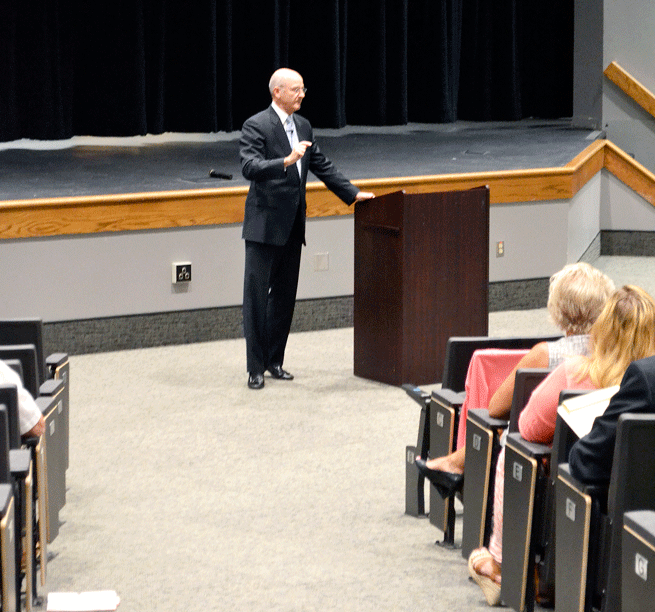
Local teachers, school administrators and members of the community attended a lecture by author Jamie Vollmer at Southern State Community College Monday morning.
Vollmer is an award-winning champion of public education, and the author of the highly acclaimed book, "Schools Cannot Do It Alone."
In addition to local educators and business leaders, the small crowd in attendance included Sen. Joe Uecker and Rep. Doug Green.
Prior to Vollmer’s lecture, Southern State Community College president Kevin Boys gave opening remarks and thanked the event’s four sponsors: Great Oaks Career Campuses, Southern State Community College, Southern Ohio Educational Service Center and the Brown County Educational Service Center.
Boys said the lecture held the same principles as another major event held annually at the college – Highland County Chamber of Commerce’s “Ag Is Everyone’s Business.”
“Ag is everyone’s business, and education even more so,” Boys said. “It’s about our future, about our children and it’s about all of our responsibility in that.”
Harry Snyder, president/CEO Great Oaks Career Center, introduced Vollmer by reading an excerpt of his biography.
Vollmer told the audience that he had no professional background in the education field. Rather, he said that he could trace his work as an education advocate to his job with the ice cream company, which received high praise and was named the “best ice cream in America” by several magazines in the 1980s.
“All of a sudden, we got all this press,” Vollmer said. “Because of it, our chief state school officer, superintendent of education in Iowa, read about us, called me up and asked me if I wanted to sit on a group of business men and women to talk about the future of Iowa schools.”
Vollmer said that he had no real interaction with public schools at the time, but he joined the group as the “token small business” representative along with individuals from some of the largest businesses in the state.
“I have no background in the classroom, I’ve never been an administrator, I’ve never served on a board,” Vollmer said. “I show up for that first Iowa business roundtable meeting all those years ago, and I have an attitude. I have an attitude that is informed by three fundamental assumptions.”
Vollmer said he “would bet good money” that many people in the Highland County community would agree with the three assumptions: 1) something is wrong with schools, and they need to change; 2) school administrators and educators are the problem; and 3) schools would be better run like a business, so they can “get the job done.”
Vollmer said that within 15 minutes, he and the other committee members “bonded” because they all shared the same assumptions. Vollmer continued to attend meetings and eventually accepted a position as the executive director of the roundtable, quitting his job at the ice cream company.
“The relationship between schools and communities has altered dramatically over the course of those 30 years, but certain fundamental things have remained the same,” Vollmer said. “The people who work inside of our schools and their allies in the community have power. They have the power to change the way the folks of southern Ohio think about public schools, about kids, about teachers and administrators. I can say that because I am the living embodiment of that power.”
Vollmer said that his platform as the executive director was initially based on those three assumptions, but told “The Blueberry Story,” chronicled in his book “Schools Cannot Do It Alone,” that changed his perception of the education system. He attended an in-service at a school in Iowa and gave a talk that was “very overbearing.”
One of the teachers in attendance used Vollmer’s ice cream company as an analogy, asking if the company used “nothing but Grade-A ingredients,” to which Vollmer responded that they used “triple-A” quality products. The woman asked Vollmer what they would do if they received a shipment of blueberries not up to their standards.
“I said, ‘ma’am, I would send them back,’” Vollmer said. “She said, ‘That’s right. You would send them back. We can never send back the blueberries our suppliers send to us. We take big, small, rich, poor, hungry, abused, brilliant, creative and curious, cautious and frightened, homeless, ADHD, juvenile rheumatoid arthritis, English as their second language … we take them all, Mr. Vollmer, and that’s why it is not a business. It’s a school.”
Vollmer said that while schools “can graft certain practices and procedures from the private sector onto the rarified culture of pre-K through 12,” the woman “showed in 90 seconds that schools have zero control over the quality of the raw material.
“They take what the parents send,” Vollmer said. “No control. I can’t think of another business that’s quite like that.”
That teacher, Vollmer said, quashed his view of his assumption about schools running as a business.
“There is no angle from which you can examine the reality of public education in which you can say ‘run it like a business,’” Vollmer said. “She realized, correctly, that I had conveniently substituted empty, bumper-sticker free market rhetoric for classroom reality. She knew it, and she wasn’t going to let me get it away with it.”
Vollmer said that it took time before his views on another assumption were changed. A superintendent in a small school district invited him to spend the day in their system, assigning him to bus duty, as a teacher’s aide to third graders and eighth graders and as a playground supervisor.
Exhausted and sore by the end of the day, Vollmer asked the superintendent if “what I saw going on around me was typical.”
“She answered, ‘for 90 percent of my staff, 90 percent of the time,’” Vollmer said. “This second idea that the people working inside our schools is the problem is 100-percent false. We do not have a people problem in our schools.”
Vollmer said that a large portion of legislation stems from the idea that “there is a people problem” in schools and the need to “hold them accountable,” including “administering a never-ending stream of standardized tests that do not accurately gauge what children have learned and what teachers have taught.”
“You don’t get it if you just have a tour,” Vollmer said. “Spend a day in a school, and what you will see is starting next week, for almost everybody, 40 hours a week is nothing. Fifty hours, 60 hours is quickly routine.
“Your educators and administrators are standing in front of the most diverse, demanding, distracted generation of students the world has ever seen. There’s no hyperbole in that. These kids are fundamentally different. They’re victims of a highly aggressive popular culture that has assaulted their physiology, fractured their attention span and given them and their parents a dangerously overdeveloped sense of entitlement.”
While two of the three assumptions have been debunked, Vollmer said that he stands by the third – that schools needs to change.
“I started with that first assumption, which is that schools were not giving us what we needed and that they needed to change,” Vollmer said. “It’s 28 years later, and I still have that one.”
This change is not due to any inadequacies by the teachers, Vollmer said, but a “need to rethink our schools because they were not designed to give us what we need.”
Among the changes Vollmer outlined are a need to rethink how children are grouped and how children are assessed.
Vollmer also said a major issue is the public’s “wavering in their traditional support of public education.” He asked audience members for their take on reasons for the community’s diminished support. One individual said it was a “misunderstanding” that teachers are “overpaid babysitters.”
Another individual said that people tend to assume that schools haven’t changed since they were students, even if it was 20 or 30 years ago, and another said that people believe the way they learned was “the right way.”
Vollmer said author Peter Senge wrote that people develop “mental models” – rigid ideas of the way things are supposed to be – and “there is not a more rigid ‘mental model’ in America than the model of what is ‘real school,’ and it’s always what they went to.” A related problem is what Vollmer calls “nosthesia” – half nostalgia, half amnesia.
“If you could take the sentence ‘if we could only have schools the way we used to have them,’ what they really mean is ‘if we could just have the Ohio that we used to have,’ and that ain’t happening,” Vollmer said. “Schools have never been better, but with that model in their head ‘that’s real school,’ that contributes to the misunderstanding.”
One educator said that educators fail as a whole “to get the message out to the community.”
Vollmer agreed that educators fail “when it comes to engaging the public in a conversation that would help them understand.”
“Everyone has power, and how I see that power crystallizing is in a thoughtful conversation with the community,” Vollmer said.
Vollmer encouraged educators to “increase the community’s understanding of what’s going on” and to use his “magic list” – a poster-sized list of all of the programs, classes, screenings and extracurriculars that have been added to school calendars since 1900.
“We have not added a single minute to the school calendar in six decades,” Vollmer said. “The contract between our communities and our schools has changed. It is no longer ‘help us teach our children. It’s ‘raise our kids.’”
According to Vollmer, “75 percent of the people who pay for public education haven’t had a kid in school for quite some time.” These individuals need to learn to care again about public schools, Vollmer said, and begins with educators reaching out.
“When you take a step toward the community, the community will take a step toward you,” Vollmer said.
Vollmer is an award-winning champion of public education, and the author of the highly acclaimed book, "Schools Cannot Do It Alone."
In addition to local educators and business leaders, the small crowd in attendance included Sen. Joe Uecker and Rep. Doug Green.
Prior to Vollmer’s lecture, Southern State Community College president Kevin Boys gave opening remarks and thanked the event’s four sponsors: Great Oaks Career Campuses, Southern State Community College, Southern Ohio Educational Service Center and the Brown County Educational Service Center.
Boys said the lecture held the same principles as another major event held annually at the college – Highland County Chamber of Commerce’s “Ag Is Everyone’s Business.”
“Ag is everyone’s business, and education even more so,” Boys said. “It’s about our future, about our children and it’s about all of our responsibility in that.”
Harry Snyder, president/CEO Great Oaks Career Center, introduced Vollmer by reading an excerpt of his biography.
Vollmer told the audience that he had no professional background in the education field. Rather, he said that he could trace his work as an education advocate to his job with the ice cream company, which received high praise and was named the “best ice cream in America” by several magazines in the 1980s.
“All of a sudden, we got all this press,” Vollmer said. “Because of it, our chief state school officer, superintendent of education in Iowa, read about us, called me up and asked me if I wanted to sit on a group of business men and women to talk about the future of Iowa schools.”
Vollmer said that he had no real interaction with public schools at the time, but he joined the group as the “token small business” representative along with individuals from some of the largest businesses in the state.
“I have no background in the classroom, I’ve never been an administrator, I’ve never served on a board,” Vollmer said. “I show up for that first Iowa business roundtable meeting all those years ago, and I have an attitude. I have an attitude that is informed by three fundamental assumptions.”
Vollmer said he “would bet good money” that many people in the Highland County community would agree with the three assumptions: 1) something is wrong with schools, and they need to change; 2) school administrators and educators are the problem; and 3) schools would be better run like a business, so they can “get the job done.”
Vollmer said that within 15 minutes, he and the other committee members “bonded” because they all shared the same assumptions. Vollmer continued to attend meetings and eventually accepted a position as the executive director of the roundtable, quitting his job at the ice cream company.
“The relationship between schools and communities has altered dramatically over the course of those 30 years, but certain fundamental things have remained the same,” Vollmer said. “The people who work inside of our schools and their allies in the community have power. They have the power to change the way the folks of southern Ohio think about public schools, about kids, about teachers and administrators. I can say that because I am the living embodiment of that power.”
Vollmer said that his platform as the executive director was initially based on those three assumptions, but told “The Blueberry Story,” chronicled in his book “Schools Cannot Do It Alone,” that changed his perception of the education system. He attended an in-service at a school in Iowa and gave a talk that was “very overbearing.”
One of the teachers in attendance used Vollmer’s ice cream company as an analogy, asking if the company used “nothing but Grade-A ingredients,” to which Vollmer responded that they used “triple-A” quality products. The woman asked Vollmer what they would do if they received a shipment of blueberries not up to their standards.
“I said, ‘ma’am, I would send them back,’” Vollmer said. “She said, ‘That’s right. You would send them back. We can never send back the blueberries our suppliers send to us. We take big, small, rich, poor, hungry, abused, brilliant, creative and curious, cautious and frightened, homeless, ADHD, juvenile rheumatoid arthritis, English as their second language … we take them all, Mr. Vollmer, and that’s why it is not a business. It’s a school.”
Vollmer said that while schools “can graft certain practices and procedures from the private sector onto the rarified culture of pre-K through 12,” the woman “showed in 90 seconds that schools have zero control over the quality of the raw material.
“They take what the parents send,” Vollmer said. “No control. I can’t think of another business that’s quite like that.”
That teacher, Vollmer said, quashed his view of his assumption about schools running as a business.
“There is no angle from which you can examine the reality of public education in which you can say ‘run it like a business,’” Vollmer said. “She realized, correctly, that I had conveniently substituted empty, bumper-sticker free market rhetoric for classroom reality. She knew it, and she wasn’t going to let me get it away with it.”
Vollmer said that it took time before his views on another assumption were changed. A superintendent in a small school district invited him to spend the day in their system, assigning him to bus duty, as a teacher’s aide to third graders and eighth graders and as a playground supervisor.
Exhausted and sore by the end of the day, Vollmer asked the superintendent if “what I saw going on around me was typical.”
“She answered, ‘for 90 percent of my staff, 90 percent of the time,’” Vollmer said. “This second idea that the people working inside our schools is the problem is 100-percent false. We do not have a people problem in our schools.”
Vollmer said that a large portion of legislation stems from the idea that “there is a people problem” in schools and the need to “hold them accountable,” including “administering a never-ending stream of standardized tests that do not accurately gauge what children have learned and what teachers have taught.”
“You don’t get it if you just have a tour,” Vollmer said. “Spend a day in a school, and what you will see is starting next week, for almost everybody, 40 hours a week is nothing. Fifty hours, 60 hours is quickly routine.
“Your educators and administrators are standing in front of the most diverse, demanding, distracted generation of students the world has ever seen. There’s no hyperbole in that. These kids are fundamentally different. They’re victims of a highly aggressive popular culture that has assaulted their physiology, fractured their attention span and given them and their parents a dangerously overdeveloped sense of entitlement.”
While two of the three assumptions have been debunked, Vollmer said that he stands by the third – that schools needs to change.
“I started with that first assumption, which is that schools were not giving us what we needed and that they needed to change,” Vollmer said. “It’s 28 years later, and I still have that one.”
This change is not due to any inadequacies by the teachers, Vollmer said, but a “need to rethink our schools because they were not designed to give us what we need.”
Among the changes Vollmer outlined are a need to rethink how children are grouped and how children are assessed.
Vollmer also said a major issue is the public’s “wavering in their traditional support of public education.” He asked audience members for their take on reasons for the community’s diminished support. One individual said it was a “misunderstanding” that teachers are “overpaid babysitters.”
Another individual said that people tend to assume that schools haven’t changed since they were students, even if it was 20 or 30 years ago, and another said that people believe the way they learned was “the right way.”
Vollmer said author Peter Senge wrote that people develop “mental models” – rigid ideas of the way things are supposed to be – and “there is not a more rigid ‘mental model’ in America than the model of what is ‘real school,’ and it’s always what they went to.” A related problem is what Vollmer calls “nosthesia” – half nostalgia, half amnesia.
“If you could take the sentence ‘if we could only have schools the way we used to have them,’ what they really mean is ‘if we could just have the Ohio that we used to have,’ and that ain’t happening,” Vollmer said. “Schools have never been better, but with that model in their head ‘that’s real school,’ that contributes to the misunderstanding.”
One educator said that educators fail as a whole “to get the message out to the community.”
Vollmer agreed that educators fail “when it comes to engaging the public in a conversation that would help them understand.”
“Everyone has power, and how I see that power crystallizing is in a thoughtful conversation with the community,” Vollmer said.
Vollmer encouraged educators to “increase the community’s understanding of what’s going on” and to use his “magic list” – a poster-sized list of all of the programs, classes, screenings and extracurriculars that have been added to school calendars since 1900.
“We have not added a single minute to the school calendar in six decades,” Vollmer said. “The contract between our communities and our schools has changed. It is no longer ‘help us teach our children. It’s ‘raise our kids.’”
According to Vollmer, “75 percent of the people who pay for public education haven’t had a kid in school for quite some time.” These individuals need to learn to care again about public schools, Vollmer said, and begins with educators reaching out.
“When you take a step toward the community, the community will take a step toward you,” Vollmer said.