


Archaeologist surveys Fort Salem earthwork
Lead Summary
By
Rory Ryan-hcpress@cinci.rr.com
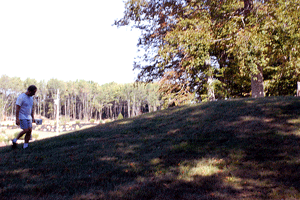
Dr. Jarrod Burks, director of Geophysical Surveys at Ohio Valley Archaeology, and Harry Campbell, a Conservation, Preservation, Special Collections archivist for the Ohio State University, have been surveying sections of the Fort Salem mounds near Pricetown this week.
Burks, a geophysical surveyor specializing in archaeology sites in Ohio and other areas of the country, uses a magnetometer seeking changes in the property's magnetic field. On Wednesday, Burks explained the process while working the Certier Road site. "Basically, we're looking for any changes in the magnetic field, possible burn sites – either used for cooking or for funeral/burial purposes."
After their second day surveying the Fort Salem earthwork, Burks said they discovered "plenty of iron and steel," likely from agricultural uses many years ago.
Burks works with Ohio Valley Archaeology, Inc. The firm provides all levels of archaeological services, including Section 106 and NEPA compliance. Burks has performed similar surveys at Fort Ancient and Serpent Mound in southern Ohio.
Burks says on his website that "Surveying earthwork sites is probably my No. 1 passion. Some people collect old cars or baseball cards, I collect magnetic data sets of earthwork sites – and Ohio is rich in ancient earthworks. My goal is to survey as many of Ohio's earthwork sites as I can in my free time. These sites are rapidly disappearing beneath urban sprawl, roads, and the farmer's plow. However, geophysical surveys can relocate these vanishing earthen monuments as long as they are not totally destroyed. To this end, I have started the Ohio Earthworks Project and partnered with a variety of organizations (e.g., the South Central Ohio Preservation Society; The Ohio State University) to help image Ohio's many earthwork sites."
Paul Gardner, Midwest Regional Director of The Archaeological Conservancy Columbus, also was on hand for the survey, as was Pricetown resident Bill Bear, who is credited with clearing and restoring the natural beauty of the Fort Salem earthwork.
In 2005, the Archaeological Conservancy purchased the 19-acre tract of land.
Gardner wrote about Fort Salem in "American Archaeology."
"The Fort Salem earthwork, also known as the Workman Works, was created by a group of Ohio Valley Indians (with both Adena and Hopewell cultural influence) sometime between 50 B.C. to AD 500. It is a circular enclosure about 450 feet in diameter that surrounds a conjoined mound. The larger mound of the conjoined pair was about 6 feet high and 60 feet in diameter, while the smaller one was about 4 feet high and 40 feet in diameter. The wall that surrounded the enclosure was about 3 feet high and was paralleled for much of its 700 foot plus length by an exterior ditch.
"Today, both mounds are about 2 feet lower and the wall is only about 1 to 2 feet high. Due to a long period of the property being used as a simple pasture, and the presence of beech trees up to 10 feet in circumference, the site has been described as one of the best preserved earthworks remaining in private ownership in America. The Ohio Historical Society nominated the site to the Historical Register of Historic Places in 1971."
Dr. Jarrod Burks, director of Geophysical Surveys at Ohio Valley Archaeology, and Harry Campbell, a Conservation, Preservation, Special Collections archivist for the Ohio State University, have been surveying sections of the Fort Salem mounds near Pricetown this week.
Burks, a geophysical surveyor specializing in archaeology sites in Ohio and other areas of the country, uses a magnetometer seeking changes in the property's magnetic field. On Wednesday, Burks explained the process while working the Certier Road site. "Basically, we're looking for any changes in the magnetic field, possible burn sites – either used for cooking or for funeral/burial purposes."
After their second day surveying the Fort Salem earthwork, Burks said they discovered "plenty of iron and steel," likely from agricultural uses many years ago.
Burks works with Ohio Valley Archaeology, Inc. The firm provides all levels of archaeological services, including Section 106 and NEPA compliance. Burks has performed similar surveys at Fort Ancient and Serpent Mound in southern Ohio.
Burks says on his website that "Surveying earthwork sites is probably my No. 1 passion. Some people collect old cars or baseball cards, I collect magnetic data sets of earthwork sites – and Ohio is rich in ancient earthworks. My goal is to survey as many of Ohio's earthwork sites as I can in my free time. These sites are rapidly disappearing beneath urban sprawl, roads, and the farmer's plow. However, geophysical surveys can relocate these vanishing earthen monuments as long as they are not totally destroyed. To this end, I have started the Ohio Earthworks Project and partnered with a variety of organizations (e.g., the South Central Ohio Preservation Society; The Ohio State University) to help image Ohio's many earthwork sites."
Paul Gardner, Midwest Regional Director of The Archaeological Conservancy Columbus, also was on hand for the survey, as was Pricetown resident Bill Bear, who is credited with clearing and restoring the natural beauty of the Fort Salem earthwork.
In 2005, the Archaeological Conservancy purchased the 19-acre tract of land.
Gardner wrote about Fort Salem in "American Archaeology."
"The Fort Salem earthwork, also known as the Workman Works, was created by a group of Ohio Valley Indians (with both Adena and Hopewell cultural influence) sometime between 50 B.C. to AD 500. It is a circular enclosure about 450 feet in diameter that surrounds a conjoined mound. The larger mound of the conjoined pair was about 6 feet high and 60 feet in diameter, while the smaller one was about 4 feet high and 40 feet in diameter. The wall that surrounded the enclosure was about 3 feet high and was paralleled for much of its 700 foot plus length by an exterior ditch.
"Today, both mounds are about 2 feet lower and the wall is only about 1 to 2 feet high. Due to a long period of the property being used as a simple pasture, and the presence of beech trees up to 10 feet in circumference, the site has been described as one of the best preserved earthworks remaining in private ownership in America. The Ohio Historical Society nominated the site to the Historical Register of Historic Places in 1971."
[[In-content Ad]]