


71st anniversary of D-Day observed
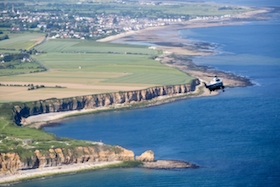
On June 6, 1944, more than 160,000 Allied troops landed along a 50-mile stretch of heavily-fortified French coastline, to fight Nazi Germany on the beaches of Normandy, France.
Gen. Dwight D. Eisenhower called the operation a crusade in which, “we will accept nothing less than full victory.”
More than 5,000 Ships and 13,000 aircraft supported the D-Day invasion, and by day’s end, the Allies gained a foot-hold in Continental Europe. The cost in lives on D-Day was high. More than 9,000 Allied Soldiers were killed or wounded, but their sacrifice allowed more than 100,000 Soldiers to begin the slow, hard slog across Europe, to defeat Adolf Hitler’s crack troops.
[[In-content Ad]]
The Normandy beaches were chosen by planners because they lay within range of air cover, and were less heavily defended than the obvious objective of the Pas de Calais, the shortest distance between Great Britain and the Continent. Airborne drops at both ends of the beachheads were to protect the flanks, as well as open up roadways to the interior.
Six divisions were to land on the first day; three U.S., two British and one Canadian. Two more British and one U.S. division were to follow up after the assault division had cleared the way through the beach defenses. Disorganization, confusion, incomplete or faulty implementation of plans characterized the initial phases of the landings. This was especially true of the airborne landings which were badly scattered, as well as the first wave units landing on the assault beaches.
To their great credit, most of the troops were able to adapt to the disorganization. In the end, the Allies achieved their objective.
The airborne assault into Normandy, as part of the D-Day allied invasion of Europe, was the largest use of airborne troops up to that time. Paratroopers of the U.S. 82nd and 101st Airborne Divisions, the British 6th Airborne Division, the 1st Canadian Parachute Battalion, and other attached Allied units took part in the assault.
Numbering more than 13,000 men, the paratroopers were flown from bases in southern England to the Cotentin Peninsula in approximately 925 C-47 airplanes.
An additional 4,000 men, consisting of glider infantry with supporting weapons, medical, and signal units were to arrive in 500 gliders later on D-Day to reinforce the paratroopers. The parachute troops were assigned what was probably the most difficult task of the initial operation - a night jump behind enemy lines five hours before the coastal landings.
To protect the invasion zone's western extremity and to facilitate the "Utah" landing force's movement into the Cotentin Peninsula, the U.S. 82nd and 101st Airborne Divisions descended on the peninsula by parachute and glider in the early hours of D-Day. The paratroopers were badly scattered.
Many were injured and killed during the attack, and much of their equipment was lost, but the brave paratroopers fought fiercely, causing confusion among the German commanders and keeping the German’s troops occupied.
Their efforts – hampered by harsh weather, darkness and disorganization, and initiative of resourceful Soldiers and leaders – ensured that the Utah Beach assault objectives were eventually accomplished. The British and Canadian attacks also accomplished their primary goal of securing the left flank of the invasion force.