


2026 Election Roundup: Roades reelected Highland County commissioner; several local issues unofficially pass
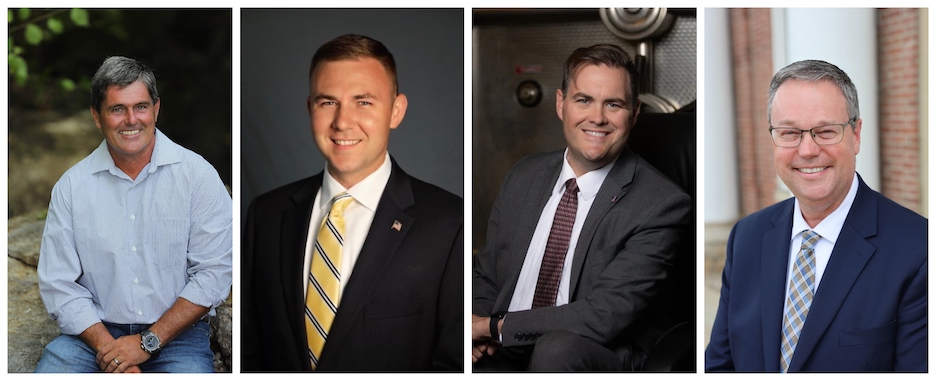
Pictured, from the left, are candidates elected to county office in November: Highland County Commissioner Brad Roades, Highland County Auditor Alex Butler, Highland County Common Pleas Court Judge-Elect John Judkins and Highland County Juvenile/Probate Court Judge-Elect Denny Kirk. (Photos courtesy of the candidates)
Highland County had over 14,000 voters head to the polls for the midterms, as an unofficial 53.33% of registered voters cast ballots in the November 2026 general election.
According to the Highland County Board of Elections, 14,459 ballots were cast, as the county has 27,110 registered voters. There were 151 provisional and 156 absentee ballots outstanding as of 1:05 a.m. Wednesday.
There was no “blue wave” in Highland County to match the rest of the state and country, as local results heavily favored Republican candidates. As of this article’s posting Wednesday at 2 a.m., the Associated Press has called the race for Ohio Governor in favor of Dr. Amy Acton, a Democrat (who received 25.7% of the vote in Highland County, with Republican candidate Vivek Ramaswamy receiving 69.24%, unofficially).
Democrat Sherrod Brown (who received 24.64% of the vote in Highland County, unofficially) was also elected to fulfill the unexpired U.S. Senate term currently held by Republican Jon Husted (68.54% of the vote in Highland County, unofficially).
Despite overwhelming support in Highland County by an unofficial 73.26% of voters, Republican Congressman Mike Carey was also ousted by Democratic candidate Don Leonard (23.48% in Highland County, unofficially), as called by the Associated Press late Tuesday night.
According to cleveland.com (https://www.cleveland.com/open/2026/11/republican-robert-sprague-conced…), Democratic candidate and current 7th District State Representative Allison Russo (24.41%% of the vote in Highland County, unofficially) defeated Republican candidate and current State Treasurer Robert Sprague (72.34% of the vote in Highland County, unofficially) in the Ohio Secretary of State race.
As of this article’s posting, other state races — Attorney General, Auditor, Treasurer and Supreme Court — had not been called, with most of those races being separated by 1% or less with 94% of precincts reporting. Fourth District Court of Appeals Judge results for Highland County and Adams County were also not available as of Wednesday at 2 a.m. Check back to highlandcountypress.com for updates on these races.
For Highland County voters, the only contested county race saw Highland County commissioner Brad Roades reelected, defeating Independent candidate Howard Zody.
Roades, a local entrepreneur and business owner, is entering his second term as commissioner. He is a graduate of Hillsboro High School and holds a bachelor’s of science in horticulture from The Ohio State University College of Agriculture.
In other countywide races, Highland County Auditor Alex Butler was also reelected for a second term.
Butler, a Republican, was elected Hillsboro city auditor in November 2019, then elected as county auditor in 2022. He is a 2009 graduate of Hillsboro High School and has an associate’s degree in Biblical studies from Cincinnati Christian University and bachelor’s in business administration from Xavier University. He is also currently a captain in the U.S. Army Reserve.
Also officially elected were two new Highland County Common Pleas Court judges — John Judkins for the General Division and Denny Kirk for the Juvenile/Probate Division — as they won their respective primary races in May. Both candidates are Republicans.
Judkins was sworn in as County Court judge in Greenfield in January 2025 and has a law office in Greenfield, where he has worked since 2009. According to his campaign site, he “has extensive experience in felony and misdemeanor criminal work throughout his 15-year law career,” including as an assistant prosecutor in Chillicothe Municipal Court, where he has also been acting judge, and an assistant law director from 2021-2025.
Judkins will replace current Judge Rocky Coss, who has served as Common Pleas Court judge since 2008 and whose term expires Feb. 8, 2027.
Kirk has been in private practice in Hillsboro for over a decade, with experience in juvenile/probate court as well as representing clients in misdemeanor and felony cases. Prior to attending law school, Kirk was a Highland County Children Services caseworker, a licensed social worker and a detective sergeant with the Highland County Sheriff’s Office, where he specialized in child abuse cases.
Kirk will replace current Judge Kevin Greer, who has served as Juvenile and Probate Court judge since 1997 and whose term expires Feb. 8, 2027.
Local candidates reelected to statewide office were 17th District State Senator Shane Wilkin (R-Hillsboro), who defeated Brian Deer, and 91st District State Representative Bob Peterson (R-Sabina), who defeated Amy Wright.
Wilkin will be entering his second term as Ohio Senator, after previously serving as State Representative since 2018 and three terms as Highland County commissioner. Ohio’s 17th District includes Fayette, Gallia, Highland, Hocking, Jackson, Lawrence, Pike, Ross and Vinton counties and part of Perry County.
Peterson was elected for a third term as State Representative, after previously serving as State Senator. He also formerly served as 85th District State Representative and as a Fayette County commissioner. The 91st District includes Fayette, Pike and Ross counties as well as Highland.
There were six local issues/options on the ballot for certain precincts throughout the county, including two school tax levies, an EMS levy, two cemetery levy renewals and a local liquor option.
The school tax levies unofficially split, with East Clinton’s failing and Miami Trace’s passing, although the MT levy may be too close to call.
Issue 1, for East Clinton Local Schools, proposed a five-year, 1.25-percent income tax levy for current expenses, effective Jan. 1, 2027. Unofficial Clinton County results show the levy failed, with 1,358 votes against the tax and 973 votes for it. In Highland County, there were 295 votes against the tax and 141 votes in favor of it, unofficially.
Issue 2, for Miami Trace Local Schools, is a renewal of an existing 2.2-mill, five-year levy, commencing in 2027 and first due in calendar year 2028. The levy unofficially, and narrowly, passed in Fayette County, with 2,532 votes for the levy and 2,471 votes against it; passed in Madison County, 15-7; failed in Highland County with two votes against it; and had no votes in Clinton County, unofficially.
Unofficially approved by Brushcreek Township voters was Issue 3, a proposed additional two-mill, five-year tax levy for emergency medical services. It is estimated to collect $98,076 annually, or $70 for each $100,000 of the auditor appraised value, commencing in 2026, first due in calendar year 2027.
Issues 4 and 5, proposed tax levy renewals for maintaining and operating township cemeteries, both unofficially passed by a slim margin that may also be subject to change. Issue 4, for Marshall Township, is a half-mill, five-year levy renewal, estimated to collect $13,139 annually or $11 for each $100,000 of the auditor appraised value. It unofficially passed by a margin of 219-168.
Issue 5, a renewal for New Market Township, is a half-mill, five-year levy estimated to collect $19,757 or $10 for each $100,000 of the auditor appraised value. It unofficially passed by a margin of 395-330.
The local liquor option on the ballot, Issue 6, unofficially passed with 347 “yes” votes and 209 “no” votes. The option was placed on the ballot for the Sunday sale of wine and mixed beverages and spiritous liquor for the Fraternal Order of Eagles Aerie 1161 in uptown Hillsboro.
The lone state issue on the ballot, Issue 3, a proposed constitutional amendment “to require voters to present photo identification in order to vote” unofficially passed, both locally and statewide. Highland County voters were strongly in favor of it, with 81.58% of voters supporting the measure, unofficially (11,191-2,527 unofficial margin).
According to the ballot language, Issue 3 will:
“Require voters to present an approved form of government-issued photo identification in order to vote;
“Allow state law to provide for an alternative method of verifying a voter’s identity for a voter who has a sincere religious objection to being photographed and, therefore, does not possess an approved form of government-issued photo identification;
“Require that voters who do not vote in person provide an approved form of government-issued photo identification, unless the law authorizes those persons to vote by providing a signature and at least one other specified unique identifier; [and]
“Define approved forms of government-issued photo identification as an unexpired Ohio driver license or state identification card; a United States passport or passport card; or a United States military identification card, Ohio National Guard identification card, or United States Department of Veterans Affairs identification card.”
Check back to highlandcountypress.com for more updates.