Judge, JFS director talk 'drastic increase' in Children Services cases amid levy considerations

Highland County Juvenile Court Judge Kevin Greer, left, and Highland County Job & Family Services Director Jeremy Ratcliff met with commissioners July 26. (HCP Photos/Caitlin Forsha)
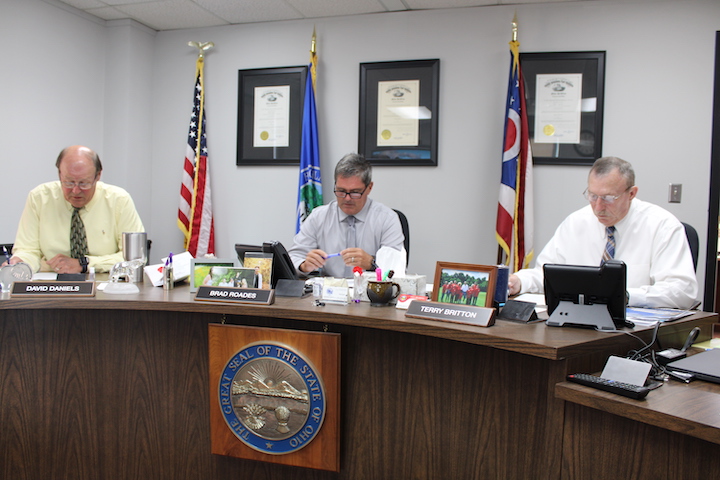
As Highland County faces a decision on how to proceed with levy funding for Children Services, commissioners Terry Britton, David Daniels and Brad Roades met with Highland County Juvenile Court Judge Kevin Greer and Highland County Job & Family Services Director Jeremy Ratcliff Wednesday, July 26 to discuss information and statistics about the agency.
Judge Greer met with commissioners at their request, but with a caveat that he was neither endorsing nor opposing anything to do with the levy, just sharing information.
“Judges in Ohio cannot — ethically, we're not allowed to publicly endorse or oppose any issue,” Greer said. “I'll be happy to give you stats of what I’m seeing.”
As he mentioned during a meeting with commissioners in May, Highland County Job and Family Services Director Jeremy Ratcliff said Wednesday he is working to make a final decision on whether to seek a renewal or replacement levy during the November 2023 election.
The current tax levy, which was first approved in November 2013 and renewed by voters in November 2018, is a five-year, .9-mill levy for Children Services placement costs and expires Dec. 31. Ratcliff said in May that the levy generates approximately $700,000 per year for the agency.
The local JFS director said he would have a final recommendation for commissioners to vote on at their Aug. 2 meeting.
Ratcliff said he met with Highland County Auditor Alex Butler to compare potential revenues for a 0.9-mill renewal versus a one-mill replacement levy. Roades asked if Ratcliff had a “ballpark figure” of the tax revenues for a renewal versus replacement.
“The way it stands now [at 0.9 mill], per $100,000 of valuation, the average taxpayer is around $23 a year,” Ratcliff said. “A one-mill replacement would be at $35 per year per $100,000 of valuation, so about a $12 increase per year.
“On average, about $12 per year per $100,000 is what we would be asking of voters if we decided to approve the replacement.”
Daniels asked how much of the levy dollars go toward child placement versus “administrative” costs.
“One-hundred percent of those levy dollars currently go to child placement costs,” Ratcliff said.
Along with discussing the levy, both Ratcliff and Judge Greer shared data regarding the number of children in care and the associated costs.
Ratcliff compared the numbers from 2013, when the levy was first approved, to current-day totals.
“When the original levy was passed, during that calendar year, we had 253 kids in care at any point,” he said. “Not all at one time, but during the year 2013. By 2018, that had jumped to 297 at any point during the year.
“The most recent full year was last year, ’22, and we had 425 kids in care at any point during the year. I just ran the first six months of this year, and we’re at 338 already, in January through June of this year.”
Britton asked Ratcliff to define “kids in care.”
“Kids in our custody,” Ratcliff said. “They could be in foster care, they could be in residential group homes, or they could be potentially in kinship. Those are kids from custody of the agency, or the county, and those are court-involved cases. We cannot get custody unless the judge approves that.
“If we have available family members, or we have available friends or whatever, that are appropriate to take these kids during that time that the [parents] are working through their issues, we utilize that as well, but sometimes — often — we do have to go to become court-involved.”
Greer said he has seen a “drastic” jump in Children Services cases going through Juvenile Court, particularly in the past seven years.
“The caseload on Children Services cases has drastically increased,” the judge said. “We’ve been averaging close to 200 cases a year, and back when I started, a long time ago, it was in the 20s and 30s.
“I can say, without hesitation, the drug issues and illegal use of drugs is the primary driver of that. Whenever you read in the paper, there’s been another drug roundup and the grand jury’s indicted 20, as an example — most of them are drug-related, and almost every one of those families has children, and we end up seeing them.”
Greer said the Court has handled approximately 105 cases “already this year” and added he doesn’t “see the caseload dropping much” anytime soon.
“I’ve been in child welfare either as a prosecutor or on the bench full time since 1980, and it just takes a lot of resources to protect these kids,” Greer said. “I appreciate all the commissioners, including you three, supporting the cause to protect these kids. Just like families, some businesses have to sometimes look at cutting their budget, but we're talking about protecting kids, and I think it's been top priority for you all. I’ve never been told, with what we're doing in court, ‘we can't do that, the money is just not there.’”
Greer added that the public is often not aware of “what's going on in this county with kids and how they're abused and neglected and some of the home conditions they have to live in.
“It’s important to let the public know just what a horrible problem it is, but that there is something being done, hopefully, to do the best we can to protect them,” Greer said. “Obviously, that is the primary job of Director Ratliff and his office.”
In addition to those stats, Ratcliff discussed the difference in costs for taking care of these children compared to 2013, as the agency has seen an increase of over $3 million annually. He said that the annual placement costs went from $1.14 million in 2013 to $2.14 million in 2018 to $4.4 million in 2022.
“We're on pace to have $3.9 million again this year, a little dip from ’22,” Ratcliff said. “We jumped up dramatically in ’22 as a result of ’21 and the impact that COVID had. Our caseload wasn't as high as it had been, and in ’22, everybody kind of came out of their homes and went back to school, and more folks had eyes on these kids, and our reports shot through the roof.”
Daniels asked Ratcliff to also discuss “costs involved” with individual placements.
“Those costs can range anywhere from $27 a day, up to $600, $700 a day, depending on the needs of the child,” Ratcliff said. “Thankfully, this didn't occur, but we were hours away from signing a contract for $1,775 a day for the care of a child.
“That is the risk that we take. We're only a phone call away from having a severely high-needs child that the only placement option may be $1,500 to $1,700 a day.”
Ratcliff said there is a “real demand” for providers for special-needs children across the state, not just locally, which leads to the potential for those high costs. Even without that extreme case, he said, “we have multiple children right now that are $400 to $500 a day.”
Britton asked Judge Greer about the “time frame” involved with children in the county’s care.
“By statute, now, something has to be done within two years,” Greer said. “I’m not apologizing for the position I take, but I can tell you, it takes a little more to convince me that it's safe to return these children when you've been using methamphetamine and fentanyl than maybe a judge in a larger county, for a lot of different reasons.
“It takes a while. Kids are in care as long as I think they need to be before they can be safely returned. I don't have an exact number for you, but it’s probably 50 or so, we've been averaging a year, where I permanently remove them from their parents, but that takes two years under the statute in most cases to get to that point.”
Daniels also asked Ratcliff to speak to situations that become “more than just temporary.”
“If if the child isn't able — or children, if it's a sibling group — if they're not able to be reunified within the two-year period that Judge talked about, then at some point, a decision has to be made in that two-year period,” Ratcliff said. “It can result in permanent custody to the county. If a child's 8 years old, and they're in the permanent custody of Highland County, that child will be in our care until they're 18 or adopted.
“The minute they move into permanent custody, we transfer that case to our adoption unit, and that becomes their primary responsibility, to find a forever home for that child, and matching them appropriately with adoptive parents.”
Commissioners thanked Ratcliff for the update, as Roades said he was impressed by the amount of work the agency does.
“Everyone should take the opportunity to understand what you guys do and what you have to shuffle, how you make your funding,” Roades said. “It's incredible.”
Ratcliff credited the agency’s staff for their efforts, as well as Highland County voters for their financial support.
“We're fortunate to have a very dedicated staff of caseworkers in this county that are in it for the right reasons,” Ratcliff said. “They care about kids, they want to keep them safe. They're willing to make personal sacrifices in their life, and we appreciate them.
“And we appreciate the voters for their continued support over the last 10 years, and continuing to see the need to protect these kids. We’re greatly appreciative of the voters and their trust in us to spend their dollars appropriately.”
Britton also thanked Greer for the information from the court’s perspective. “We do have to subsidize Jeremy’s budget throughout this process,” Britton said.
The judge responded that “nothing is more important” for the county than protecting its children.
"What you deal with day in and day out is very important, but nothing can be more important than the safety and welfare of these children,” Greer said. “It just can’t be. There may be some things as important, but nothing more important than that.”