


Hillsboro: Fire district is best solution
The amount city residents pay annually for EMS and fire protection services versus what townships pay per resident was a main point of contention during a public meeting held by the city of Hillsboro Wednesday. While the city initially alleged Hillsboro residents pay "$130 to $150," while townships currently pay $22 per resident, firefighters and township trustees said that figure was "false."
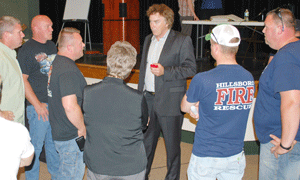
More than 100 Hillsboro residents, firefighters and township residents and representatives turned out to Southern State Community College Wednesday for a public briefing by Hillsboro Mayor Drew Hastings regarding the ongoing negotiations with area townships for EMS and fire protection.
While there were no major resolutions during the meeting, all parties agreed they will continue to work on the negotiations in an attempt to find a long-term solution.
Township Trustees from Liberty, Jackson, New Market and Washington townships submitted a proposal to the city administration, at $30 per township resident, and they have requested a response by May 23. [See Sidebar]
The mayor opened the meeting by thanking the SSCC Theatre class that had been displaced due to the city scheduling the meeting in the Edward K. Daniels Auditorium. The cast of "A Night of Durang" rescheduled its rehearsal, and Hastings encouraged the public to attend the May 30 performance of the show.
Hastings said that he believes the best long-term resolution will be for the city and four remaining townships - Liberty, Jackson, New Market and Washington - to form a fire district. Although Hastings said he has repeatedly stated the townships either join the city's proposed district or they will not receive services from Hillsboro after 2012, he remains open to the idea of contracting if they can reach an agreement that is "equitable" for all parties.
Hillsboro auditor Gary Lewis, safety and service director Rick Giroux and deputy law director Laura Curliss also weighed in during the meeting. They were joined by Hillsboro City Council president Lee Koogler, and several members of council were in the audience, as well.
Trustees from Liberty, Washington and New Market spoke out, along with township residents, saying they wanted accountability for the funds that are being paid for fire protection services. Current and former personnel from Hillsboro Fire and Rescue wanted to know why their department was the only one that has seen layoffs, while they are to bring in hundreds of thousands in revenue for the city's general fund.
Giroux said that in 2012, funds have been taken from other departments in order to continue funding Hillsboro Fire and Rescue.
Hastings said that when he took office in January, "My stance was that we solve this. No more kicking the can down the road. This has been a problem for over 25 years."
Hastings said that in doing research for the meeting, he had looked at the minutes from Hillsboro City Council meetings for the past several decades and that in 1985, the city was dealing with the same problems with EMS and fire that it is today. That is a point Hastings' predecessor, former mayor Dick Zink, had made to council numerous times through the negotiation process.
"I want to get this problem solved," Hastings said. "We have a lot of problems in Hillsboro, Highland County and America. I think we want to get this one behind us and move on to other pressing issues."
Hastings said that he believes the townships were "suspicious" of the city when it proposed the district.
Hastings said that in the current relationship the city has in the townships, "I felt like I was married to a woman and her previous husband had lied to her and cheated on her over and over and over again, and now I've married her, and I'm paying the price. I never did anything, I'm just trying to make this work, but I'm paying for something that happened five, 10, 20 years ago. When we're dealing with that kind of a situation, it made negotiations hard. And there has been bad blood. But I don't want to dwell on the past, we're trying to move forward."
[[In-content Ad]]
The townships may have a false perception, Hastings said, regarding how the district would be structured. Hastings said the townships probably think of the structure as a wagon wheel, with the city as the hub and the townships as spokes. However, Hastings said he envisioned the district more like "a bowl with seven equal marbles," that represents the townships and the city.
"I've been at this four months. I'm trying to get transparency, accountability and get some of these knots untied," Hastings said. "My team was - and still is - convinced a fire district is the best solution."
At times throughout the meeting, voices were raised, and people began to talk over one another. As city representatives began to answer one question, other questions were asked, while residents tried to demand that their original questions be answered.
During several points, the city officials asked that they be allowed to finish their answer. Lewis, at one point, said, "You've had your time to speak, now let me have mine."
One question that was repeatedly asked was how much the city residents pay for the services, and why the city does not have a levy for fire/EMS.
Lewis said city of Hillsboro has a 1.5-percent earnings tax that is paid by people who work in the city of Hillsboro, regardless of residency. Lewis said that the levy is pretty equally divided into thirds, with approximately 33 percent going toward fire/EMS, 33 percent going toward police protection and 33 percent going into the general fund.
The state of Ohio allows municipalities to operate "under the concept of pooled assets. We'll continue to do that. That money is separated by funds and sub funds so you can see where the money goes, you can see where it's allocated at. I'd be happy to share it with anybody. Just stop in and ask to see the fire budget. I'll show you everything you want to know. Unfortunately, I don't have very many people ask, though."
Giroux said approximately 85 percent of Hillsboro Fire and Rescue calls are EMS, with 15 percent fire calls.
The original HFR budget for 2012 was $1,434,000, with the city contributing $833,000 and six townships contributing $583,000. When Hamer and Paint townships joined other districts earlier this year, the budget was cut to $1,250,000, with the townships contributing $271,500 and the city contributing $985,000.
Hastings said Paint and Hamer township residents now pay between $63 and $104 per person for the services, which he said goes "to the argument and to the reality, and a little bit the sticker shock, of how much townships have been under-paying for the last 30 years. There's a big disparity between $22 and and what that real number is. I am not necessarily proposing townships pay the actual number because it would be huge. We will still have to subsidize to a degree. I just don't want it to be a back-breaking degree, which it has been."
It has been difficult to devise a budget for the proposed district, Giroux said, because "We don't know which townships are still interested in contracting or joining the fire district. Until we actually have a solid indication and know positively there are other members that want to join the budget, so to speak, then we can determine what we need operationally and devise a budget, and then we can reverse-engineer that to get an actual cost per person."
Hillsboro resident Bob Lambert said the HFR staff "have saved my life twice, so they're worth whatever they're getting. The way I look at it ... they're my fire department. I live in the city, and I'm paying $130 to $150 for the coverage. But you're telling me that if I move to the county, it's only going to cost me $22 for the same service?"
"That's exactly right," Hastings said.
Lambert said, "Why would they turn that down?"
Hastings said, "You'd have to ask the respective township trustees that."
Some trustees noted that the $22 figure was only for 2012, and that contracts have not been offered past the current year. Figures for joining the fire district would be substantially higher, it is believed, although there are no solid numbers yet.
Giroux also said that two-thirds of the calls are to the townships, with one-third of the calls to the city. Several trustees and residents voiced objections to that number.
David Snider, Jr., of Hillsboro Fire and Rescue, said that the assertion city residents pay $130 to $150 is "false."
"Before we lost Paint and before we lost Hamer, the runs were almost 50/50 (between calls to the city and calls to the townships), in the city and out of the city," Snider said. How did you figure the price per person in the city? I think you took the $823,000 (city's contribution to the fire budget), that comes in from the tax, and divided it by the number of residents that live in the city. Correct?
Giroux said that is what he did.
"That is a false number," Snider said.
"We also took into considerations EMS collections, as well," Giroux said.
Snider and New Market Township Trustee Kenny Harless said that Lewis had told them that 55 percent of people who pay Hillsboro's earnings tax are townships residents. Lewis said that number had been a "guesstimate," and he had specifically stated he was unsure what that number was.
Curliss said that she had spoken with Hillsboro's tax commissioner and that it would be "almost impossible" to figure out what percent of taxpayers lived where.
Several people said, "that's convenient," and Curliss said she wanted to clarify.
"(Hillsboro's tax commissioner) lives on the same road Drew does, but she lives in Hamer Township," Curliss said. "He lives ... his farm is in New Market. In terms of finding out which township somebody lives in, on the income tax form, it doesn't have a box for which township you live in. And keep in mind there are a lot of people from other counties, other cities, that also work here. I did try to get that information."
Curliss said there were 807 city residents who filed city income taxes and 3,445 who live outside the city who filed city income taxes. However, people from other cities and not just the Highland County Townships, contributed to that figure. Curliss noted that those who work in the city "spend about a third of their life in Hillsboro," and they would receive protection services should they need a squad or be involved in an accident.
Snider said, "What I'm getting ready to argue is that the $130 to $150 per person per city resident is completely way off. You can't just take what comes into the city income tax and divide it by that many residents who are in the city. Because there are so many more people that contribute to that."
Giroux said that it was the same type of formula that people paid to Highland County with their income taxes.
Hastings said that he would like to make sure their numbers are "confirmed and re-confirmed," and that because he only recently assumed the office, he tends to think like a resident, rather than a politician.
"As somebody who was a resident just like you four months ago, who was really ticked off and ran for this office, so I tend to think more like you than anything else," Hastings said. "When I hear all this talk and suspicion, my mind goes right to, 'Well, maybe this is exactly why a district makes sense.' Where everybody is proportionately paying the same amount with an independent board of governance and you know exactly what's going on."
A Hillsboro resident said, "I don't want to be double-taxed," by having to pay for a fire district, as well as pay the earnings tax.
Hastings said that has been discussed, and that city residents would have " a commensurate tax rollback" if there is a district levy.
Washington Township Trustee Arthur Harless said that means that there are some Hillsboro residents, "like retirees, who are paying zero," for fire protection and EMS.
Hastings said that in all communities there is, "dead weight."
Giroux said that Liberty, Jackson, New Market and Washington townships have a combined 7,742 residents, multiplied by $22 is $170,324. Adding $101,000 for EMS collections, "You have townships paying $271,425 toward a current budget of $1.25 million.
Hillsboro firefighters said they wanted to township residents to realize that if they form the district, that will not be guaranteed the same type of services because the firefighters will all lose their jobs and have to be rehired. Hastings said that was not the case, and they would need to speak to their International Association of Firefighters (IAFF union) representative "because they determine that you are laid off. Not me."
Hillsboro firefighter Ryan Passet said, "No, they don't. State law determines that."
Giroux and Hastings said it was stipulated in the firefighters' contract.
Passet asked the city what the Ohio Revised Code said regarding layoffs in the creation of a district is "word for word."
Hastings said, "But it's inserted in your contract."
Passet said, "The contract supersedes Ohio law? Ms. Curliss? Is the contract stronger than Ohio law?"
Curliss said, "I am not prepared to answer those kinds of questions."
Hastings said that also was not the purpose of the meeting.
One resident asked if it was true, as had previously been reported in The Highland County Press, that firefighters working with four people on a shift cannot make entry into a burning structure until backup or mutual aid arrives.
Hastings said, "What is true is whatever you decide is true. Those are called protocols."
The firefighters said five people are needed to make entry: one engineer, two in the structure and two outside the structure.
Hastings said that the current layoffs were meant to be temporary, and that when there is a resolution with the townships, there is a possibility of recalling some of the part-time and volunteer firefighters.
"We have six departments, not just one, as a lot of people would like to think," Hastings said. "All of them concerned with public safety. A lot of people in the private sector are pulling double duty around here to make ends meet. You're either part of the problem, or you're part of the solution. It's that simple."
Hastings said, "We're in the middle of talks right now with the fire union," and he didn't think it was appropriate to discuss fire department issues, specifically regarding staffing.
Hastings said that point of the meeting was to see if residents wanted to go toward a district, or if they would rather have some type of extended contract.
A fire district that is based on an existing fire department, with a proven record of success, has a greater rate of succeeding than a district that starts from scratch.
"But you have to decide and tell your trustees what you really want. They will get with me, and I ultimately will ... I have to do what is best for the citizens of Hillsboro, obviously, because that is who I represent. But I also feel a duty - and I said this back in the campaign - in Hillsboro I don't think our borders stop at corporation limits. I own a farm that is half in New Market, half in Hamer. I've got a good friend who's a township trustee who I might lose as a good friend over all this. I've got a personal stake in all this too. We all do. But I want to get the problem solved once and for all. And I want to do it fairly."