


Administrators give update on Hillsboro athletics, COVID-19 precautions during school board meeting
Lead Summary
By
Caitlin Forsha-crforsha@gmail.com
The Hillsboro City Schools Board of Education heard a presentation on the COVID-19-related adjustments made to the district’s sports programs during their Monday, Sept. 21 meeting.
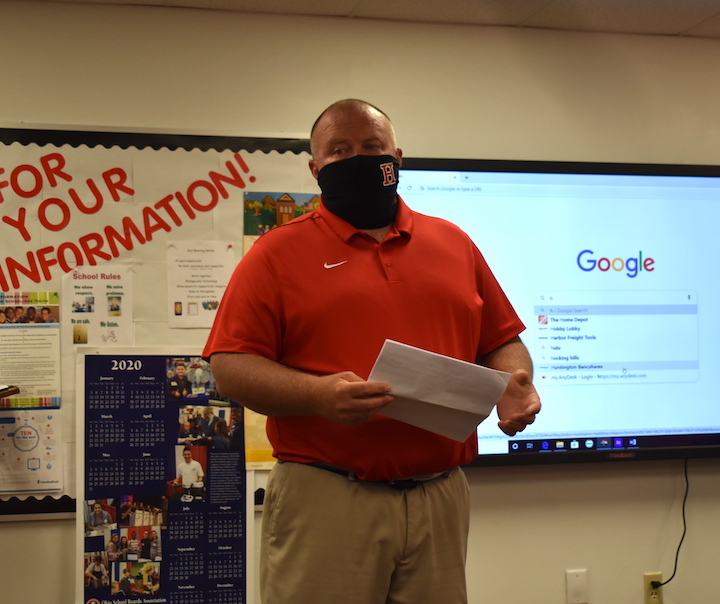
Hillsboro High School principal Joe Turner and athletics director Dave Dietrick discussed how the school has adapted for fall sports — which include football, cross-country, girls tennis, golf, soccer and volleyball — as they work to adhere to state and local guidelines for COVID-19 prevention.
Superintendent Tim Davis said he invited the administrators to speak to the board and “bring light to what has happened, the things we have to do in order for us to continue to play.”
Dietrick told the school board the regulations thus far could best be described as “fluid.”
“Our recommendations are coming from the Ohio health department, from the governor’s office and then sometimes it’s repeated or interpreted and re-presented to us from the OHSAA, the Ohio High School Athletic Association,” Dietrick said. “Sometimes they do change. A lot of it’s the same you see every day in life, that you go through and everyone’s used to seeing — the stickers, little marks on the floor, the constant visual reminders of six feet and social distancing. That’s the key we’re working on for most of athletics.”
Safety measures include offering hand sanitizer in “multiple locations in each venue,” plus providing general cleaning and sanitation between events. Spectators must sit in “pods” with their families, six feet away from other families, and masks must be worn at all times.
For the student-athletes, they undergo temperature checks prior to practice and prior to transportation and/or competition. If they are not actively playing, athletes are required to wear a mask and sit six feet from teammates. They also cannot share water bottles.
“The key word here is ‘education,’” Dietrick said. “We keep educating and keep trying to inform. We’ve put signage up, we’re on the PAs and social media and the website.
“Our kids have had their temperatures taken probably more than they ever have in their life. They go to get on the bus, and the first thing is they have to have a face covering to get on the bus. We’re checking their temperature as they go on.”
Dietrick said they also do symptom checking of each athlete, and by turning in their roster for a game at each venue, “we’re saying we’ve checked everybody on this bus, and everybody on this bus does not have a high temperature and they’ve been through that health screening.”
Another way to limit congregating in the buildings is by eliminating the use of locker rooms in nearly all instances, Dietrick said. Athletes are asked “to come dressed and come prepared,” regardless of the sport.
“You don’t see the postgame handshakes,” he said. “We’re really trying to limit the high-fives and all that congratulatory stuff.”
Dietrick said that one of the most significant changes has been reduced crowd sizes, with attendance at sporting events limited to 15 percent of the facility’s capacity. Priority is given to necessary game personnel, members of the participants’ families and media.
“The push all along was to get the kids back to playing,” Dietrick said. “I think sometime in the process, we either got so far ahead of it or didn’t think it all out as to what about the attendance? What about the spectators? I think at some point, a large part of society was thinking our Friday nights would be just like they always were, with pep rallies and bands playing and just a great community atmosphere.
“It still is, but it’s just different. This has become the new normal for us.”
Across the Frontier Athletic Conference, Hillsboro and the other five schools (McClain, Chillicothe, Jackson, Miami Trace and Washington) agreed that visiting teams will be given two tickets per visiting player and cheerleader for sporting events. Bands are not traveling to away games, per state orders.
“Our first game, our away game at Western Brown, we were allowed to bring 75 fans,” Turner said. “For a 50-kid football roster, only 75 people could come watch them. Those are some of the things that we’re dealing with that made this season a little bit tough, but everybody’s been working with us, and for the most part it’s going pretty smooth.”
For home games, HHS is limiting the total spectators per player, per home sport, as follows: varsity football, two; varsity soccer and middle school volleyball, three; and high school volleyball, JV football, JV soccer and middle school football, four. Dietrick said the number of tickets was determined based on the capacity of the venue as well as the size of the sport’s roster.
For example, Dietrick and Turner explained the number for varsity football is so low because it also takes into account cheerleaders and band members, as varsity football also has the largest roster of any sport.
“It’s kind of deceiving when you see varsity football gets two tickets, whereas JV football gets four tickets,” Turner said. “You’ve got to take into consideration the number of people that attend those games. For a varsity football game, you’ve got the 50 football players, but then you’ve got the 100 band members, you’ve got the cheerleaders, all those other people that are still student participants, so they get two tickets as well. For the JV game, it’s only the team, so we can allot more tickets for each player.”
Despite the restrictions, Dietrick said the district has “been able to accommodate most of our families” in permitting them to attend games.
“We try to work as hard as we can with it, and it’s an ongoing process,” he said.
If players know their vouchers for tickets aren’t being used, the school offers an option for a third voucher to other students — giving seniors’ families first priority — in an effort to “help out the best that we can,” Dietrick and Turner said.
“We’re still learning as we’re going through it,” Dietrick said. “We’re trying to do the best we can and follow the recommendations, and at the same time, we’re trying to keep the kids playing and help out our families as best we can.”
Board president Bill Myers asked if the vouchers are prepaid or presented at the gate in order to pay an entrance fee.
“We’ve done both,” Dietrick said. “Which one works better, I don’t know. They both seem to work OK. We’re dealing with a much smaller number in attendance. Doing it ahead of time kind of helped with the tracking — we could say there’s no more tickets at the gate.”
Dietrick said they have also asked people who they are “supporting tonight” at the entrance and checked off a roster when they turn in their vouchers.
As part of the OHSAA’s efforts to gauge schools’ compliance, Dietrick said the OHSAA is sending “evaluators that show up at the larger ball games” and give feedback to the state association, which in turn shares the findings with member schools.
Football games have taken the largest hit in terms of spectator restrictions, and Dietrick spoke about other changes, including the football season being reduced to a six-week regular season instead of the normal 10 games.
“Looking at the end game of it, the championship game, they’re trying to get that wrapped up in the pre-Thanksgiving period, prior to that cold and flu season, really throwing that in on top of it,” Dietrick said. “We chose to play Week 1 as a regular non-league game, and then we play five league games. That’s the only games we had in the league.
“Every team that’s still eligible to play, come Week 7, will make the playoffs.”
The OHSAA announced Saturday that “664 schools opted in to the postseason,” instead of the usual 224 teams. Hillsboro has been placed in Division IV, under the OHSAA’s updated regional alignments. Brackets for the football postseason are scheduled to be released Oct. 1.
Myers asked if the state has given any information on winter sports yet. Dietrick said the OHSAA is still awaiting official guidance from the governor’s office and Ohio Department of Health.
“Will it have a big effect on winter sports? Absolutely,” Dietrick said. “It’s going to affect it, especially like a boys [basketball] game where you have freshman, JV, varsity and you have a lot of people coming and going. The sport of wrestling — it’s all contact.”
Myers thanked Dietrick and Turner for their presentation, along with thanking the district’s families for their cooperation.
“We appreciate everybody being as patient as they have been with us, as we all are learning on the fly how best to keep some normalcy in the midst of all this,” Myers said.
Davis also thanked the administrators, as well as everyone involved in the athletics program, during the superintendent’s report later in the meeting.
“I want to thank Mr. Dietrick, our athletic department, all our administrators, our fall coaches, athletes and parents,” Davis said. “This has definitely been a different year.”
One of the major differences the superintendent has noticed is that not only are there fewer “people in the stands,” but the restrictions mean very few students are actually supporting their classmates at athletic events.
“A lot of our student body is staying home on Friday night because they can’t come into the game,” Davis said. “They’re not a family member, and that’s very difficult. I think that has been the biggest change. Your mom and dad can come in, but there is no student section. There is no group of people that you’re looking in the stands — it’s just Mom and Dad, it’s not your buddies, your friends. That’s tough on kids.
“They’ve adapted extremely well, they know it is what it is, but I’d say for me, that’s the biggest difference. It’s the adjustment that has to be made by your peers. You don’t get to go to support them, to see them during these times, and I know that that’s difficult for them as well.”
[[In-content Ad]]
Hillsboro High School principal Joe Turner and athletics director Dave Dietrick discussed how the school has adapted for fall sports — which include football, cross-country, girls tennis, golf, soccer and volleyball — as they work to adhere to state and local guidelines for COVID-19 prevention.
Superintendent Tim Davis said he invited the administrators to speak to the board and “bring light to what has happened, the things we have to do in order for us to continue to play.”
Dietrick told the school board the regulations thus far could best be described as “fluid.”
“Our recommendations are coming from the Ohio health department, from the governor’s office and then sometimes it’s repeated or interpreted and re-presented to us from the OHSAA, the Ohio High School Athletic Association,” Dietrick said. “Sometimes they do change. A lot of it’s the same you see every day in life, that you go through and everyone’s used to seeing — the stickers, little marks on the floor, the constant visual reminders of six feet and social distancing. That’s the key we’re working on for most of athletics.”
Safety measures include offering hand sanitizer in “multiple locations in each venue,” plus providing general cleaning and sanitation between events. Spectators must sit in “pods” with their families, six feet away from other families, and masks must be worn at all times.
For the student-athletes, they undergo temperature checks prior to practice and prior to transportation and/or competition. If they are not actively playing, athletes are required to wear a mask and sit six feet from teammates. They also cannot share water bottles.
“The key word here is ‘education,’” Dietrick said. “We keep educating and keep trying to inform. We’ve put signage up, we’re on the PAs and social media and the website.
“Our kids have had their temperatures taken probably more than they ever have in their life. They go to get on the bus, and the first thing is they have to have a face covering to get on the bus. We’re checking their temperature as they go on.”
Dietrick said they also do symptom checking of each athlete, and by turning in their roster for a game at each venue, “we’re saying we’ve checked everybody on this bus, and everybody on this bus does not have a high temperature and they’ve been through that health screening.”
Another way to limit congregating in the buildings is by eliminating the use of locker rooms in nearly all instances, Dietrick said. Athletes are asked “to come dressed and come prepared,” regardless of the sport.
“You don’t see the postgame handshakes,” he said. “We’re really trying to limit the high-fives and all that congratulatory stuff.”
Dietrick said that one of the most significant changes has been reduced crowd sizes, with attendance at sporting events limited to 15 percent of the facility’s capacity. Priority is given to necessary game personnel, members of the participants’ families and media.
“The push all along was to get the kids back to playing,” Dietrick said. “I think sometime in the process, we either got so far ahead of it or didn’t think it all out as to what about the attendance? What about the spectators? I think at some point, a large part of society was thinking our Friday nights would be just like they always were, with pep rallies and bands playing and just a great community atmosphere.
“It still is, but it’s just different. This has become the new normal for us.”
Across the Frontier Athletic Conference, Hillsboro and the other five schools (McClain, Chillicothe, Jackson, Miami Trace and Washington) agreed that visiting teams will be given two tickets per visiting player and cheerleader for sporting events. Bands are not traveling to away games, per state orders.
“Our first game, our away game at Western Brown, we were allowed to bring 75 fans,” Turner said. “For a 50-kid football roster, only 75 people could come watch them. Those are some of the things that we’re dealing with that made this season a little bit tough, but everybody’s been working with us, and for the most part it’s going pretty smooth.”
For home games, HHS is limiting the total spectators per player, per home sport, as follows: varsity football, two; varsity soccer and middle school volleyball, three; and high school volleyball, JV football, JV soccer and middle school football, four. Dietrick said the number of tickets was determined based on the capacity of the venue as well as the size of the sport’s roster.
For example, Dietrick and Turner explained the number for varsity football is so low because it also takes into account cheerleaders and band members, as varsity football also has the largest roster of any sport.
“It’s kind of deceiving when you see varsity football gets two tickets, whereas JV football gets four tickets,” Turner said. “You’ve got to take into consideration the number of people that attend those games. For a varsity football game, you’ve got the 50 football players, but then you’ve got the 100 band members, you’ve got the cheerleaders, all those other people that are still student participants, so they get two tickets as well. For the JV game, it’s only the team, so we can allot more tickets for each player.”
Despite the restrictions, Dietrick said the district has “been able to accommodate most of our families” in permitting them to attend games.
“We try to work as hard as we can with it, and it’s an ongoing process,” he said.
If players know their vouchers for tickets aren’t being used, the school offers an option for a third voucher to other students — giving seniors’ families first priority — in an effort to “help out the best that we can,” Dietrick and Turner said.
“We’re still learning as we’re going through it,” Dietrick said. “We’re trying to do the best we can and follow the recommendations, and at the same time, we’re trying to keep the kids playing and help out our families as best we can.”
Board president Bill Myers asked if the vouchers are prepaid or presented at the gate in order to pay an entrance fee.
“We’ve done both,” Dietrick said. “Which one works better, I don’t know. They both seem to work OK. We’re dealing with a much smaller number in attendance. Doing it ahead of time kind of helped with the tracking — we could say there’s no more tickets at the gate.”
Dietrick said they have also asked people who they are “supporting tonight” at the entrance and checked off a roster when they turn in their vouchers.
As part of the OHSAA’s efforts to gauge schools’ compliance, Dietrick said the OHSAA is sending “evaluators that show up at the larger ball games” and give feedback to the state association, which in turn shares the findings with member schools.
Football games have taken the largest hit in terms of spectator restrictions, and Dietrick spoke about other changes, including the football season being reduced to a six-week regular season instead of the normal 10 games.
“Looking at the end game of it, the championship game, they’re trying to get that wrapped up in the pre-Thanksgiving period, prior to that cold and flu season, really throwing that in on top of it,” Dietrick said. “We chose to play Week 1 as a regular non-league game, and then we play five league games. That’s the only games we had in the league.
“Every team that’s still eligible to play, come Week 7, will make the playoffs.”
The OHSAA announced Saturday that “664 schools opted in to the postseason,” instead of the usual 224 teams. Hillsboro has been placed in Division IV, under the OHSAA’s updated regional alignments. Brackets for the football postseason are scheduled to be released Oct. 1.
Myers asked if the state has given any information on winter sports yet. Dietrick said the OHSAA is still awaiting official guidance from the governor’s office and Ohio Department of Health.
“Will it have a big effect on winter sports? Absolutely,” Dietrick said. “It’s going to affect it, especially like a boys [basketball] game where you have freshman, JV, varsity and you have a lot of people coming and going. The sport of wrestling — it’s all contact.”
Myers thanked Dietrick and Turner for their presentation, along with thanking the district’s families for their cooperation.
“We appreciate everybody being as patient as they have been with us, as we all are learning on the fly how best to keep some normalcy in the midst of all this,” Myers said.
Davis also thanked the administrators, as well as everyone involved in the athletics program, during the superintendent’s report later in the meeting.
“I want to thank Mr. Dietrick, our athletic department, all our administrators, our fall coaches, athletes and parents,” Davis said. “This has definitely been a different year.”
One of the major differences the superintendent has noticed is that not only are there fewer “people in the stands,” but the restrictions mean very few students are actually supporting their classmates at athletic events.
“A lot of our student body is staying home on Friday night because they can’t come into the game,” Davis said. “They’re not a family member, and that’s very difficult. I think that has been the biggest change. Your mom and dad can come in, but there is no student section. There is no group of people that you’re looking in the stands — it’s just Mom and Dad, it’s not your buddies, your friends. That’s tough on kids.
“They’ve adapted extremely well, they know it is what it is, but I’d say for me, that’s the biggest difference. It’s the adjustment that has to be made by your peers. You don’t get to go to support them, to see them during these times, and I know that that’s difficult for them as well.”
[[In-content Ad]]