


The visiting bears of summer, Part II
By Jim Carnes
Wildlife Officer
ODNR/Division of Wildlife
Even though Suzie Prange and Laura Graber live in different parts of the Ohio – Suzie in the southeastern foothills and Laura in the northeast – they both share many common passions and interests. Both are passionate and devoted to their families and friends. Both have always held an eye for the outdoors and wildlife, which led both to a higher education in wildlife management.
This ultimately paid off by both eventually being hired as by the Ohio Department of Natural Resources in the Division of Wildlife.
Laura is assigned to District Three in Akron, and Suzie is in District Four in Athens. Both are involved in many programs, some involving the research studies on Ohio’s protected species, such as bobcats, badgers, and black bears. Between the two, they have close to 20 years of service.
In Part One of this series, we ended with bear biology across the Ohio line in Pennsylvania. It seems fitting we come back across into Ohio and into Laura’s district.
“With bear reproduction in adjacent Pennsylvania counties, we have to have a female somewhere,” Graber said. “We just haven’t been able to confirm it in Ohio. We get a lot of the juvenile bears moving through and even adult male bears, but have not yet been able to verify that reproduction piece of the puzzle. Some of those bears do display signs of travel that would indicate they are local, meaning they are staying in Ohio year-round and not going back to Pennsylvania.”
Female and male bear ranges are quite different. Female bears are more tolerant of other females in established population areas, and populations seem to overlap. Male bears are not so. They are territorial among other males of the species and they don’t get along. Males are predominantly solitary and roam a lot of territory in in home ranges. Females won’t move far when establishing a home range, which is why population expansion is slow in Ohio.
But that’s not to say that Mother Nature doesn’t throw in a curveball every now and then.
“We once had a radio-collared sow that over two years was bred both years, and still managed to move halfway across the state,” said Roger Coup, wildlife management supervisor in Pennsylvania.
[[In-content Ad]]
And that’s just not one occasion. In the 1990s, Ohio had a sow bear from West Virginia move through its southwestern counties before it was tranquilized on the outskirts of Columbus. The bear was transported back home to her home range in the coal mine state. The bear reportedly gave birth to cubs later that winter even after her wandering.
Back in northeast Ohio, we do have something documented that is very exciting and encouraging. Jefferson County, Ohio lies right at the intersection border of Pennsylvania and West Virginia along the Ohio River. Jefferson is on the southeastern edge of Laura Graber’s jurisdiction.
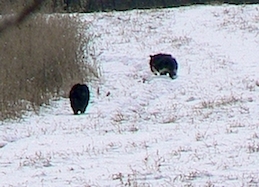
Deer hunters were on the Brush Creek Wildlife Area and a local neighbor property looked out the window and caught glimpses of two black bear cubs running through the snow. Grabbing her camera, she was able to take two pictures of them running off, and then a third, larger bear came out of the wildlife area and headed in pursuit of the smaller two. The camera malfunctioned, and the third picture was not taken.
In the photographs, it certainly appears to be two potentially year-old cubs running away. Unfortunately, the third picture of the third bear was not taken. It certainly would have raised the level of confirmation of a breeding sow with cubs.
Because wildlife management is based on sound biology and testimony, biologists operate as close to fact as they can when the sightings occur. Confirmation of bear sightings are normally done with good quality pictures or video taken by the witness. A cluster of sightings in an area by many different witnesses provides additional evidence.
And although we have had that close confirmation of a breeding population in northern Ohio, it is not the only location within Ohio’s borders.
“There is one spot, one location, that it appears that we do have resident population of bears moving through there even in the fall and winter,” said Suzie Prange, in southeast Ohio.
“With the number of sightings in that area at that time, it is suspicioned that there might be a sow over there because males aren’t going to normally stay around in a cluster like that unless there were a female around.”
Where is this location and what other confirmed clues are there?
How bears in West Virginia and Kentucky are having a role in Ohio and what the bears are doing here, locally, I’ll cover those curiosities and questions in the upcoming conclusion of “The visiting bears of summer, Part III.”