


Portman tours Turning Point facility, hears success stories
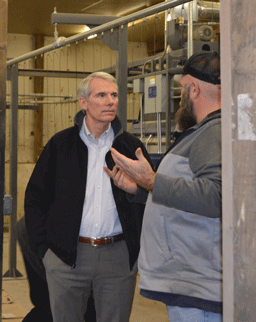
Sen. Rob Portman toured the Turning Point Applied Learning Center in Hillsboro and met with their staff, board members and several graduates to discuss his Second Chance Act and its effect on the program, Wednesday afternoon.
The bipartisan Second Chance Act, which was passed into law in 2008, focuses on "reduced prison costs and improved public safety by giving federal, state and local governments tools to help inmates successfully re-integrate into their communities upon release and avoid re-offending. The bipartisan Second Chance Reauthorization Act improves existing programs that have demonstrated success and consolidates some programs that were duplicative or less successful."
According to Sen. Portman, the legislation provides ex-offenders an opportunity to turn their lives around through recovery programs and job training, which is Turning Point’s mission. Turning Point has been providing employment training and supportive services to residents of the Highland County region for 18 years.
In addition to executive director of Turning Point Applied Learning Center LuAnn Winkle and plant manager, Portman met with Turning Point board members Jim Evans and Dennis Huston; Highland County Probation Department Jeremy Ratcliff; and Highland County Reentry Services Director Rhonda Fannin. Representatives of Portman’s office, as well as Highland County Commissioners Shane Wilkin, Jeff Duncan and Tom Horst, also attended the tour of the facility.
Several of Turning Point’s manufacturing partners, including Michael Cao of IC3D Printers, Ann Pence and Nina Pence of Greenfield Products and Robert Moots of Weastec, were also present. While touring the building, Portman viewed areas where Turning Point facilitates work for these Ohio businesses.
Following the tour, Portman met with individuals who successfully completed the required 420 hours at Turning Point and have since enjoyed success, earning meaningful employment and/or enrolling in college courses. One testified that she is now studying behavioral psychology in college, while others expressed their gratitude at earning employment with the business partners of Turning Point. After they gave testimonials about Turning Point, Portman asked them questions about their backgrounds, their time at Turning Point and their current employment.
In addition to gaining information on the Turning Point program’s effect on these individuals’ lives, Portman asked the Turning Point staff for information on how the Second Chance Act’s grant funding impacted their program.
“I understand you got the grant and used it, but how much did it help these guys?” Portman asked.
“It helped them 100-percent,” Winkle said. “We would not have been able to offer them positions here in the program had it not been for the Second Chance Act. The grant helped 236 participants. It was instrumental in getting our re-entry program up and going.
[[In-content Ad]]
“It changed the whole direction of our mission here at Turning Point. I think it’s been a very good change for us and for the community as well.”
Fannin addressed the senator’s question about Turning Point’s success rate and presented Portman with a board celebrating the program’s success.
Of the 236 people enrolled in the program, 41 percent graduated, and 10 earned their GED. Sixty-two individuals were employed after completing the required 420 hours at Turning Point.
“Our goal for Turning Point was to serve 200 individuals, and we actually exceeded that with 236,” Fannin said. “One thing we really found consistently through Turning Point’s re-entry programming is if someone completes the program, the success rate for getting a job is so much higher. If they can stay long enough to complete, they get so many additional skills that can help them later on the job.”
Fannin said that Turning Point looks at the individual’s entire situation to identify their specific needs to increase their chances of success.
“Another thing that really makes the Turning Point program a success is it’s holistic,” Fannin said. “It doesn’t just address the employment training needs, but it looks at do you need a GED, do you need some more education, do you need counseling in addition to the programming. We’ve had partnerships with transportation. We have routes in the county where it gets people here. We’re trying to remove some of those barriers.
“The program itself, just being able to offer a stipend where you can make some money you can put toward your fines and fees you owe, is huge.”
Winkle pointed out that the Turning Point program’s participants have paid “a third of a million dollars” – $314,585.05 – in fines, fees, child support and restitution.
“That helps the victims, and it goes back to our courts,” Winkle said. “It enables them to feel good about what they’re doing. They’re making headway.”
Winkle said that the local judges are “incredibly cooperative” with the ex-offenders in the program and also thanked the manufacturing partners for their continued support.
“There was a match requirement for that grant,” Winkle said. “That came from our manufacturing partners. It’s the pay-for-success model, and that’s an incredible model.”
Some of the individuals who did not complete the program are still in contact with Turning Point staff and use their resources, Fannin said.
Portman called Turning Point’s success “really exciting.”
“We’re trying to get this program reauthorized, as you know,” Portman said. “I hope you guys apply again. One of the push-backs get from my colleagues is ‘you need to prove that it’s working,’ so I’m always looking for data. These success stories are well beyond statistics, better than any statistics.
“Helping people get that second chance comes out of our faith tradition, too. People understand they have a God-given purpose in life, and we all have that, and you need to bring it out.”
Winkle thanked Portman for his support and presented the senator with a “career passport” as a keepsake, along with a copy of some of the success stories of the program.
“When our folks complete their 420 hours successfully here at Turning Point, we offer them a career passport that they take to employers that highlights all of their accomplishments here with us,” Winkle said. “We thought it would be nice to present you with a career passport with our certificate of appreciation for you, but we also wanted to include for you a copy of the testimonials.”
Portman thanked Winkle and joked that he didn’t earn it.
“I don’t deserve that,” he said. “I’ve only put in an hour and 15 minutes.
“Thank you very much. It’s an honor to get this, and I’ll display this in my office.”