


Liquor Control hearing held for Allensburg business application
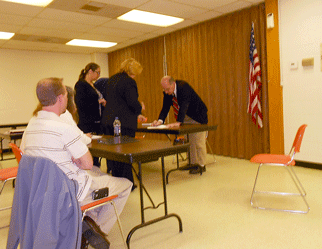
James Bally, hearing officer Ohio Division of Liquor Control, presided over a hearing Thursday, April 12 in the Highland County Administration Building, regarding a liquor license application for a former Allensburg tavern.
Business owner Christina Gill of Lynchburg has purchased the former Sunnyside Inn on U.S. 50 in Allensburg across from the Allensburg Church of Christ.
Gill was represented by Hillsboro attorney Kathryn Hapner.
The church, which opposes the liquor license, was represented by Pastor Bob Stevens.
In addition, the Highland County commissioners have objected to the license and were represented by Highland County Prosecutor Anneka Collins.
Prior to the start of the hearing, Commission President Shane Wilkin told both parties, "When it comes to liquor issues, I will abstain." Wilkin explained that he and his wife hold a liquor license in Highland County.
Wilkin then excused himself from the hearing.
[[In-content Ad]]Also in attendance were Highland County Commissioner Tom Horst and Highland County Sheriff Ron Ward.
Bally heard testimony from both parties and their respective counsel.
The county based its objection, in part, on the establishment's close proximity to a church and also on the owner's previous arrest record, which included misdemeanor offenses entered as exhibits to the hearing.
Also testifying were Ward, Horst and Lynchburg resident Wayne Thoroman.
"We request that the license be denied," Collins told Bally in her closing statement, after referencing Gill's previous record.
Hapner argued that for many years the former Sunnyside Inn had operated from the Allensburg location, and with another carryout nearby, "people are already accustomed to having a liquor establishment there."
Hapner added that her client has testified that as a new business owner she will police the parking and litter issues that had caused a number of concerns in years past.
"I don't know what more you can ask of a proprietor," Hapner said. "We ask that you grant the liquor license."
At the conclusion of the hearing, Bally announced he would not make a decision today, and the matter would be forwarded to Bruce Stevenson, superintendent of the Ohio Division of Liquor Control.
The Ohio Division of Liquor Control is responsible for controlling the manufacture, distribution, licensing, regulation, and merchandising of beer, wine, mixed beverages, and spirituous liquor within Ohio pursuant to Ohio Revised Code Chapters 4301. and 4303. Regulatory functions include the issuance of permits to manufacturers, distributors and retailers of alcoholic beverages. As a “control state” all beer and intoxicating liquor must be bought and sold pursuant to Ohio law.