


GAP training for all tobacco producers
By David Dugan
OSU Extension Educator, Agriculture and Natural Resources
Adams/Brown/Highland Counties
Ohio Valley Extension Education Research Area
Despite several weeks in this newspaper and several times on local radio, not to mention the Adams Co. Extension Facebook page, my tobacco e-mail list, papers hanging at local agricultural businesses and word of mouth, we still have several tobacco producers that have not been through GAP training.
It is my understanding that GAP (Good Agricultural Practices) is going to be required by all companies who buy tobacco in 2014.
Contracts were delayed, so several producers are not aware of the situation. We had over 200 producers attend the earlier training sessions in Adams and Brown Counties over the past 2 weeks. Mason Co. had over 300 attend a session during that same time period.
If you slipped through the cracks, and still need training, we will have another one sometime. I am waiting until everyone has contracts so we can do a final training for this year. YES, this year. It appears this will be an annual re-certification for growers. Help spread the word. If you know people growing tobacco in 2014, ask them if they know about this. Watch this newspaper for the date, time and location of the final GAP training in 2014.
In the meantime you can log onto the GAP Connections webpage to obtain your ID number. Follow the instructions and print it, then bring it to the upcoming meeting. The web address is www.gapconnections.com
Good Time to Control Poison Hemlock
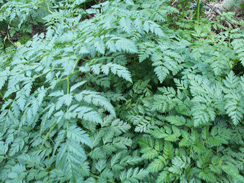
I have heard several names for Poison Hemlock over the years, but as it becomes more and more populated around streams, fencerows, buildings and even hay fields, more people can properly identify this problem weed. Part of the problem is that, as the name implies, it can be toxic. Another problem is that it spreads rapidly due to the large number of seeds that one plant can produce.
[[In-content Ad]]
Poison Hemlock, once it begins to bolt, has a hollow stalk. The best time to control it is when it is still in the rosette stage. Being this weed is a starts off in the fall it can be controlled in November with some success. The other time to apply herbicides that seems to be effective is right now, the last part of March before it begins to bolt.
When mature it produces a white flower, is often over 6 feet in height, has a stalk that could get well over an inch in diameter that has purple areas on what is mostly a pale green stalk. A single application may not result in a complete kill. Going back with a possible second application in a week or two might be a good idea.
The plant is dark green in most areas right now and should be easy to identify. A simple google search will provide pictures of the plant now and what it looks like when it matures. If you have dealt with it in the past as a mature plant you may want to go those areas to look for it now.
Prevent Grass Tetany and Other Problems
Winter seems like it will not give up. Monday morning the thermometer read 20 degrees and we are officially into spring. The grass is just starting to green up a little, but it will not be long now. With the hope for lush green pastures, there are some risks that we need to take into account. Hungry livestock turned into lush pastures may be susceptible to bloat, which can be fatal. Take precautions by feeding cattle dry hay, and getting them pretty much full, before turning them out to new grass. Also, be aware that wet grass is more of a concern, so wait until the grass is dry in the afternoon to open the gate.
Another potential problem is grass tetany. Treatment is limited for this problem because in most cases it is too late to do much, because the animal is usually dead when you realize there is a problem.
Since there is a slim chance of treating such a problem, the best strategy would be to make every attempt to reduce the chances of grass tetany. In order to prevent it, we need to know what causes the problem to begin with. Basically, grass tetany is caused by a magnesium deficiency in the diet.
Lush grass in the spring tends to be a problem when it comes to meeting the need for magnesium. Part of the problem is that plants do not take up enough phosphorus or magnesium when weather conditions are cool and wet. Another issue that could cause more of a problem is a high level of potassium. This is even more of a problem for cows that have young calves at their side. Spring calving cows that have calves just a few weeks old on their side have more nutritional needs, so they are more susceptible than the rest of the herd.
I am trying to put you into prevention mode, so the idea of not turning these cows onto new pastures hungry should be noted, avoid turning cows into new pastures while the grass is still wet, and avoid applying too much nitrogen or potassium to the soil. With current fertilizer prices, potash is not near what it was in price a few years ago. With that in mind, if you skimped on potash recently, and decide to take advantage of more reasonable prices, use some caution if it is on grazing land.
Another preventative step that should be done is the use of a good loose mineral program. Livestock can consume the loose mineral easier and better than blocks. Most animal nutritionists that I have heard speak in the past few years have expressed their preference for using loose mineral. Check the mineral tag to insure that you are providing a mineral that contains enough magnesium. To prevent grass tentany, cows need to consume .6 ounces of magnesium on a daily basis. Most companies have a mineral made for the prevention of grass tetany.
A good mineral program is essential for several things in livestock production including reproduction, growth, and overall good health. Livestock will consume what they need if it is available. Providing a mineral with the necessary magnesium now may help prevent grass tetany once it does green up in the pastures, as well as many other benefits. Consult the company, or other companies, to learn more about the mineral programs available. Keep in mind that the cheaper bag in cost is most likely cheaper because it does not provide as much actual minerals as the more expensive bag. I am not talking dealer to dealer, or company to company. Each dealer and/or company will most likely have several different minerals available. Read the tag, consult your local veterinarian for additional advice on which mineral program might be best for your herd.
Dates to Remember
April 2 – Highland Co. Cattlemen’s Annual Meeting and Banquet at 7:00 p.m. at the Hillsboro Elks. Tickets are available at the Union Stockyards.
April 10 – 20th Annual Southwest Ohio Perennial School in Owensville at the Clermont Co. Extension Office located on the fairgrounds. Registration information and other details can be found at http://clermont.osu.edu or you can call the Extension Office at 513-732-7070.
April 30 – Farm to School Workshop at Mt. Orab Elementary School from 3:30 p.m. until 7:00 p.m. with a registration deadline of April 20. For details go to my archived articles on the county extension webpage or call Sue Basta at 937-378-4171. County webpage is the (name of the county).osu.edu