


DeWine announces $400 million Apple e-book settlement payouts to begin Tuesday
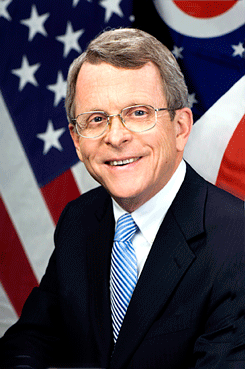
Ohio Attorney General Mike DeWine announced that eligible consumers in Ohio and across the U.S. will begin receiving their share of Apple Inc.’s $400 million consumer compensation payout this week, the result of a multi-state e-books price-fixing case.
An additional $21 million, left over from related settlements with book publishers, also will be distributed to consumers this week.
Ohio consumers are expected to receive an estimated $15 million of the total $421 million that will be issued beginning Tuesday.
“My office played a key role in this case, helping to secure the maximum amount of consumer compensation possible and prevailing despite multiple appeals. We’ll continue our efforts to protect consumers and ensure fairness in the marketplace,” Attorney General DeWine said.
Apple’s $400 million consumer payment stems from an antitrust case brought by Attorney General DeWine and 32 other states and territories accusing Apple of conspiring with five top U.S. publishers to artificially raise the price of e-books between 2010 and 2012.
The five publishers – Penguin, Macmillan, Hachette, HarperCollins and Simon & Schuster – settled before trial, agreeing to pay $166 million in consumer compensation (most of which was distributed to consumers in March 2014).
Apple declined to settle and the case went to trial in the U.S. District Court for the Southern District of New York in June 2013. The trial court found that Apple had violated antitrust laws. Subsequently Apple appealed to the U.S. Court of Appeals for the Second Circuit, which affirmed the lower court’s ruling. In March 2016, the U.S. Supreme Court refused Apple’s request to review the Second Circuit’s decision.
That refusal triggered a conditional settlement between Apple and the states, in which Apple had agreed to pay $400 million to consumers should the lower court’s ruling ultimately be upheld.
[[In-content Ad]]
Combined with the $166 million publisher settlements, consumer compensation from the e-books case totals $566 million, about twice the estimated actual damages to consumers.
The Ohio Attorney General’s Office, Antitrust Section, was part of the trial team against Apple and part of the executive committee in the e-books case.
Distribution to Consumers
The $15 million that Ohio consumers are expected to receive beginning on June 21 is in addition to the millions already distributed from the publisher settlements.
The amount an e-book purchaser will receive is based on the number and type of e-books the purchaser bought between April 1, 2010, and May 21, 2012, published by one of the five publishers. For each e-book that was a New York Times bestseller, consumers will receive $6.93. For other e-books, they will receive $1.57 per e-book.
Consumers who purchased eligible e-books through Amazon, Apple, Barnes & Noble or Kobo will automatically receive credits in their accounts, unless they previously requested to receive checks. Consumers who purchased eligible e-books through Sony will automatically receive a check by mail. Customers who purchased eligible e-books through Google will receive a check if they filed a claim by the deadline.
Customers receiving account credits should expect to receive an email between June 21 and June 24, notifying them about the credits. Due to the large number of consumers affected, it will take a few days to fully load account credits, and some consumers may not see credits in their account until Friday, June 24, 2016. Credits can be used to purchase anything sold by the retailer, not only e-books.
Compensation is being distributed by a third-party settlement administrator. The settlement administrator has set up a website and toll-free phone number to assist consumers who have questions about the distribution. Consumers should visit www.ebooklawsuits.com or call 866-686-9333 for more information.