


Council, FRS director discuss proposed addiction treatment facility
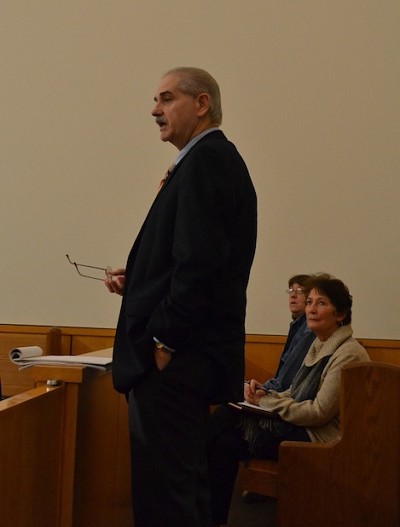
FRS Counseling executive director Joe Adray met with Hillsboro City Council members during their regular February meeting Monday evening to discuss the local drug abuse epidemic and to share information on plans for a residential treatment facility in the community.
Adray came before council at Hillsboro mayor Drew Hastings' request to answer questions about drug problems in the city and discuss treatment options.
FRS Counseling offers "intensive outpatient treatment" services up to five days per week, along with medication-assisted treatment, Adray said. They have three buildings in the city limits: the main office on Chillicothe Avenue; a connections program center, also located on Chillicothe Avenue; and administration offices on Erin Court.
Adray told council that while FRS Counseling's main goal upon its formation in 1982 was to treat alcoholism, over 60 percent of the cases they see involve opiates or methamphetamine.
"Judge [Rocky] Coss said not long ago to me that he wouldn't doubt we have at least a thousand people addicted to opiates [in Highland County]," Adray said.
Adray told council members that the pervasive opiate addiction problem in the county began in the mid-1990s after painkillers became more frequently prescribed in medical facilities.
"What many of them didn't understand is that to the body, the only difference between a prescription pain medication and heroin is legality," Adray said. "The brain just knows 'I need the opiate, and if I can't get it by going to the doctor or in some way buying it' … along comes our heroin dealers and our heroin traffickers."
Adray said that it's "not just a local problem," as national statistics show approximately 62 people die each day from opiate overdoses.
In response to this widespread problem, Adray said that FRS Counseling is researching residential treatment programs.
"There are many of these folks that are addicted, and they have no place to live that doesn't have drug issues around their environment," Adray said. "Sometimes it's in their entire family. Some people need that 90 or 100 days away from everything just to have their heads begin to clear up."
Adray said that FRS would "staff the facility 24/7," and that he may come back to discuss the matter with council as the research progresses.
Adray invited council members to ask questions.
Hastings said that he had "concern" about suboxone treatments and about addicts from other counties coming to a Hillsboro treatment facility.
"You were talking about Hillsboro becoming the regional center for treatment for this, for I forget how many counties you said," Hastings said.
"I wasn't talking about Hillsboro becoming a regional treatment center," Adray said. "There are residential treatment centers that are operating in a lot of counties around us, but nothing in Highland County itself. That means that people have to be sent to another county, another facility, to get residential treatment. We'd like to offer that locally."
Adray said that the drug task force he is a part of is "looking at how we develop kind of a regional approach … but that isn't centered in Hillsboro."
In response to Hastings' concerns of suboxone, Adray explained that it is "one of two medications that are designed to help treat opiate addiction."
"We've all heard of methadone," Adray said. "Methadone is more or less a treatment that you go on, and you're on it on a daily basis probably for the rest of your life."
On the other hand, Adray said that suboxone is a "newer treatment option" compared to methadone and is a "partial opiate."
"It blocks the opiate receptors," Adray said. "It keeps people from getting drug sick, which is one of the things you want to do to keep them from using again. The controversy comes in in that suboxone gets diverted and it's on the street pretty quickly."
To combat that issue, Adray said that FRS prescribes "treatments for one week at a time" and in lower doses than the maximum required by law. They also have strict drug testing guidelines and require suboxone patients to bring back their strips to monitor their usage.
"We find that the clients who come in that are on suboxone, they do pretty well with eight to 12 milligrams," Adray said. "At that rate, and with weekly prescriptions and making sure they don't have large quantities they're taking home, we think we limit the diversion of suboxone pretty well."
[[In-content Ad]]
Adray said that any administration of suboxone at FRS is done alongside therapy treatments.
"If they don't come to treatment, they don't get their prescription," Adray said. "That's a bit of a double-edged sword. You don't give someone their prescription, guess what they'e going to do? They're probably going to be back out using. We don't take that lightly."
Hastings said that Adray "kind of" addressed his concerns, but that he was still concerned with the idea of "attracting or servicing more addicts" in the city.
"I don't think this is a matter of 'attracting,'" Adray said.
"They're already in our backyard," council president Lee Koogler said.
"We are talking about people who are Hillsboro born and raised, and Highland County born and raised, that are addicted," Adray said. "Addictions cross all socioeconomic lines and boundaries. We're seeing people die.
"I don't think we're going to 'attract' anyone. That's not what we're looking to do. We're looking to treat the people that are here and do the best job that we can."
Koogler asked if the facility would be only for Highland County residents or if it would be open for residents from other areas.
"It would be designed primarily to be for Highland County residents," Adray said. "We would operate under some federal and state statutes where we couldn't say 'well, you're not from Highland County, we can't treat you.'"
Koogler then asked if the facility would be for patients who enter treatment voluntarily or under court order. Adray said "it could work either way."
Adray also clarified that it would not be a "lockdown" facility under state law and that Medicaid billing is the primary source of funding for such establishments.
"Do you have any idea how many treatment houses you would want in Highland County?" council member Tracy Aranyos asked.
"Ideally, I'd like to see a female facility that would treat eight to 16 clients," Adray said. "I'd like to see an equivalent amount for males. We would be looking at 16 to 32 beds we would like to have in Highland County."
Aranyos asked what the treatment program's success rate was.
"This is going to sound bad, but it's not bad compared to other numbers that are out there," Adray said. "We are probably seeing about a 50-percent success rate with the people that we have on suboxone treatment.
"The people that come into outpatient or intensive outpatient without medication assisted treatment, we're probably seeing more like a 25- to 30-percent success rate. We're talking about opiates. We have much better outcomes if we're dealing with almost any other substance."
Council member Justin Harsha said that he was concerned with patients on suboxone treatments "coming in, getting their fix and wanting to go."
"The two are separate," Adray said, adding that suboxone treatments will continue to be administered at the main office on Chillicothe Avenue, a nonresidential area, even for those in residential treatment.
Adray also noted that a new treatment facility would not necessarily have to be in a residential area.
"There are places that kind of sit off by themselves where that could be done," Adray said. "We understand that. We want to be good community partners."
Adray said that he and fellow FRS employees would be happy to meet with city council members or administrators to further discuss the issue.
"We're working in a collaborative effort with other agencies," Adray said. "People right now are having to be incarcerated or endangering themselves and other citizens.
"We want them all ultimately to become responsible citizens, own property, pay taxes, get back on track and be able to do something more productive with their life than where addiction is going to take them."