


Academic, business partnerships enhance workforce development
Plans are currently under way at Hillsboro High School to help students take workforce development to the next level through a new program sharing resources with local businesses, which could start as early as this fall.
Hillsboro High School Principal Jason Snively said the school is "trying to build relationships with local businesses and share resources with local businesses within the community," which could involve local business owners and employees volunteering their time or donating materials to help HHS students.
The idea springs from a change in education standards. Snively said the Common Core Education standards focus on "more in-depth material, more so than learning a lot" of different things.
While HHS currently offers two workforce development programs – Career-Based Intervention, a program offering paid positions within the school for freshmen and sophomores; and the Business Co-Op program, a class where students are trained in the process of applying for a job and participate in off-campus work at businesses throughout the community – Snively said the school wants a program that is more goal-oriented.
"We're looking at more than just a knowledge base for students but also making sure they can do some critical thinking and start to apply what they know and evaluate what they know," Snively said. "We can't provide those opportunities realistically sometimes within the four walls of our school, so we're trying to find some resources where we can share with others."
This project has been discussed for the past two years, but Snively said Hillsboro City Schools' addition of superintendent James Smith, a former Grant Career Center principal, and the enthusiasm of Highland County Chamber of Chamber President Melissa Elmore and local business owner Dave Gingerich have helped put plans in motion.
Elmore is partnering with the school in seeking businesses to help "see this vision of partnerships and preparing students," Snively said.
The school currently has some level of committed support from Weastec, Great Oaks, PAS and Southern State Community College.
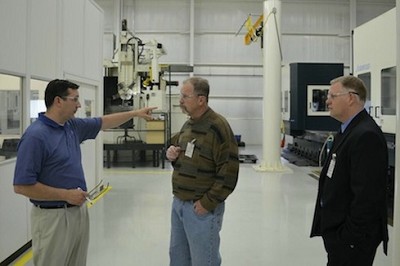
Snively, along with Gingerich and Elmore, recently met with representatives of PAS Technologies Mark Greene and Ronald Boyne, who have offered to give demonstrations and tours for students and share resources and supplies whenever available. Weastec had supplied a lab at the former Hillsboro High School location, and the school hopes to continue a working relationship with Weastec.
The goal of this program is to help students develop critical thinking and problem-solving skills in a real-life workplace atmosphere.
"We're trying to prepare students to be productive citizens, not just to take standardized assessments," Snively said.
This includes not just job experience, but what Snively calls "soft skills," which some business owners have told him is lacking in young workers today, such as "the ability to be at work every day and take initiative, and basic problem-solving skills."
"Sometimes if you don't have things to make connections to, it's hard to really apply these critical thinking skills," Snively said. "They need to go out, see the problem, see what needs to be done so they can analyze things and how they are going to solve that problem. What are the real problems, the real issues that come across on a daily basis at a job?
"We're not just looking at skilled labor, vocational-type labor. We're looking at the comprehensive employee."
Snively said a major reason why the school is trying to develop a program in the community is to give students "opportunities that are close to home." A concern of the school's administration is the reluctance of students to pursue post-secondary opportunities or even vocational school because of their desire to stay close to home.
"Some students don't want to even go to college because the college they may be interested in may be two or three hours from home," Snively said. "Some of our kids don't want to go to Laurel Oaks as high school students. Even though it's only a half hour, to them, it's miles away."
As a solution to this issue, the school is looking into satellite programs with the vocational school. Snively said that he hopes to work with SSCC to find "opportunities that are legitimate careers that can be close to home as well."
Another reason why Snively wants to begin working with high school students is to get them interested in either college or a career. One of the major problems facing some high school students, Snively said, is "lack of a vision" – a student's plan to further his or her education or to find meaningful employment.
"So many of our kids come in here without goals, without a vision of what they want out of life," Snively said. "Without that, coming to school every day is meaningless. We've got to find a way to put some meaning into the education."
A mentorship program with local business owners and employees is critical to help guide such students.
Anyone interested in working with Hillsboro High School on becoming a mentor, giving business tours or demonstrations can contact the high school at (937) 393-3485.
Snively said it would take "some special people" to be mentors who are willing to work with the students and be patient.
"We don't have everything in line, but it would be nice to know that when we're ready, we can contact you and start setting up those guidelines," Snively said.
Snively said the school is "at the beginning of this phase," but hopes to make progress over the summer and find and recruit mentors.
"We have to sit down with local businesses to see who's willing to work with students an hour a day or have a student job-shadow them an hour a day," Snively said.
The school hopes to start working with students in the upcoming 2014-15 school year and getting them connected to partners in the business community. This fall, Snively said the school would like to begin taking students on field trips for tours and demonstrations at local businesses and getting resources together for the project.
The school is hoping to start small in the first year and find eight to 10 businesses to commit to providing mentorships.
"I anticipate this to meet the levels and needs of all students and where they are," Snively said. "It's a wide spectrum of needs, and we want to meet all of their needs."
As plans are still under way, Snively said that no final decisions have been made on whether this project will involve a specific class setting or some other type of pre-mentorship instruction.
"We're going to have the students prepared," Snively said. "There's going to have to be some instruction.
"I'm not going to set the student, the employer, the business or the mentor up for failure. We're going to have some things in place to make sure we're not putting anybody in a bad position."
Ultimately, Snively said they hope to begin finding internship opportunities within the community for interested students. A long-term goal for the project, Snively said, would be to provide students with the skills and tools needed to enter the workforce locally, either as employees or even eventually starting their own businesses.
"We ultimately hope that we're going to bring some businesses into Highland County because we're hoping to prepare the workforce, in one way or another, that the community needs and that the businesses want," Snively said.
[[In-content Ad]]