


SSU math professor named Woman of the Year
Lead Summary
By
-
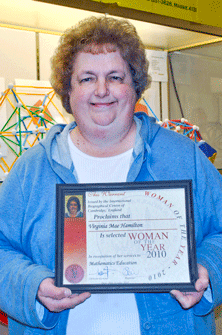
Knowing that she wanted to pursue math even as a young child, it’s no surprise that Shawnee State University Math Professor Ginny Hamilton has been awarded Woman of the Year 2010 in Mathematics Education. The award is from the International Biographical Centre of Cambridge, England.
She has been included in Who’s Who books for several years and in 2008, Hamilton was named one of the Top 200 Educators in the nation.
“This summer, they notified me and said that I had been nominated for Woman of the Year,” Hamilton said. “I do not know who nominated me.”
When they notified her that she had been nominated, they requested a portfolio that she submitted and in October, she received the award.
Hamilton has been teaching 38 years with 24 of those years at SSU. She was one of the original 24 faculty members that came when Shawnee State first became a university in 1986. Before that she taught at Ball State University in Indiana.
“Now I teach pre-service teachers, early childhood, middle childhood and I supervise student teachers for middle school and high school math,” Hamilton said. “I also teach math methods for the early childhood program.”
She is past president of the Ohio Mathematics Educators Leadership Council, and she has been presented the Ohio Council of Teachers in Mathematics outstanding service award. Hamilton is listed in Who’s Who in American Women, Who’s Who in Education, Who’s Who in America, Who’s Who in Science, and she has presented at numerous conferences.
Hamilton is also referee for the “Ohio Journal of Mathematics” and has done a lot of professional development in mathematics for local school systems.
She worked on professional development workshops for teachers with a grant and presented three activity-based workshops for 60 teachers. She continues to work with some of the teachers.
“I work with several teachers from the workshops,” Hamilton said. “Some of the teachers agreed that they would use two classes that were fairly comparable for research, one that they would teach activity-based methods and one that they would teach in the traditional lecture-type method. The activity-based class has far outshone the traditional method class. The improvement was remarkably different.”
Even though the small research grant has expired, Hamilton continues her research in activities-based teaching methods.
“We are working on a shoestring,” she said. “But we are continuing to do the research. It’s cutting edge.”[[In-content Ad]]
She has been included in Who’s Who books for several years and in 2008, Hamilton was named one of the Top 200 Educators in the nation.
“This summer, they notified me and said that I had been nominated for Woman of the Year,” Hamilton said. “I do not know who nominated me.”
When they notified her that she had been nominated, they requested a portfolio that she submitted and in October, she received the award.
Hamilton has been teaching 38 years with 24 of those years at SSU. She was one of the original 24 faculty members that came when Shawnee State first became a university in 1986. Before that she taught at Ball State University in Indiana.
“Now I teach pre-service teachers, early childhood, middle childhood and I supervise student teachers for middle school and high school math,” Hamilton said. “I also teach math methods for the early childhood program.”
She is past president of the Ohio Mathematics Educators Leadership Council, and she has been presented the Ohio Council of Teachers in Mathematics outstanding service award. Hamilton is listed in Who’s Who in American Women, Who’s Who in Education, Who’s Who in America, Who’s Who in Science, and she has presented at numerous conferences.
Hamilton is also referee for the “Ohio Journal of Mathematics” and has done a lot of professional development in mathematics for local school systems.
She worked on professional development workshops for teachers with a grant and presented three activity-based workshops for 60 teachers. She continues to work with some of the teachers.
“I work with several teachers from the workshops,” Hamilton said. “Some of the teachers agreed that they would use two classes that were fairly comparable for research, one that they would teach activity-based methods and one that they would teach in the traditional lecture-type method. The activity-based class has far outshone the traditional method class. The improvement was remarkably different.”
Even though the small research grant has expired, Hamilton continues her research in activities-based teaching methods.
“We are working on a shoestring,” she said. “But we are continuing to do the research. It’s cutting edge.”[[In-content Ad]]