


SSCC computer science students’ 'curiosity' gets the best of them
Lead Summary
By
-
By Juliane Cartaino
Freelance Writer
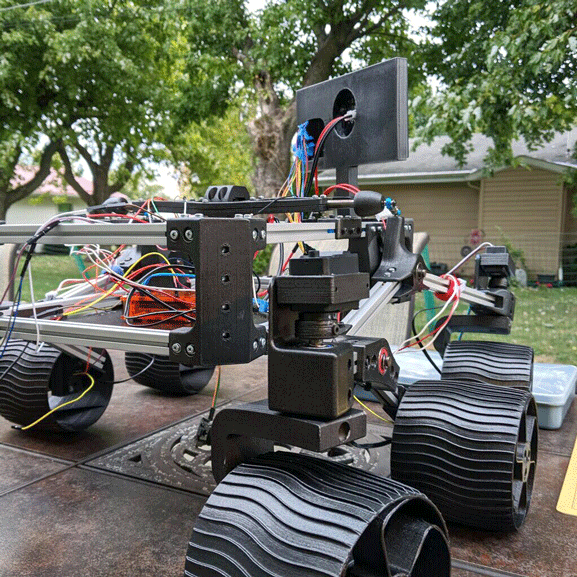
Through a process that Southern State Community College computer science professor Josh Montgomery describes as involving “hundreds of hours of work” on the part of students, including their “coming in early and on weekends and staying late after class," SSCC’s computer science program, under the direction of Montgomery, has recently added a new space-themed droid to its growing cache of student-fabricated technology projects – a one-quarter scale robotic replica of NASA’s Mars Curiosity Rover.
Students Mary Mundt and Jake Williams crafted the rover, commencing construction in May. They said it is made out of aluminum extrusion beams, steel and 3D printed parts.
“There are 10 servo motors that control the movement of the rover,” Mundt said. She also “designed a part to mount the, ‘face’ of the rover, which is an LED matrix panel.”
“I created an image to project different emotions such as angry, happy, etc.," Mundt said.
Mundt collaborated on the rover’s construction with Williams, who she said, “designed 3D prints, such as the base plate we use to hold our control board, fuse boxes and batteries.”
Montgomery said Williams, “had experience in some of the hardware” and “assisted in all aspects of the project."
Montgomery said the idea for the rover project emerged from a comment Mundt made to him at the end of last spring semester.
“I found an amazing project for one of your students-a 3D print of Mars Rover," he recalled her saying. He said that he replied, “Yes, that is an amazing project for YOU to build.”
Mundt then took on the project and said it was well-suited for her in that “I have always loved the environment, space and technology” and that to build the project perfectly, “encompassed those interests.”
“I happened to come across an open source Curiosity rover replica from NASA’s Jet Propulsion Laboratory," Mundt said. "This was a little too pricey for what we could do provided resources from the college, so when looking into alternatives, I came across a 3D printed version that cut costs by more than half.”
From there, Mundt said, the build began, and, “We decided to pursue the 3D print plans using open source resources provided by other robotics enthusiasts.”
“With the new 3D printers at SSCC, we felt this would be an amazing project to work on,” Montgomery said.
He said that the process of working on the rover, which he described as a “passion project," was not without its many challenges and obstacles. He described a scenario whereby, “they had to build a lathe to cut indents into metal for the wheels.”
“We don’t have a lathe," Montgomery said. "And it was difficult finding someone who could help us with that. So the students built their own lathe with some 3D parts, a drill and a dremel.”
Montgomery said the students’ constructive and adaptive response to these challenges, “showed me that these students had developed the critical thinking skills necessary to be successful in any endeavor.” He explained, “Overcoming obstacles as you 'fail up’ is a key skill all students need to master.”
Mundt echoed Montgomery’s sentiments about the project’s challenges, but emphasized that, “The process has been a great learning experience for me. I have learned skills such as soldering, wiring and how to create proper circuits. It has emboldened my interest in engineering.”
Mundt said that she is, “considering furthering my education and continuing in the field of STEM, and would love to potentially be a teacher in the future to share the same kind of advice and inspiration to others.” When asked what advice she would give to others interested in pursuing technology careers or education, Mundt replied, “Your job is always evolving as technology changes at a quick pace.”
Williams agreed that, “There have definitely been some speed bumps to overcome, but I couldn’t be happier with the progress we’ve made since I started working with Mary on the project this spring.”
"This project has had me researching everything from mass spectrometers and 3D modeling to how to cut steel and operate a lathe,” Williams said.
Mundt said that the rover is subject to continuing refinements and adjustments, and that, “We plan to continue to make improvements to the rover, and are excited about its future.”
“Ideally, we would like for the rover to be wireless via a Bluetooth receiver,” she said.
“I think we’ve had a new idea for something to add or improve on nearly every day since we started the project," Williams said, and it’s been really fun to find out what works and what doesn’t.”
The public had the opportunity to witness the rover replica in action at the Wilmington Public Library in Wilmington on Oct. 12, where it was accompanied by other projects, including a replica of the Star Wars character R2D2, built by Montgomery, and was also displayed for students in Chillicothe. Montgomery said it received a welcoming reception at the events.
“Everyone loves the little guy,” Montgomery said, “and we look forward to showing him off more as time goes on.”
Montgomery said that there are upcoming events being planned for the rover to be shown at Shawnee State University and Marion Technical College, with dates to be announced.
The Mars Curiosity Rover is one of a myriad of completed, ongoing and planned technology projects developed under the auspices of Montgomery’s Computer Science classes, which also includes a six-foot-tall “super computer,” which, according to Montgomery, is “composed of 320 small computers.”
"It is getting closer to completion," he said. When finished, “It will be doing some cluster computing for different research institutions."
Montgomery stressed the importance of helping to facilitate the realization of academic potential in the students with whom he works.
“I am blessed to be at SSCC where I get the opportunity to work with students…seeing a person take an idea…and reach and achieve that goal,” he said.
For more information about SSCC’s computer science program, call 1-800-628-7722 ext. 3678 or email jmontgomery@sscc.edu.
Freelance Writer
Through a process that Southern State Community College computer science professor Josh Montgomery describes as involving “hundreds of hours of work” on the part of students, including their “coming in early and on weekends and staying late after class," SSCC’s computer science program, under the direction of Montgomery, has recently added a new space-themed droid to its growing cache of student-fabricated technology projects – a one-quarter scale robotic replica of NASA’s Mars Curiosity Rover.
Students Mary Mundt and Jake Williams crafted the rover, commencing construction in May. They said it is made out of aluminum extrusion beams, steel and 3D printed parts.
“There are 10 servo motors that control the movement of the rover,” Mundt said. She also “designed a part to mount the, ‘face’ of the rover, which is an LED matrix panel.”
“I created an image to project different emotions such as angry, happy, etc.," Mundt said.
Mundt collaborated on the rover’s construction with Williams, who she said, “designed 3D prints, such as the base plate we use to hold our control board, fuse boxes and batteries.”
Montgomery said Williams, “had experience in some of the hardware” and “assisted in all aspects of the project."
Montgomery said the idea for the rover project emerged from a comment Mundt made to him at the end of last spring semester.
“I found an amazing project for one of your students-a 3D print of Mars Rover," he recalled her saying. He said that he replied, “Yes, that is an amazing project for YOU to build.”
Mundt then took on the project and said it was well-suited for her in that “I have always loved the environment, space and technology” and that to build the project perfectly, “encompassed those interests.”
“I happened to come across an open source Curiosity rover replica from NASA’s Jet Propulsion Laboratory," Mundt said. "This was a little too pricey for what we could do provided resources from the college, so when looking into alternatives, I came across a 3D printed version that cut costs by more than half.”
From there, Mundt said, the build began, and, “We decided to pursue the 3D print plans using open source resources provided by other robotics enthusiasts.”
“With the new 3D printers at SSCC, we felt this would be an amazing project to work on,” Montgomery said.
He said that the process of working on the rover, which he described as a “passion project," was not without its many challenges and obstacles. He described a scenario whereby, “they had to build a lathe to cut indents into metal for the wheels.”
“We don’t have a lathe," Montgomery said. "And it was difficult finding someone who could help us with that. So the students built their own lathe with some 3D parts, a drill and a dremel.”
Montgomery said the students’ constructive and adaptive response to these challenges, “showed me that these students had developed the critical thinking skills necessary to be successful in any endeavor.” He explained, “Overcoming obstacles as you 'fail up’ is a key skill all students need to master.”
Mundt echoed Montgomery’s sentiments about the project’s challenges, but emphasized that, “The process has been a great learning experience for me. I have learned skills such as soldering, wiring and how to create proper circuits. It has emboldened my interest in engineering.”
Mundt said that she is, “considering furthering my education and continuing in the field of STEM, and would love to potentially be a teacher in the future to share the same kind of advice and inspiration to others.” When asked what advice she would give to others interested in pursuing technology careers or education, Mundt replied, “Your job is always evolving as technology changes at a quick pace.”
Williams agreed that, “There have definitely been some speed bumps to overcome, but I couldn’t be happier with the progress we’ve made since I started working with Mary on the project this spring.”
"This project has had me researching everything from mass spectrometers and 3D modeling to how to cut steel and operate a lathe,” Williams said.
Mundt said that the rover is subject to continuing refinements and adjustments, and that, “We plan to continue to make improvements to the rover, and are excited about its future.”
“Ideally, we would like for the rover to be wireless via a Bluetooth receiver,” she said.
“I think we’ve had a new idea for something to add or improve on nearly every day since we started the project," Williams said, and it’s been really fun to find out what works and what doesn’t.”
The public had the opportunity to witness the rover replica in action at the Wilmington Public Library in Wilmington on Oct. 12, where it was accompanied by other projects, including a replica of the Star Wars character R2D2, built by Montgomery, and was also displayed for students in Chillicothe. Montgomery said it received a welcoming reception at the events.
“Everyone loves the little guy,” Montgomery said, “and we look forward to showing him off more as time goes on.”
Montgomery said that there are upcoming events being planned for the rover to be shown at Shawnee State University and Marion Technical College, with dates to be announced.
The Mars Curiosity Rover is one of a myriad of completed, ongoing and planned technology projects developed under the auspices of Montgomery’s Computer Science classes, which also includes a six-foot-tall “super computer,” which, according to Montgomery, is “composed of 320 small computers.”
"It is getting closer to completion," he said. When finished, “It will be doing some cluster computing for different research institutions."
Montgomery stressed the importance of helping to facilitate the realization of academic potential in the students with whom he works.
“I am blessed to be at SSCC where I get the opportunity to work with students…seeing a person take an idea…and reach and achieve that goal,” he said.
For more information about SSCC’s computer science program, call 1-800-628-7722 ext. 3678 or email jmontgomery@sscc.edu.