


President Gee visits SSCC, Leesburg farm WATCH THE VIDEO
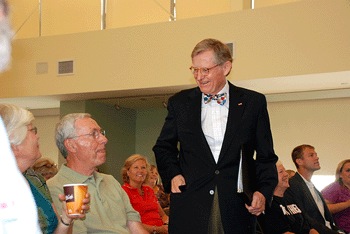
Making stops at Southern State Community College, the Fayette County Fair and a family farm in Highland County, The Ohio State University President Dr. E. Gordon Gee spoke to area residents Thursday regarding the work of OSU, its role in creating jobs for the state, as well as the importance of education and agriculture.
Gee told a group at SSCC's Fayette Campus that he feels that OSU is a "first-rate" institution, and that it is Ohio's future, because of its job creation and the job it does in education Ohio's students.
"When I came here, I had said, 'I never want to lose a good Ohioan to someone else.' And I have taken that on as the university's motto. We don't want anyone from Ohio to go to another place, whether it be for school or work, because what is going to fuel this state is no longer going to be our manufacturing base - it will still be important - our farming base, which is the most important economic issue that we have in this state. What is going to fuel this state is going to be ideas. And we have to have bright people who stay here, who create ideas, who create jobs."
Gee said OSU was the largest creator of jobs in Ohio, either directly or indirectly, and that if Ohio were a nation, it would have the 18th largest economy in the world. Ohioans, he said, need to realize that the competition was not only Michigan and Illinois and other surrounding states, but also in other countries like China, where OSU is establishing offices to assist Chinese students in their pursuits to attend OSU. Building partnerships is essential in building the future of the nation, and of Ohio and the university, he said.
"This community college right here is enormously important, in terms of our partner," Gee said. "Because if we don't have partnerships with community colleges and universities, we fail. And by the way, I believe this about community colleges. They are the single most important institutions in the country because they are people-centered, they are here in the community, they are the front road to the American dream ... and we need to support them."
Through partnerships such as OSU Extension and 4-H, Gee said, Ohioans have "a unique education opportunity."
Interspersing serious discussion on job creation and the future of Ohio, Gee delivered a few personal anecdotes, such as how he had spoken with OSU head football coach Jim Tressel the night before his visit to Southern Ohio.
"He gave me my Rose Bowl ring," Gee said, noting that it was his second Rose Bowl, as the university also won one in 1997. "And I didn't do a damn thing ... But if you see me after a game, I feel like I've played in the game. I say, 'That's my budget running up and down that field.'"
Later, when he visited the farm of Ken and Christa Davis off Careytown Road in Highland County, Gee had an opportunity to take to a field himself. But instead of a football field, it was a cornfield, as he was given a lesson on how to drive a tractor.
In introducing Gee to a group of area farmers, 4-H leaders, OSU Extension Educators and other local residents, Ken Davis discussed his concerns over the opinions that is commonly heard in discussions on agriculture.
"It seems like agriculture, in the various locations and the various sources," Davis said, "we seem to be under attack more and more, especially in the national media today, not so much locally. But I think we all get concerned about that from time to time. It seems there are things being said in the media that aren't true many times - most times. Things like, 'Well, we're getting too fat and that's because we're producing too much corn ... Or, 'People are starving, there's not enough corn to go around."
Davis acknowledged criticism farmers receive, from allegations animals are treated poorly, to their use of pesticides and hybrid plants, to growing food that is not organic.
"A lot of people have the feeling and want to tell us that corporate factory farming is the norm today in food production," Davis said. "Well, I'm here to tell you today that if being successful, or trying to be successful in agriculture and having the size of operation that is economically viable, if that's factory farming, then I guess I'm one."
In response to, what Davis said is common criticism against fertilizer and farm technologies, "Those that would say everybody needs to produce organic food, or everyone needs to produce a certain way, who are they to say who dies? We can't today produce enough food to feed the world without some of this technology."
Davis and his wife Christa presented him with a t-shirt that read, "I got my start in 4-H," and Gee said that when he was growing up in rural Utah, he indeed did get his start in a 4-H program.
"4-H was what I grew up with, as a matter of fact," Gee said. "I attribute much of the opportunity and and honors that I've had growing up in very small towns and small communities."
Gee said he agreed with what Davis said, and that through the education system at OSU, the research done at the university is able to be developed and dispersed through the Extension programs, and are then put to use by area farmers.
"We made a decision at Ohio State, we want to invest in the things that matter the most," Gee said. "And Extension is one of those programs that matters, undeniably, the most.