


Discover yourself in 4-H
By Kathy Bruynis
4-H Youth Development Educator
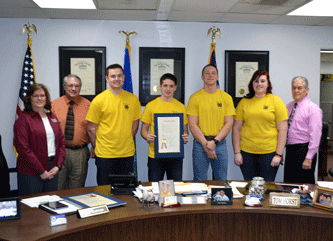
4-H Week is being celebrated in Highland County during the week of March 1-7. 4-H youth and volunteers will be actively informing the community about the 4-H program and how it benefits participants, families and their communities.
Now is the time to get involved and become part of one the largest youth organizations world-wide.
4-H prepares youth for success by providing them with the life skills such as: interview skills, time managements skills, teaching responsibilities, etc. In 2014, 840 youth ages 5-18 participated in traditional 4-H programs with the assistance 312 adult and youth volunteers.
For those who would like more information, to talk directly to advisors and 4-H members join us at the 4-H Club Round-Up on March 19 from 6:00 – 8:00 p.m.in the Wharton Building at the Highland County Fairgrounds.
We're hoping that anyone who is interested in learning more about our local 4-H program and the many opportunities it offers will contact the office, current 4-H advisors, or attend the 4-H Club Round Up. Now is the time of year when new 4-H clubs are enrolling for the 2015 year (deadline is April 1), and it is an excellent time for youth to begin their 4-H career.” added Bruynis.
For more information about the 4-H program and Ohio 4-H Week activities, please contact the Highland county OSU Extension office at (937) 393-1918 or email bruynis.5@osu.edu.
The fifth annual Ohio State University Extension/4-H Auction will be held on April 4, 2015 from 6:00 – 9:00 a.m. in the Poultry and Rabbit Building at the Highland County Fairgrounds. There will be a silent action followed by a live auction. 4-H clubs and local businesses will be donating wonderful items for this auction. Tickets can be purchased at the door.
During this time of testing in our area schools, the schools still have allowed youth to come into the buildings to talk about 4-H and its opportunities.
The following article from the February 26, 2015 Ohio Ag Manager will reinforce how 4-H has an impact on those test scores and with youth who are involved in 4-H.
Want Kids’ Test Scores to Improve? Try 4-H
When 4-H’ers across the county pledge their ‘heads to clearer thinking,’ they may not realize that recent research suggests this venerable yet adaptive youth development organization may be delivering much more than mental clarity.
A study using data collected over five academic years from Florida students in grades 3 through 10 reveals that standardized test scores in math and reading are higher in school districts, grades and years that saw more 4-H participation.
The research was conducted by Alfonso Flores-Lagunes of the State University of New York – Binghamton and Troy Timko of the University of Miami conducted the research, and appears online in at http://ajae.oxfordjournals.org/content/early/2014/08/01/ajae.aau060.abs…" American Journal of Agricultural Economics.
The magnitude of the effect of 4-H participation on test scores was similar to the effects seen from reducing class size and other well-known approaches to enhancing student test scores. Analysis of the data further suggests that the positive effect of 4-H on test scores accumulates over time, particularly for performance on math tests.
Known by its iconic four-leaf clover logo, 4-H is the largest youth development organization in the United States, with over six million young Americans participating in the various programs it offers, such as organized clubs, day camps, and school enrichment programs (the next largest is Boys & Girls Club of America, serving 4.8 million).
4-H has an uncanny geographical reach with a presence in every county and state in the United States, which is made possible through its partnership with universities within the Land Grant University System. 4-H traces its origins to 1902, when it provided a link between public school education and rural communities, and for this reason it is widely regarded as agriculturally-focused.
However, since the 1950s, it has spread into urban areas and its focus has shifted towards life skills development of youth. Indeed, Flores-Lagunes and Timko find evidence that 4-H appears to be more effective in district-grade-year combinations with a higher proportion of urban students and with a higher proportion of African American students, although the evidence is not fully conclusive.
Flores-Lagunes and Timko note that the standardized test results are particularly remarkable given that the 4-H program has not been designed with the purpose of improving test scores. They suggest test score improvements are most likely by-products of positive youth development and the programmatic focus on science, engineering and technology.
For example, improvements in test scores could result from increased student interest in academically related topics, improved general motivation for school, or more productive interaction with instructors.
The authors point out that, while their research focuses on standardized test scores, the program obviously only represents a partial effect of 4-H’s overall impact on participants. The ubiquitous nature of 4-H across the US means it has a large reach and can complement the efforts by teachers, schools, and communities to improve their schools in the face of the higher accountability brought about by federal and state pressures.
This synergy can provide valuable positive spillovers to schools and communities beyond the private benefits to participants in the program. Finally, they note that 4-H makes use of a vast pool of volunteers in the delivery of its programs in a cost-effective manner, which must also be appealing to school officials looking to stretch ever tightening budgets.
See: http://ohioagmanager.osu.edu/newsletters/march-2015/want-kids-test-scor…
[[In-content Ad]]