


Golf interruptus
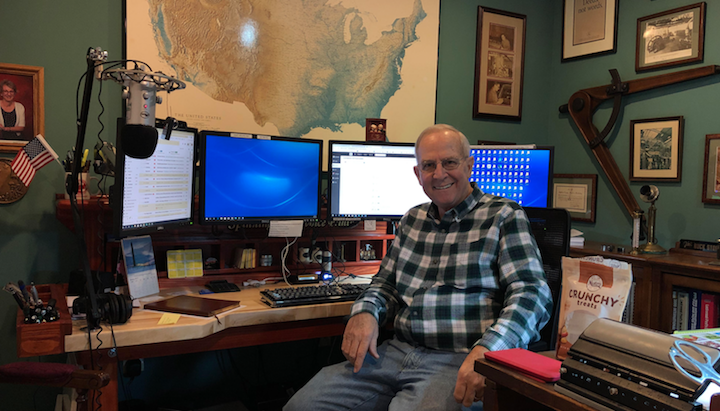
Jim Thompson
By Jim Thompson
HCP columnist
We had played golf that afternoon at Kingsmill Plantation Course at Williamsburg, Virginia. I was there for a conference.
At dinner that night, the couple that had been playing with me were seated with me. Very competitive golfers. In the middle of dinner, the wife asked me, “What did you do with the money your father gave you for golfing lessons?”
I was not a very good golfer, but that was an extremely rude question.
My response? “My Dad never gave me money for golf lessons; he thought golf was a waste of time.” I went off to bed, thinking about the keynote speech the next morning which was my job.
We were at the Kingsmill Resort in, again, Williamsburg, Va. The next morning, I got up, showered and so forth and went down to breakfast. My speech went well, I thought. After my speech, we took our first break.
Some of our crowd went out in the hall and soon came running back in. They had seen televisions in the hall and the first plane had hit the World Trade Center. It was September 11, 2001. At that point, the organizers decided to cancel the rest of the convention. Everyone scattered and headed for home.
I picked up a colleague who also lived in Atlanta. By now we knew that all planes were grounded. We both had rental cars we had rented in Richmond. We agreed to take his back, and I would drive us both back to Atlanta. I added, I am not going to ask the rental car people if I can take their car to Atlanta, I’ll beg forgiveness later (turns out that all the rental car companies forgave all the unauthorized rentals day).
I tried to call Laura all day, the phones never work, the lines were completely jammed.
We didn’t know what was going on in New York, Washington, nor anywhere else.
There was plenty going on, especially in New York:
Welles Crowther was 24 years old on the morning of September 11, 2001, working as an equities trader on the 104th floor of the South Tower of the World Trade Center. He wasn't a firefighter. He wasn't trained in evacuation procedures.
But according to survivor testimony gathered afterward, he moved with a level of calm and purpose that helped people who were otherwise frozen with panic actually start moving toward safety. Survivors described him leading groups down multiple flights, then going back up into the smoke and debris to search for more people – repeating this pattern several times. Some accounts describe him carrying an injured woman on his back down over a dozen flights of stairs.
Welles Crowther did not survive. His body was recovered from the wreckage in May 2002, nearly eight months later, found alongside firefighters near what had been the building's lobby, suggesting he was still actively helping others when the tower collapsed.
Another man walked through an office tower with a bullhorn, calmly singing old songs while thousands evacuated down stairwells around him. Nobody knew then that his voice – and a decade of unpopular decisions – would save their lives.
His name was Rick Rescorla. Before the suit and security badge, he was a soldier. Born in Cornwall, England, he carried a rifle through Vietnamese jungles as a young captain, standing shoulder-to-shoulder with the men under his command. The Battle of Ia Drang in 1965 left photographs of him—bayonet fixed, eyes steady—burned into the history of war itself. But Rescorla never forgot the real lesson from that jungle: survival belongs to those who prepare before the crisis comes.
By the 1990s, he'd swapped fatigues for an office. Morgan Stanley hired him as their security director, and he took one look at the South Tower of the World Trade Center – more than 20 floors of desks, phones, and human beings stacked toward the sky – and saw what nobody else wanted to acknowledge. This building is a target. Not maybe. When.
After the 1993 truck bombing in the garage killed six people, Rescorla had his answer. He made a choice that made him deeply unpopular: mandatory evacuation drills. No warning. No exceptions. For nearly a decade, thousands of employees found themselves pulled from their desks and walked down dozens of flights of stairs, over and over, until the path became muscle memory. Executives complained. Workers grumbled. Rescorla didn't flinch.
Then came September 11th.
When the first plane hit the North Tower, officials told everyone in the South Tower to stay at their desks. Standard protocol. Reasonable protocol. The kind of instruction designed for normal emergencies in buildings that stand alone.
But Rescorla had spent eight years studying this building, this risk, and this specific vulnerability. He'd trusted his judgment over scripts before, under fire, when the wrong call meant men didn't go home.
He trusted it now.
He grabbed his bullhorn and moved through Morgan Stanley's floors, calm and unhurried, singing as he walked – the same songs he'd sung to soldiers to steady their hands in the jungle decades earlier. People stopped panicking. They moved. They trusted him, the way soldiers trust officers who walk beside them into danger.
When witnesses later described him, they used the same word again and again: unafraid. Not reckless. Unafraid – which is something only earned through years of preparation.
Nearly 2,700 Morgan Stanley employees walked out of that building alive. Of everyone who worked on their floors, only a handful did not survive – most of them Rescorla's own security team, the men who stayed with him until the end.
Before going back inside, Rescorla called his wife, Susan. He told her he had to make sure everyone else got out first. He told her that whatever happened, being married to her had made his life complete.
Then he went back in.
He was last seen on the 10th floor, still searching for stragglers, still doing the job he'd spent a decade preparing for. The building came down with him inside.
Then there were the search dogs. The search dogs at Ground Zero were trained to find the living. The last survivor came out on September 12th. After that, roughly 300 dogs worked 12-hour shifts and found only the dead.
Handlers watched them stop searching. Veterinarians called it depression. So, rescuers pulled everyone off the pile, hid police officers in the rubble and told them to lie still like they were hurt.
Then they sent all the dogs in, and the dogs started barking. The dogs never found another survivor.
They kept working for nine months anyway using the procedure with live volunteers.
We were supposed to play golf that afternoon. It goes without saying, that never happened.
Some of this is personal experience, other parts pulled from sources deemed to be reliable.
Jim Thompson, formerly of Marshall, is a graduate of Hillsboro High School and the University of Cincinnati. He resides in Duluth, Ga. and is a columnist for The Highland County Press.
Golf of America
Jim, that was a good come back to the rude comment about your golf game.
I think I have the most boring "where I was during 9/11"story. The short version is I was up in the rails a tobacco barn. I was hanging (or housing, if you will) Burley tobacco to pay for community college that fall. Instead of the typical hour dinner break at noon, I think we spent an hour and half watching FOX News during dinner. Then we went out to the patch and cut more tobacco that afternoon. Then loaded up more wagons of tobacco that evening, to do the same thing the next day.
When I did get home on the night of the 11th, I was glued to the news and the dramatic footage, and the President's statement.
Since I was still under contract with the Individual Ready Reserves for the USMC, I was recalled to Active Duty for ten months in 2002. I was assigned to Ground Security Forces at the Marine Corps Recruit Depot in San Diego, California. Not exactly the frontlines, but that's what I did in the aftermath of the terrorist attacks.
As a side note, San Diego is the best overall city in the world. (Key West, FL- Charleston, SC - Natchez, MS - Pigeon Forge - Custer, SD - Fargo - Seward, AK are pretty good smaller cities)