


White-tailed deer in Ohio impacted by common deer disease
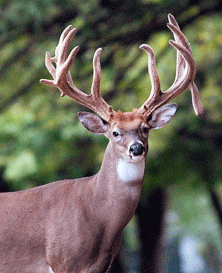
State wildlife and animal health officials have confirmed localized outbreaks of a common white-tailed deer disease in eight Ohio counties, including: Ashtabula, Columbiana, Geauga, Holmes, Paulding, Portage, Ross and Summit.
Ohio Department of Agriculture's Animal Disease Diagnostic Laboratory confirmed that of the 20 samples, 13 deer had epizootic hemorrhagic disease (EHD). State animal health officials stress EHD occurs annually in deer herds across North America. A similar hemorrhagic disease called bluetongue has been known to occur throughout the United States and Canada, but should not be confused with EHD. There are no cases of bluetongue disease confirmed in Ohio.
White-tailed deer contract EHD from the biting midges, which typically live near water. White-tailed deer, along with mule deer, elk, bighorn sheep and pronghorn antelope are susceptible to the disease.
[[In-content Ad]]
The disease is not spread from deer to deer or from deer to humans. Once infected, deer show symptoms within five to 10 days. Infected deer initially lose appetite and fear of man, grow progressively weaker, often salivate excessively and become unconscious. Many deer die within 36 hours of the onset of symptoms.
Midges can also spread EHD among cattle and sheep. These outbreaks may occur at the same time deer are being impacted. However, this is not a case of the disease spreading from deer to livestock or vice versa, but is an indication that the biting midges are present in large enough numbers to spread the disease.
State wildlife officials stress to those planning to hunt impacted areas this fall that although this disease does not affect humans nor impact the safety of consumed deer, hunters should report deer that appear to be sick or diseased to their local wildlife officer. Deer that appear unhealthy should never be taken for human food.
According to the University of Georgia's annual Southeastern Cooperative Wildlife Disease Study, EHD is the most common ailment affecting deer in the Eastern United States.
The disease is common in portions of the northern Great Plains and the southeastern United States, and was first identified in 1955 in New Jersey.