


Life on the inside: A look behind the walls of the Highland County Justice Center
Editor’s note: The Highland County Press extends its appreciation to Highland County Sheriff Ron Ward and Jail Administrator Chris Lengefeld for their cooperation and assistance on this story.
In order to help give taxpayers an up close and personal look at how their tax dollars are being managed, the Highland County Sheriff’s Office has opened its doors to allow area residents to take a look behind the walls of the Highland County Justice Center.
Beginning in May with a group of 15 Highland County residents, Jail Administrator Chris Lengefeld began taking tour groups of civilians through the jail, with the intent to educate taxpayers on how the Justice Center is run, and to change some perceptions on what life is like “on the inside.”
Lengefeld starts the tours by leading the group in “the way 99 percent of inmates enter the facility” in an area of the facility located on the opposite side of the structure from the main entrance. Cruisers and transport vehicles can pull directly in to a garage-like structure, where a door closes and locks behind them so people in custody can be safely brought in.
As the group made its way into the structure, Lengefeld explained the process inmates go through as they enter the jail. People entering the doors have to be buzzed in from the inside, and before a new door can open, the first door has to be locked behind those entering.
“No one has ever gotten out if we didn’t let them out,” Lengefeld said. “But they’ve tried.”
No firearms are permitted inside the jail area, so weapons are checked into lock boxes near the entrance.
The Highland County Justice Center opened its doors in October 2001 and cost $6.4 million, with $2.3 million in grants. The city of Hillsboro donated the land, and an additional $400,000 toward the construction.
According to Highland County Sheriff Ron Ward, “The county jail is one of the largest expenditures in my budget, and I have the single largest budget out of Highland County’s general fund. We want the taxpayers to know how their money is being spent, the efficient way we run the jail, and the safe way we run the jail.”
The jail has held as many as 94 inmates and had as few as 46, Lengefeld said.
When the holdings get crowded, mats are brought in to accommodate more people.
“We will not pay another county to house our people,” Lengefeld said.
Once inside the Justice Center, there are holding cells for detoxing, and a room to administer breathalyzer tests. Lengefeld explained that when initially brought in, prisoners can be experiencing various effects of drugs or alcohol, or withdrawal. Sometimes they can be violent and have to be restrained until they are under control.
Once inside the processing area, inmates are fingerprinted, mug shots are taken, and their personal information is put into the computer system. When processed in, all inmates are required to shower to control bugs and lice. The clothes, shoes and jewelry they came in are stored and inmates are given uniforms. The county provides all clothing items, from underwear to shoes.
[[In-content Ad]]
The uniforms are color-coded so jailers know at a glance what type of inmate they are handling: orange uniforms are for workers, black and white stripes for misdemeanor offenders, and red and white stripes for felony offenders.
Lengefeld said he charges inmates for as many privileges as he can, which helps ease the financial burden of the taxpayers. Inmates have to pay for phone cards for calls outside the facility, and for extra food items such as pop and cookies. But for every privilege item earned, Lengefeld said that it can be taken away. That can be a big motivator for good behavior.
“You get respect when you take someone’s Mountain Dew and cookies away from them,” Lengefeld said. “A jail community is a culture all its own.”
The average stay in the jail is 30 days, he said, although in some uncommon circumstances people have been incarcerated for more than a year. Approximately 57 percent are pre-trial detainees, while the other 43 percent have been found guilty of a crime and sentenced.
Inmates who have earned a degree of trust can work in different areas, from kitchen services, to laundry. They prepare food, wash clothes and bedding, and mend uniforms.
Lengefeld said that “the jail and its staff adheres to the rules and guidelines set by the Ohio Jail Minimum Standards. These standards outline most aspects of a correctional facility, from medical services to how much light is in a room.”
In addition to the fluorescent lights, there are skylights high overhead that let in natural light. In an interior area of the jail, inmates can have limited “outdoor” time, in a roofless room where they can spend up to three hours a week to get fresh air and exercise. The white interior walls appear to be cinderblock, but Lengefeld said they are thick and supported by rebar.
“I did have someone try to dig his way out of a wall once,” Lengefeld said. “When you’re put in a situation where you have nothing to do, you find ways to fill your time.”
The jail has a collection of items from some creative inmates who tried to keep their hands busy while serving their time. A glass case displays contraband items that were discovered in cells, such as a tattoo gun constructed out of wire and toilet paper tubes.
As the tour group made its way down the hall, Lengefeld began to prepare them for seeing the inmates. “You need to experience seeing another person behind glass,” Lengefeld told the group. As the tour group rounded a corner, there were floor to ceiling walls of glass, behind which stood the inmates. As the civilians walked by, some inmates came right up to the glass and stared, while others hid their faces or walked away.
Some people said it was unexpectedly disturbing to see other people behind glass, like a zoo, rather than the stereotypical bars that comprise cells.
Lengefeld said he remembered the first time he saw the inmates in the jail, and he could identify with what the members of the tour group were going through.
“It’s a really unnerving experience,” he said. “I could kind of sense it as we got closer to the inmates. People started dragging their feet a little. It is very uncomfortable to see another person like that. It kind of knocks your humanity down a little. It’s not degrading, by any means, but it maybe makes you want to leave.”
The holding arrangements, and who the inmates share a space with, are carefully thought out, as with all other aspects of how the facility is run. Lengefeld explained that people who have been charged with similar crimes seem to be housed more peaceably together. Violent offenders are housed with other violent offenders.
People charged with non-violent offenses, such as drug-related charges or thefts are together. People who are charged with sex-related crimes are together. Women are in an area by themselves. People who are on suicide watch, or have mental issues are housed together.
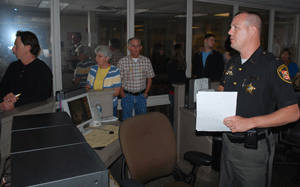
All of the separate units form a square, with the corrections officers’ “central control” area in the center. From that location they monitor the inmates, visually, and through the use of cameras and monitors. Through the use of dimmer lighting and tinted windows, once inside the central control area the inmates cannot see the guards, but they can always see the inmates.
Looking through the glass at the inmates, Lengefeld explained the opportunities they try to provide to the people they house. While recidivism is high, the facility offers educational training, drug and addiction counseling and mental health services, to help better their chances of success once they are on the outside again.
“We try to give them something so that when they leave here, they don’t come back again,” Lengefeld said.
Lengefeld said the facility will continue doing tours for as long as there is interest.