


Hillsboro City Council mulls more pay ordinance changes
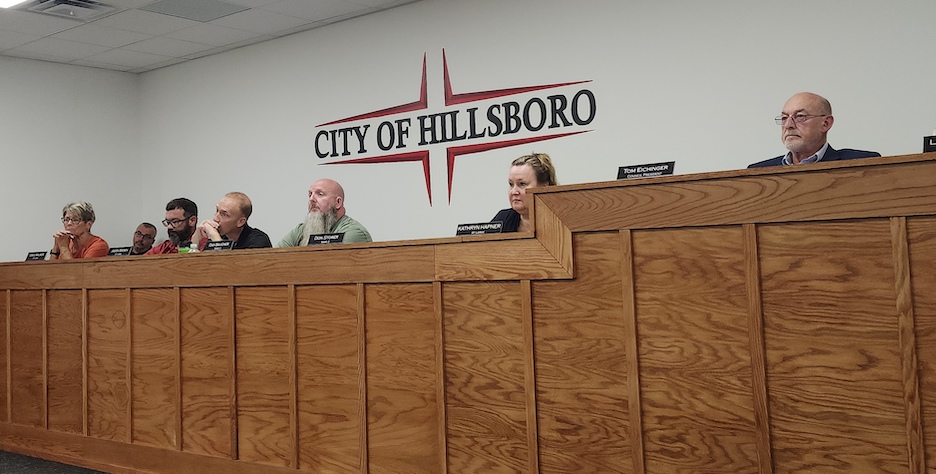
Pictured (l-r) are Hillsboro City Council member Mary Stanforth, Hillsboro Police Chief Eric Daniels and council members Greg Maurer, Jason Brown, Dan Baucher, Kathryn Hapner and Tom Eichinger. (HCP Photo/Caitlin Forsha)
For the fourth time since January 2024, Hillsboro City Council members are considering an update to the city’s pay ordinance, while a pay raise for the city auditor was introduced again after being rejected a year ago.
The lone standing committee report during council's Thursday, Sept. 11 meeting was given by finance committee chair Mary Stanforth, who reported on their Aug. 28 meeting “to further review the compensation study the city had done.
“The study compared the city’s current pay ranges to comparable markets,” Stanforth said. “According to the study, a good baseline is being within 90 percent to 110 percent of the market. The study also concluded that it would cost the city $22,279.05 to bring employees up to the minimum.
“Pay grades 7 and 8 were changed from hourly to salaried positions. These positions receive no overtime or comp time. The pay rates will take effect after January 1, 2026.”
As previously reported, after a nearly hourlong executive session, council members voted to revise the city’s pay ordinance in June. That pay ordinance revision added or revised several positions and their salary or wage ranges. The legislation was vetoed by Mayor Justin Harsha, but council overturned the mayoral veto at their August meeting.
An ordinance to adjust compensation for non-union city employees was introduced Thursday. Instead of listing each position with either a salary range or pay rate range, this version of the ordinance has a pay scale, for grades 1-8, and a breakdown of which positions fall under each grade.
Grade 1 positions include deputy clerk, custodian, administrative assistant II and meter reader. The minimum pay would be $20/hour, middle would be $24/hour and maximum would be $28/hour.
Grade 2 positions are code enforcement official, paralegal, equipment operator, parks and recreation laborer, public works laborer, administrative assistant II/building department and utility office clerk. The minimum pay would be $21/hour, middle would be $25.20/hour and maximum would be $29.40/hour.
Grade 3 positions are administrative assistant for the police department, deputy tax administrator and deputy auditor I. The minimum pay would be $22.47/hour, middle would be $26.96/hour and maximum would be $31.46/hour.
Grade 4 positions are public works crew leader, clerk of court/bailiff, administrative assistant I, wastewater treatment plant operator, water treatment plant operator I, director of victims’ rights/paralegal, deputy auditor HR/office manager and utility office manager. The minimum pay would be $24.49/hour, middle would be $29.39/hour and maximum would be $34.29/hour.
Grade 5 positions are economic development coordinator/grant writer, systems administrator and wastewater treatment plant operator II. The minimum pay would be $26.94/hour, middle would be $32.33/hour and maximum would be $37.72/hour.
Grade 6 positions are the assistant prosecuting attorney, assistant law director and tax administrator. The minimum pay would be $29.64/hour, middle would be $35.56/hour and maximum would be $41.49/hour.
Grade 7 positions are the parks and recreation director, wastewater treatment plant superintendent and water treatment plant superintendent. Their minimum salary would be $67,808, middle would be $81,369.60 and maximum would be $94,931.20.
Grade 8 positions are the chief of police, public works superintendent and safety and service director. Their minimum salary would be $75,275.20, middle would be $90,313.60 and maximum would be $105,372.80. The police chief also receives a stipend for serving as systems administrator, ranging from $28,019.19 to $39,226.87.
Council member Jason Brown asked if council could receive more information on the municipalities surveyed during the wage study.
“Depending on who it was, if you only got four or five [responses], I mean, the wages could be real high, or they could be real low, compared to what Hillsboro should be able to pay,” Brown said.
Brown also pointed out that for 18 of the 31 positions listed in the ordinance, the city is “already paying over the maximum amount allowed, or at least the maximum amount that's in the ordinance.
“I’m guessing that's because of the way it's set up with that everybody that's maxed out continues to get a three-percent pay raise every year,” Brown said.
“They do,” Stanforth said. “If they’re maxed out, they get the three percent.”
The proposed ordinance says “All employees receiving compensation that exceeds the pay range set forth in this Ordinance, as previously approved prior to the passage of this Ordinance, shall continue to receive such compensation without a reduction in compensation, and will be given a three-percent cost of living increase based on merit and the amount of funds available.”
Brown suggested that instead, the city should look at doing “a one-time three-percent bonus every year.
“That way, it would kind of prevent inflation from just continuing to baseline more and more and more over the max,” he said. “We've got some people that are making quite a bit over what the max is supposed to be.”
“That’s a thought,” Stanforth said.
Brown said that if someone was making $100,000 a year, the cost-of-living raises would “cost the city $43,000 in four years.” Council member Kathryn Hapner pointed out that “it would actually be more” because the three-percent raise would continue to be applied to the elevated salary each year, not on the base $100,000.
“It would save the city,” Brown said. “I mean, it wouldn't be as nice for the employees, probably, but I think that's the whole point of the cap is so that they're at a cap.
“I would like to see that changed.”
Stanforth said she wanted council to have time “to dissect this” over the next three months instead of passing it as an emergency on its first reading.
The second pay-related item on the agenda was a proposed ordinance to adjust the salary of the city auditor.
“According to the ORC, the only elected official eligible for a raise during their current tenure is the auditor,” Stanforth said. “The auditor’s salary, according to the survey results, show that it is at 78.86 percent, which puts it below the baseline of 90 percent.”
If enacted, this ordinance would raise the city auditor’s salary to $64,240.66 starting in 2026.
After a year of off-and-on discussion, a proposed ordinance to adjust the salary of the city auditor was voted down by Hillsboro City Council in August 2024. The legislation had been in limbo since being introduced and subsequently tabled in August 2023.
The original version of the ordinance, in 2023, had proposed raising the auditor’s salary to $70,000. The amended version in 2024, which was ultimately rejected by council, would have made the salary $63,000.
Council previously voted in July 2022 to increase the city auditor’s salary through an emergency ordinance. At that time, the city auditor’s salary had not been increased since 2008. The 2022 ordinance set the position’s annual salary at $57,500, effective immediately — up from its previous rate of $45,000 per year.
In other legislation, council approved an ordinance making supplemental appropriations in the amount of $700,000 for park-related improvements. In response to a question from Brown, soon-to-be safety and service director and current public works superintendent Shawn Adkins said that it includes work on the Rails to Trails construction, mower purchases and Shaffer Park electrical upgrades.
An ordinance amending section 39.35 of the codified ordinances of the City of Hillsboro pertaining to the disposition of human remains had its first reading.
The current ordinance states, in part: “The City Auditor, upon information supplied upon a form devised by the Auditor's office for that purpose that an indigent resident of the county was found deceased within the corporation limits of the city, shall immediately inquire of the funeral homes in the southwest Ohio area as to the cost and availability of services to make disposition of human remains; and shall provide up to $750 toward the entire cost of the disposition, determining the lowest responsive, responsible proposal, as in the Auditor's opinion best serves the needs of the city.”
The proposed revision would change the phrase “shall provide up to $750 toward the entire cost of the disposition” to read “shall provide an amount of funds deemed appropriate by the Auditor toward the entire cost of the disposition.” The new ordinance also adds: “In the event the Ohio Board of Embalmers and Funeral Directors are operating the Indigent Burial and Cremation Support Program, the allowable expense shall be increased to the maximum reimbursement amount set forth by the State of Ohio Board of Embalmers and Funeral Directors.”
“This is to repeal the set amount of $750 that we pay now,” Adkins said. “The state's reimbursement exceeds that amount, but I’d also like to have it so that if the auditor gets to choose or put out for bids, more or less, on the indigent burials. He would pick the cheapest one, not to exceed the $1,000, and the $1,000 is a first-come, first-serve, so when they are out of money, we still have to pay to have them buried.”
In response to a question from Hapner, Adkins clarified that “indigent burial’s what it’s called, but it’s cremation” that takes place.
Council had two time-sensitive pieces of legislation on their agenda being presented as an emergency, but no action was taken due to not having enough members to suspend the three-reading rule. Council president Tom Eichinger said a special meeting may need to be called in order to take action on the legislation, which includes a resolution certifying nuisance abatement invoices to the Highland County auditor for placement on the Highland County tax duplicate and a resolution certifying delinquent water and sewer bills to the county auditor for placement on the county tax duplicate.
In other discussion:
• Adkins gave the safety and service director’s report, which primarily focused on city construction projects.
According to Adkins, construction on Crossroads Park will begin in the coming weeks, with Rails to Trails construction starting later.
As previously reported, the city received a $5,204,536 Appalachian Community Grant to supplement already earmarked grant funding for Crossroads Park (formerly known as the green space on West Main Street), as well as a $1.44 million Transportation Alternatives Program (TAP) grant from the Ohio Department of Transportation for a walking and bicycling trail on an abandoned railroad bed (the Rails to Trails project).
In other projects, Adkins said they are down to a “punch list” for the Beech and Railroad Street reconstruction project; a new parking lot for the uptown area is under construction on North High Street; and paving of Harry Sauner Road is also slated to begin by the end of the month. According to Adkins, the Rails to Trails work will begin after the parking lot construction is complete.
Adkins also reported that the city issued 34 building permits, including nine commercial and 25 residential, in August, while the Hillsboro Planning Commission “approved one variance granted and one replat” at their most recent meeting.
• At Adkins’ request, Eichinger placed three ordinances related to water rates in the utilities committee for further review. During the finance committee report, it was also noted that Adkins wanted to “meet with the law director to make the necessary changes” to a 1995 ordinance regarding the Office of Victims Services.
• At the start of the meeting, council voted 5-0 to excuse the absences of council members Don Storer and Adam Wilkin. Although their attendance is not required, Mayor Harsha and Auditor Dawson Barreras, along with Safety and Service Director Brianne Abbott (on her penultimate day in office), were also absent.
• During citizens’ comments, council heard from one resident, Keith Sonner, who spoke out against the city’s code enforcement officer. According to Sonner, the officer is “writing papers and putting them on people's doors” for having campers on their properties. In at least one such instance, Sonner said the officer said there would be a “$100 fine if [the camper is] not gone in three days and a misdemeanor” charge.
Sonner said that he had an issue with the officer writing citations without speaking to the property owners first.
“Tell him to talk to people, to find out what’s going on, before he starts doing this,” Sonner said.
• Under communications, it was noted that the city received a letter from a Hillsboro business owner with concerns about the city’s policy for replacing water meters. No action was taken. They also received a notice of a liquor permit application for the new Aldi under construction on Harry Sauner Road, with council voicing no objections.
For more from Thursday's meeting, see the story at https://highlandcountypress.com/news/hillsboro-city-council-oks-appoint….
Publisher's note: A free press is critical to having well-informed voters and citizens. While some news organizations opt for paid websites or costly paywalls, The Highland County Press has maintained a free newspaper and website for the last 26 years for our community. If you would like to contribute to this service, it would be greatly appreciated. Donations may be made to: The Highland County Press, P.O. Box 849, Hillsboro, Ohio 45133. Please include "for website" on the memo line.