


'High Hopes'
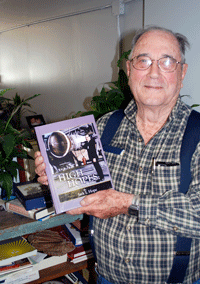
For the past eight decades, Jack I. Hope has had his eyes turned toward the sky, and his heart set on filling two lifelong goals.
The Highland County native’s history, and story are told in his new autobiography “High Hopes: The Adventures of an Engineer.” Copies are available at The Highland County Press and a book signing will be held June 27 at the Hillsboro Library.
“I’ll turn 84 next month,” Hope said. “I’ve been working on this for about three or four years, and my editor said it’s really three books in one. From the time I grew up, I have had two goals in life. One: I wanted to live in my hometown area. I used to go to reunions in Fort Hill, and I would walk the hills and say, ‘I’m going to have a farm down there.’ And now I do. I have hills and I have runways, but no airplane.
“My second goal was to work in aviation,” Hope said. “And I did. I went on to be an aeronautical engineer.”
Hope grew up building model airplanes, and when he was 14 years old, he began flying airplanes.
“When I was in high school, I’d take kids out in the plane, and we’d go buzz the high school and fly it between the chimney stacks and the building of Belleville High School.”
Although he was flying a plane before he was driving a car, his aspirations of being a professional pilot were altered when instructors realized that he was colorblind.
“I applied to be a Naval aviator, and they took me to Detroit for the exams,” Hope said. “Fifteen minutes into the exam, they found out I was colorblind and pulled me out. I argued with them when they said I couldn’t be a pilot. So I became an engineer instead.”
The 593-page book chronicles his life, and his family’s history, as well as the decades he spent working across the U.S., from Washington, D.C. to California, moving from being a flight test engineer at GE to managing engine development. A group he worked with designed and built the engine portion of the first aircraft nuclear power plant for testing at the U.S. government’s Idaho test facility. He also worked on the development of subsonic and supersonic aircraft and was later involved in NASA flight tests of hypersonic aircraft.
“Whenever I collected a paycheck, I didn’t think of it in dollars. I thought of it in acres, because I was always looking to my property in my home county,” Hope said. “When I got paid, I’d say, ‘Well, that’s 1.6 acres.’”
The third portion of the book tells this story of his attempts at “revitalizing my hometown area.
“I think when a lot of people hear my name they think ‘Parker House,’” said Hope, who owns the historic Parker Hotel on West Main Street in uptown Hillsboro. “But that is a very small part of what I’ve done with my life. But this is my home.
The editor of the book is Adams County resident Carol Cartaino.
“I’m not a glamorous writer. When I write, I write technical, from the perspective of an engineer, with numbers and a lot of detail. Carol was always saying, ‘People don’t want to hear that detail. Where’s the juicy stuff?’ I don’t know if it’s juicy, but I tried to learn to write more glamorous,” Hope said.
According to the book’s cover description, in the last half century there have been multiple advancements in the fields of transportation and communication.
“This book traces the life of one individual, Jack I. Hope, who was deeply involved in the development of such products during the last half of the 20th Century.
"It follows his activities from childhood through his formal education and practical work experience to his involvement in major technical programs for national and international companies and government. These developments include advanced aircraft engines, nuclear aircraft engines, advanced military engines, technology support for the White House, and management of an international joint venture to develop and produce a new commercial aircraft engine.
"Hope’s love for airplanes and what makes them work, and his knack as an idea man and developer led him into a life of aeronautical engineering, which led him to rub elbows with the famous and be privy to some of the greatest minds in history.”