


Conference addresses collaborative efforts in drug treatment
Lead Summary
By
Brandy Chandler-brandychandler@gmail.com
It takes a community to transition an offender with a drug abuse problem into being a productive member of society, according to local treatment experts. Drug treatment, counseling and job training are essential tools in make sure offenders are less likely to relapse into drug abuse, or reoffending in crimes. State and local agencies met Friday to discuss how their collaboration could help create a transition that addresses the problem, and how they can remove obstacles that would help create a stronger community.
Members of the justice system in Highland County, treatment and training facilities, and private employers met Friday at Southern State Community College in Hillsboro for a conference that examined the process of reentry, from all perspectives.
The conference was a collaborative effort by FRS Counseling, Highland County Office of Reentry Services, and Turning Point Applied Learning Center.
The conference is supported in part through a grant from the Health Foundation of Greater Cincinnati. FRS is the fiscal agency for the grant.
Beginning at 9 a.m., the group was able to discuss and share their ideas and perspectives, from the counselors who try to help offenders and addicts get treatment and back on their feet, to the business leaders who would consider employing them.
"There has been a wonderful response from the different sectors," said Jill Wilson of FRS Counseling. "From people who provide treatment, criminal justice, employers, and even some students have stopped by. The conference has definitely had its intended effect. It has been a very good day."
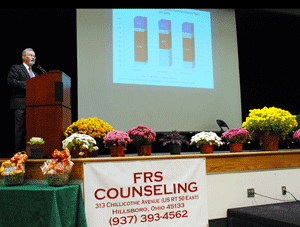
One of the keynote speakers for the conference was Orman Hall, director of Ohio Department of Alcohol and Drug Addiction Services.
Hall spoke about the addressing "Ohio's opiate epidemic." He said that opiates, or prescription drugs, have become by far the most prominent "drug of choice" in Ohio, in particular in the southern counties.
Between 2000 and 2008, opiate drug overdoses in Ohio have increased by 300 percent, according to statistics Hall provided.
"More people now die of overdoses than traffic accidents," he said.
Opiate distribution in general has increased since 1997 by nine times. If opiate dose distribution were spread across all of Ohio's population, Hall said, that in 1997 each person across the state received seven doses. In 2010 it increased to 67 doses. In Scioto County, where he noted that the opiate abuse problem has reached an epidemic level, it is 123 doses.
Hall said that this year he has begun advocating medicated treatment for drug abuse, which can be a controversial opinion.
Hall said 50 percent of opiate abusers self-terminate treatment.
"Without medicated-assisted treatment, 90 percent will relapse," he said. "That's a very disturbing statistic when you realize the likelihood of death."
Hall briefly discussed the medications methadone, suboxone, and vivitrol in treatment. Hall said that he has found methadone "morally questionable," and that many people considered it "a replacement drug." However, "If it were the only option we had available, considering what we know (about relapse and death) I would have no qualms about using it. Some people may have so profoundly changed their brain chemistry through drug abuse, it may be the only treatment."
Because medicated treatment can be expensive - around $800 a month and up - funding can be difficult, he said.
The Ohio Department of Alcohol and Drug Addiction Services does not have a medication funding line item, which is something that is being worked on, Hall said.
For people who don't have insurance, "the availability is not great. We need to work on it. For those who have been in jail, that is perhaps their greatest need," due to the increased likelihood of overdose.
When a person has built up a tolerance to opiates and then is off drugs for 30 days or more - while incarcerated, for instances - Hall said that they still have the "need" but that their tolerance "drops to baseline" which means they are likely to overdose when when released.
Joe Adray, executive director of FRS, concluded the day by saying that it was more than $1,000 per month to incarcerate a person in local jails, while medicated treatment was approximately $800.
"We need to think about what the human toll is," Adray said. "None of us have enough dollars to throw at it. But together, maybe we can come up with solutions."
It takes a community to transition an offender with a drug abuse problem into being a productive member of society, according to local treatment experts. Drug treatment, counseling and job training are essential tools in make sure offenders are less likely to relapse into drug abuse, or reoffending in crimes. State and local agencies met Friday to discuss how their collaboration could help create a transition that addresses the problem, and how they can remove obstacles that would help create a stronger community.
Members of the justice system in Highland County, treatment and training facilities, and private employers met Friday at Southern State Community College in Hillsboro for a conference that examined the process of reentry, from all perspectives.
The conference was a collaborative effort by FRS Counseling, Highland County Office of Reentry Services, and Turning Point Applied Learning Center.
The conference is supported in part through a grant from the Health Foundation of Greater Cincinnati. FRS is the fiscal agency for the grant.
Beginning at 9 a.m., the group was able to discuss and share their ideas and perspectives, from the counselors who try to help offenders and addicts get treatment and back on their feet, to the business leaders who would consider employing them.
"There has been a wonderful response from the different sectors," said Jill Wilson of FRS Counseling. "From people who provide treatment, criminal justice, employers, and even some students have stopped by. The conference has definitely had its intended effect. It has been a very good day."
One of the keynote speakers for the conference was Orman Hall, director of Ohio Department of Alcohol and Drug Addiction Services.
Hall spoke about the addressing "Ohio's opiate epidemic." He said that opiates, or prescription drugs, have become by far the most prominent "drug of choice" in Ohio, in particular in the southern counties.
Between 2000 and 2008, opiate drug overdoses in Ohio have increased by 300 percent, according to statistics Hall provided.
"More people now die of overdoses than traffic accidents," he said.
Opiate distribution in general has increased since 1997 by nine times. If opiate dose distribution were spread across all of Ohio's population, Hall said, that in 1997 each person across the state received seven doses. In 2010 it increased to 67 doses. In Scioto County, where he noted that the opiate abuse problem has reached an epidemic level, it is 123 doses.
Hall said that this year he has begun advocating medicated treatment for drug abuse, which can be a controversial opinion.
Hall said 50 percent of opiate abusers self-terminate treatment.
"Without medicated-assisted treatment, 90 percent will relapse," he said. "That's a very disturbing statistic when you realize the likelihood of death."
Hall briefly discussed the medications methadone, suboxone, and vivitrol in treatment. Hall said that he has found methadone "morally questionable," and that many people considered it "a replacement drug." However, "If it were the only option we had available, considering what we know (about relapse and death) I would have no qualms about using it. Some people may have so profoundly changed their brain chemistry through drug abuse, it may be the only treatment."
Because medicated treatment can be expensive - around $800 a month and up - funding can be difficult, he said.
The Ohio Department of Alcohol and Drug Addiction Services does not have a medication funding line item, which is something that is being worked on, Hall said.
For people who don't have insurance, "the availability is not great. We need to work on it. For those who have been in jail, that is perhaps their greatest need," due to the increased likelihood of overdose.
When a person has built up a tolerance to opiates and then is off drugs for 30 days or more - while incarcerated, for instances - Hall said that they still have the "need" but that their tolerance "drops to baseline" which means they are likely to overdose when when released.
Joe Adray, executive director of FRS, concluded the day by saying that it was more than $1,000 per month to incarcerate a person in local jails, while medicated treatment was approximately $800.
"We need to think about what the human toll is," Adray said. "None of us have enough dollars to throw at it. But together, maybe we can come up with solutions."