


Company B's bond stronger than ever
By Sam Stockard
The Daily News Journal
Murfreesboro, Tenn.
www.dnj.com
MURFREESBORO, Tenn. — These Vietnam veterans aren’t fazed by their longtime portrayal in movies and media as drug-addled lunatics.
“We’re the 3rd Platoon, the bad boys of the company,” says Jesse Duron, nicknamed Mad Max.
“We trained Rambo!” claims squad leader Jim Fort, bringing a roar of approval from his buddies as they knock back a few beers, look at old photos and tell real war stories during a recent reunion of B Company, 2/8 Infantry of the 4th Infantry Division, also called the Panthers.
Murfreesboro’s Andy Womack, a State Farm agent, former state senator and Vietnam veteran, persuaded the company to hold its annual get-together this year in Murfreesboro.
They’ve been reuniting since 1985, and about 30 of them from across the country stationed at Baymont Inn off Old Fort Parkway for the week before taking tours of Murfreesboro and Nashville historic sites, playing golf and renewing the friendships that started when they were just out of high school and went headlong into a hostile environment.
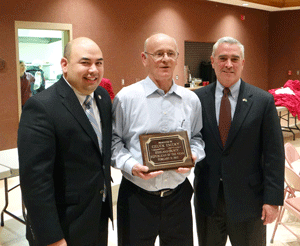
• Highland County native and Vietnam War veteran Charles "Chuck" Emery was part of Company B's Tennessee reunion.
"It was good to see everyone," Emery told The Highland County Press this week. "We may start trying to get together every year, as we're all getting older."
Emery, from the Sugar Tree Ridge community, serves on the Festival of the Bells Committee, is a past president of the Supplemental Assistance to the Handicapped Board of Trustees, and was honored earlier this year by the local GOP as the 2013 Highland County Republican of the Year.
Emery said the reunion brought back many memories.
The ironic thing, Emery said, was that he was reunited with his fellow soldiers through his volunteer work at last year's Great Ohio Bicycle Adventure in Hillsboro.
"I was working the information booth, wearing my 4th Division ball cap, and this guy remarks: 'B Company?'
"How did you know?" I asked.
"I was there," he said.
It turned out to be 3rd Platoon leader Lt. John Schafer from northern Ohio.
"That's how they got my name (for the reunion)," Emery said. "I had a great time."
Serving together between 1967-68 and 1968-69, this group was part of the American and South Vietnamese forces that warded off the North Vietnamese and Viet Cong Tet Offensive when it broke out Jan. 31, 1968.
Their black hats emblazoned with B Company patches say Pleiku, but they were rarely there because they were in the field, patrolling the central highlands near the Cambodian and Laotian border trying to stop the enemy’s supply lines.
[[In-content Ad]]
In 365 days alone, Company B was involved in up to 94 incidents of sniper fire, ambushes or land mines. In 1968-69, it lost 31 of 110 men, and 52 were wounded. During Tet, they were near the Dak To Province.
For most, the only thing keeping them going was a picture of a girl from back home.
“I had a gal, it was her picture in the helmet,” remembers Steve Wittenberg of New York, the lieutenant’s radio man. “That was good for me. I didn’t end up marrying her, but it was good for me over there.”
Mike Hughes of Cleveland, Ohio, says the same thing motivated him.
“I had a young lady that I got engaged to, got married to and am still married to, to this day,” Hughes says, from under a bushy mustache. “At that time, once you got there, you just really wanted to get home.”
First Platoon leader Lt. John Starkey echoes the sentiment.
“When you got in-country, and it’s really everybody from all over the place, you have one goal in mind, and that’s going home,” he explains. “So you form those bonds, and ... they’re still there 40-odd years later. And it’s everybody’s desire to make it out of there, so everybody’s pulling together, working together, doing the work.”
Friends under fire
The men tell stories of starting with 15 in the 3rd platoon and a year later returning with only four of the original group. Other tales are lighter, including the time a herd of baboons in a dry river bed got after them.
“They didn’t have no rifles or nothing, and we were running like hell,” says Duron, laughing as Doc Kirscher, a medic, tells the story.
Starkey, who grew up in Lawrenceburg and attended Middle Tennessee State University before going to Vietnam, recalls his first day in the field. He and 3rd Platoon leader Lt. John Schafer flew in together on choppers in an air assault into the mountains. Their landing zone was a rice paddy and they were dropped 15 feet into four feet of water filled with paddy leaches. “I thought, ‘This isn’t good.’ You’d work your way about 20 yards to the edge and climb out, first day.”
During the rainy season, in fact, they never dried out. “It was a major operation just to light a cigarette,” says George Hoss of Chicago.
They would go from a foot of mud to a foot of dust during the dry season.
Care packages from home were among their best moments, when they could receive underwear, socks, even chocolate chip cookies individually wrapped. The New York guys often got salami or pepperoni in the mail. They usually shared with each other.
Gary Henry, a farmer from Stockton, Calif., points out that they all suffer from post-traumatic stress.
“This helps relieve that,” Henry says of the reunions. “We had a lot of bad times, but we had a lot of good times, too. Most spent 10 months together, some longer, maximum a year, but the bond we developed in that time is something that will never be forgotten. All the deaths you had, people that died ...”
Womack acknowledges it took him years to talk publicly about the war.
“I think the reunions have helped all of us because it gave us somebody to talk to who understood what we were talking about,” Womack says. “Then once we could get it out in the open again, it was easier to talk to other people.”
Most of them faced a misunderstanding public when they arrived home in the late ’60s amid an unpopular war.
Starkey says his brother kept him up until 4 in the morning asking him why he killed women and children. He ignored him, but adds if they had to go to war again they’d all stick together.
“The bonds you form over there are lasting forever, and unless you’re there or experienced it, you don’t really understand it,” Starkey says.
“When we came back, they were spitting in people’s faces and everything, but we weren’t the problem, it was the politicians; but we were the obvious target, so we bore the brunt of it.”
In contrast, this week, people have bought the men meals at local restaurants, and Indian Hills Golf Course refused to let them pay for playing nine holes.
Still sorting it out
Despite heavy casualties inflicted on communist forces during the Tet Offensive, the event was a turning point in the war as President Lyndon Johnson decided to draw down U.S. troops. Shortly after that, he decided not to run for re-election.
In December 1969, President Richard Nixon announced a plan to conclude the war. The next April, though, he expanded it by ordering troops into Cambodia, leading to widespread protests in America and in the tragic student deaths at Kent State. Following the Paris Peace Accords of January 1973, U.S. forces completely withdrew, and in 1975 Saigon fell to the communists.
Wittenberg points out that after he and his buddies came home in 1968 and 1969, they watched the end of the war on television. “We all figured, least ways I did, well, there’s 58,000 guys dead in a 10-year war. They had to have learned their lesson. They’ll never do this again.”
Yet the nation locked into war in Iraq for 10 years and Afghanistan for 12 years, he notes.
“We need to just get one philosophy where we either do it, get our asses kicked or kick ass and finish the job,” he says. “But it’s very painful to know that we’re almost in the same situation ... and the American public has totally forgotten there are guys gearing up every morning with Kevlar helmets, the same stuff we wore, and going to work.”
And while the American people are shocked and saddened by events such as the Newtown, Conn., school shooting and Boston Marathon bombing, which are tragic events, he points out, they tend to forget about the troops in Afghanistan.
“I thought, My God, we’ll never see this again,” Wittenberg says. “Now, we’re all 65, and we’re watching it transpire again.”
The enemies’ goal was no less than to kill them, the same as it is today for soldiers in Afghanistan, Starkey says, pointing out U.S. troops face the same weapons they did: AK-47s, rocket-propelled grenades and improvised explosive devices, which they called land mines 45 years ago.
But as Starkey notes, the Vietnam generation’s children are fighting today’s wars, and he and his buddies are trying to make sure, this time, the country doesn’t wait half a century to give their due.