


Collins addresses TEA Party
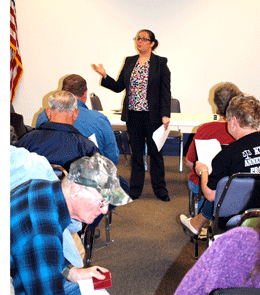
Highland County Prosecutor Anneka Collins addressed the Highland County TEA (Taxed Enough Already) Party Monday, and answered questions regarding the function and duties of the prosecutor's office.
Collins addressed the group as a featured presentation following their monthly meeting at the Hi-TEC building.
She was appointed to the office in June 2011 by the Highland County Republican Central Committee following the retirement of former prosecutor Jim Grandey. Collins will face Independent candidate Kim McGuire-Haines in the November general election.
The TEA Party had asked Collins to speak regarding the responsibilities of the office, and how certain procedures are handled.
Collins said that the question she receives most involves how her office arrives at plea agreements in criminal prosecutions.
A plea agreement allows a defendant "to plead to something less than the charged offense," Collins said. "The defendant always has the right to plead to the indictment and argue sentencing."
Some crimes are "allied offenses" or fall under a "merger," Collins said, with the example that if a person is charged with trafficking in drugs they can also be charged with possession, but can only be sentenced on one of those charges.
"If you read in the paper that someone entered into a plea deal, but four counts of possession were dismissed, they may think they got a great deal, but they wouldn't have been sentenced on those charges anyway," she said.
Before any plea is entered, "when there is a victim, the victim is always consulted. That is how we always do it in my office."
Plea agreements are a necessity in the court system, she said, because in addition to the financial savings, a prosecutor has some degree of control and can recommend how much prison time the judge imposes. Once it goes to a jury of 12 people, there is not a guarantee of a conviction, or sentencing.
House Bill 86, which instated the Ohio Legislature's new sentencing guidelines, went into effect in 2011. Collins said HB 86 "takes sentencing out of judges' hands and puts it in the hands of bureaucrats."
As she explained that some crimes under HB 86 do not qualify for prison time, unless an offender has a prior criminal record, some people asked if there was anything they could do about it. Collins encouraged them to write to their state legislators.
When questioned on the intent of HB 86, Collins said it was to save funds in Ohio's prison system by having fewer people sentenced to time behind bars.
"I think they need to open another prison, not just let people out," Collins said.
However, while defendants may be eligible for judicial release, Collins said that her office almost always opposes it, and it is something Highland County Common Pleas Court Judge Rocky Coss rarely grants.
Additionally, Collins spoke about the delinquent tax collection and health department complaints.
Responding to a question, Collns said that a rough estimate is that each delinquent tax case can cost $3,000, and that processing the delinquent taxes does not necessarily bring in funds for the county.
The process begins with a list from the Highland County Treasurer's Office showing delinquent residents, a letter is sent out advising property owners of the delinquent taxes, a certified list is received from the auditor and then a title search is performed. A foreclosure complaint is filed, and a list is published in the paper if the defendant's address is unknown. If the residents answers, her office files for summary judgment and the judge signs the entry, and the property goes to sheriff's sale.
"If it doesn't sell, then it is forfeited back to the state for an auditor's sale," Collins said. "It is expensive to file a foreclosure, and in the past the DTAC (Delinquent Tax and Assessment Collection) fund was being used to pay the salary of an assistant prosecutor. By keeping the staff at only one full time and one part-time assistant, we were able to use the DTAC fund to pay for foreclosures."
The properties have to sell for the delinquent tax amount, not the value of the property.
Regarding health department complaints, the investigation begins with the health department.
"If they find a violation, they send out notice to the resident, and only after the resident fails to remedy, then the board votes and they forward the complaint to our office," Collins said, and her office files "a complaint to abate a nuisance."
[[In-content Ad]]