


A Brother's Gift
By STEPHEN FORSHA
The Highland County Press
If there ever were a circle of life, it occurred for two Highland County residents and six other individuals from various parts of Ohio, including nearby Ross County, this past December, as they participated in a four-way paired kidney exchange.
The two Highland County residents were donor Thomas Coleman and transplant patient Richard Harmon, who are both not only graduates of Fairfield High School, but even more importantly, they are brothers.
This is a story about a brother’s gift.
Seven years ago, Harmon, 43, was diagnosed with double renal failure and during that span received dialysis multiple times a week. For the first three years of his illness, he had to receive treatment in Wilmington, before it became available in Hillsboro.
Harmon is described by his younger brother as a hard worker who is a good person and a productive and upstanding citizen … a good person to know and to have as a brother.
Coleman said when he first found out about his brother’s condition seven years ago, he wanted to donate his kidney, but to no avail.
“As soon as I found out, donating a kidney was the first thing that popped into my head,” Coleman said. “We had a lot of red tape to go through. The opportunity didn’t really arise until this year in August.”
Harmon, who is still recovering from the procedure as his immune system continues to heal, was unable to speak on the matter. Coleman said he saw his brother for a little while around Christmas, and he was doing well.
“He was apprehensive about me doing this,” Coleman said. “We tried one hospital first, but we looked into Ohio State and went up there.
“We weren’t an exact match because of cross-matching [blood compatibility] wasn’t what we needed. Our blood types were the same, but his antibodies, from where he was previously in the hospital seven years ago from blood transfusions ... those would have rejected my kidney.”
That’s where a transplant chain from Ohio State University came to fruition for Harmon and Coleman, and six others.
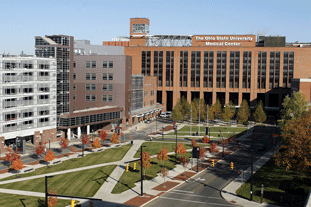
According to The Ohio State University Wexner Medical Center’s website, OSU offers a living kidney donor program in which people can register to donate a kidney to one of the approximately 650 people in OSU’s transplant program awaiting a transplant.
Surgeons at the Wexner Medical Center have performed 4,000 kidney transplants, and the center is considered one of the premier transplantation centers in the country for kidney, liver, kidney/pancreas, pancreas and heart transplants, according to their website.
“Usually it takes at least a year to get together, but we got on the list in September, and three months later, we were on the operating table,” Coleman said. “We were lucky. There were four recipients and four donors.”
Then came Dec. 13, 2013 … the day lives were changed, both physically and mentally for Coleman, Harmon and the six others involved in the transplant chain. Coleman donated his left kidney.
OSU’s program is open to individuals donating a kidney to a specific patient and “non-directed” donors, who enter the living kidney donor program without an intended patient in mind. According to NBC 4 in Columbus, the four-way exchange included a husband and wife and friends, along with Coleman and his brother and even some total strangers.
“We all got operated on the same day,” Coleman said.
The entire sequence of events really cut to the core of all the individuals involved, as Coleman described what it was like for him personally.
“It was intense,” he said. “Just seeing everybody … there was one donor there that didn’t even have anybody they were related to.
“I met the man I was donating my kidney to, and it was emotional. It was spiritual, in a way. A couple days later, he visited me in my room and thanked me ... it was special.”
Looking back to that December day, Coleman said he did this to help his brother, to improve his quality of life.
“I was excited, because I felt like, and this may sound corny, but it was like I was getting ready for a big game,” he said. “I wasn’t nervous or worried, because I knew I was going to improve my brother’s quality of life, and that was important to me.
“This extremely improves his quality of life. He was on dialysis three times a week for three to four hours per day. He couldn’t drink water or anything, and his dialysis basically only allowed him 10-percent kidney function, so you are just barely living all the time.”
As for Harmon’s reaction to his brother’s willingness to go through this to improve his quality of life, Coleman recalled what Harmon said to him during the process.
“He was nervous for me, because he didn’t like the thought of me being cut on, because he’s the big brother,” Coleman explained. “He came to terms with it and expressed his feelings with me.
“He was really thankful. He’s always been great with the entire situation. He’s tough. Even when he was on dialysis … if you didn’t know he was on dialysis, he’s the the type of person you wouldn’t know he was going through it. He’s old-school tough.”
Coleman described how the procedure will continue to change the quality of life for his brother.
“Right now, his immune system isn’t what it normally would be because his body is treating the new kidney as a virus, but eventually that will all work itself out,” Coleman said.
“Right now, he can do things we take for granted, and he’s already feeling better. The creatinine in your system should be at one or less, and a bad level is like nine … his has been 11 before the transplant. The day he got the transplant, his went down to 1.7.”
The procedure not only changed Harmon’s life, but that of his younger brother as well, as he has revamped his outlook on life.
“Just being able to help somebody and have hope again … it was life-changing,” Coleman said.
Coleman encourages those who are thinking about becoming organ donors to look into the living donor program.
“If you have an opportunity to do it … then do it,” he said. “I would do it all again right now. It is a small part of me changing a whole life for someone else.”
For more information on the OSU Wexner Medical Center’s living donor program, visit http://medicalcenter.osu.edu.