


Reversing earlier decision, Hillsboro City Council extends promissory note for Marriott developers
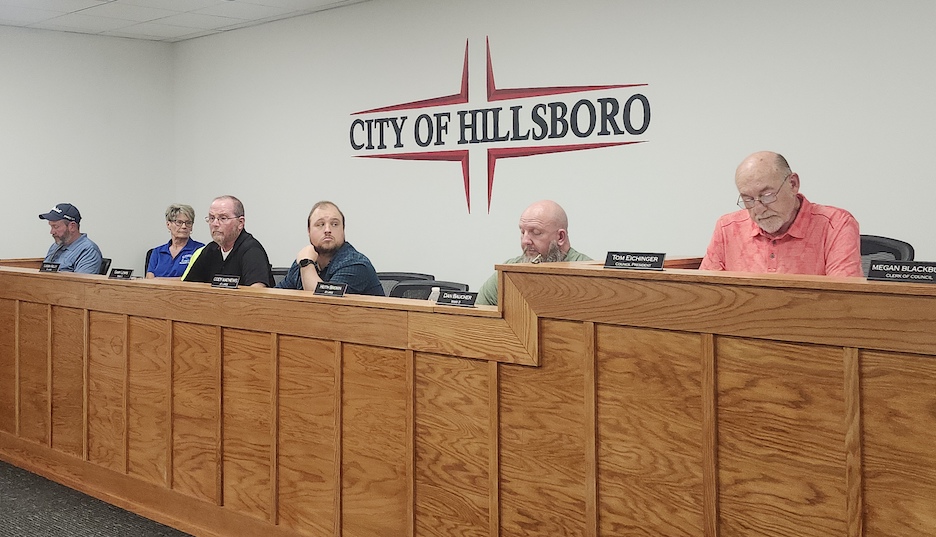
Pictured (l-r) are Hillsboro City Council members Adam Wilkin, Mary Stanforth, Gary Lewis, Cody Mathews, Dan Baucher and Tom Eichinger. (HCP Photos/Caitlin Forsha)
Less than three weeks after voting against extending a promissory note for the sale of bonds for a long-discussed hotel development, Hillsboro City Council had a change of heart Tuesday, March 31, as they passed legislation for another two-month extension at a special meeting.
The March 12 vote not to extend the promissory note for the Marriott Hotel development was by voice vote only, while council passed an emergency resolution at their March 31 special meeting to authorize the extension.
As previously reported, safety and service director Shawn Adkins asked council March 12 for “guidance” on how to proceed with plans for a proposed Marriott Hotel project, which has been in planning stages for over six and a half years. Council voted 6-0 to deny extending the city’s promissory note with the hotel developers, Leo Capital, for the repayment of a $200,000 loan past its March 31 deadline.
For background, both Hillsboro City Council and Hillsboro City Schools agreed in October 2019 to establish a tax increment financing [TIF] district for the proposed multimillion-dollar hotel project in the city of Hillsboro, near the state Route 73/Harry Sauner Road intersection. At the time of that approval, bond counsel Richard Spoor said that it would offset the cost of infrastructure, then estimated at $3 million.
An ordinance approved by the city in 2019 declared a five-acre tract at 1308 North West Street (state Route 73) “to be exempt from real property taxation” and “requiring annual statutory service payments in lieu of taxes.” The ordinance also creates the TIF fund for “the deposit of the balance of such statutory service payments.”
Council voted in May 2025 to suspend the three-reading rule and to approve and adopt an ordinance providing for the issuance and sale of not to exceed $3 million of special obligation development revenue bonds, series 2025 (Leo Capital/Hillsboro project), of the City of Hillsboro under Chapter 5709 of the Ohio Revised Code for the purpose of paying the cost of certain public improvements; authorizing a pledge of and lien on certain service payments to secure such bonds; authorizing the execution and delivery of a trust agreement to secure such bonds; and authorizing and approving related matters.
In May, one of the developers told council that the next step toward construction was “getting the TIF bond to be able to be issued in order for us to get the funding in place,” and that “based off of the TIF bonds being issued, we're contingent upon that with our construction lenders.”
Then, in August 2025, council authorized the execution of bonds through the Southwest Ohio Regional Development Port Authority.
Now, after a unanimous vote against extending the promissory note, council voted 5-1 March 31 to extend the deadline to May 31, as hotel developers have identified a potential buyer for the bonds.
City law director Hannah Bivens told council that Spoor, as well as representatives from Leo Capital, reached out with the extension request after the March 12 meeting.
“[Leo Capital] have made efforts to secure a purchaser for the bonds, which is a nontraditional purchaser,” Bivens said. “They have provided myself and Mr. Spoor with what is called a letter of intent, or a letter of offer of purchase, for this investment group to purchase all the bonds so that they can stay on track with the development of the hotel project.”
The potential bond purchaser is Hageman Capital of Carmel, Ind. According to their website, “Hageman Capital was formed to provide developers and communities with expertise in tax increment finance and provide capital for TIF bonds. Hageman Group is a multigenerational family business that invests in agriculture and real estate.”
Spoor explained that after making arrangements with the Southwest Ohio Regional Development Port Authority, “we were poised to issue the bonds last fall,” but attempts to sell the bonds with two separate bond underwriter firms were unsuccessful.
“When I inquired as to the reason, the following reasons appear,” Spoor said. “One is bonds traditionally now are being bought by bond funds, big mutual funds, so the individual bond purchaser like us here in the room are almost nonexistent. Most individuals don't have an individual bond or have interest in big bond funds, or mutual funds, that buy a lot of bonds. What that means is they're managed by these big bond funds, and they didn't like the bonds, mainly because it's a rural area to them, Hillsboro is, and the developer is a small developer, and also the concern that there be a hotel in a rural area.
“That meant we had to go to nontraditional buyers. Now, nontraditional buyers are the specialty bond funds or groups that buy only TIF bonds, and frankly, TIF bonds that other mainstream people don't want to buy. It's like any other market. If people don't want them, but it's still viable, the market will fill with other people.”
That led to identifying the Hageman Capital company as a possible buyer, Spoor said.
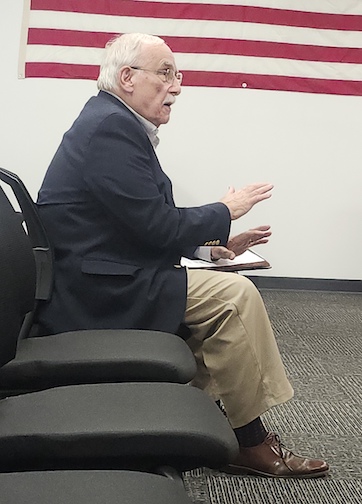
“They look only to buy TIF bonds, and the TIF bonds that they are in the market to buy are the nontraditional, in other words, the ones that the major underwriters don't want, so we are in that area,” Spoor said. “This commitment, this letter of intent, just came in today.”
Spoor told council that he has vetted the company and confirmed they are “legitimate,” and he has also reviewed the letter of intent.
“I’ve looked at it, and the conditions they list the purchase, they've all been met by now,” Spoor said. “One advantage of this deal that's been going on so long, every piece of documentation, every piece of legislation, from you and from the port authority, has been accomplished. It is in the can, ready to go.
“The letter talks about closing on, I think they're saying, by May 1 of this year. That's a month from now, because tomorrow is the first of April. It can be done. Again, the documents are finished. If the documents were not finished, I would say that’d be a little tight. However, there's always potential for slippage, so in bond transactions, if they say let's close in one month, it's safe to allow for two months for unforeseen circumstances.”
Spoor added that “from my standpoint, I think we're good to go.
“I really do, I think, at long last,” he said.
After Spoor’s opening comments, Bivens opened the floor for council to ask questions. Council member Gary Lewis asked by asking how long Hageman Capital had been in operation, and Spoor said he was unsure but later confirmed that they were formed in 2011.
As part of the agreement, “money will be placed in escrow and held for disbursement to the City of Hillsboro if the sale of the TIF bonds does not happen by May 31,” according to the resolution. Lewis asked, “How much money are we talking about?”
“Leo Capital Investments have indicated they would put money in escrow, and I have confirmation they have put $25,000 in escrow,” Bivens said. “It was originally $50,000. They asked to reduce that. They in good faith deposited $25,000 into an escrow account. We do have an escrow agreement drafted, just awaiting signature, depending on what happens this evening.
“The reason why they asked for the $25,000 is to complete this bond transaction, Leo Capital Investments has to put up $35,000 to pay for initial legal fees that if the bond transaction for some reason should not go through is nonrefundable. They asked if, instead of putting $50,000 in escrow and straining them to get the 35 [thousand dollars] to pay, they’d put $25,000 in escrow, take the 35, get this bond process moving.”
Spoor agreed, confirming that “this letter from Hageman requires them to put up $35,000 nonrefundable for their cost.”
Council member Logan Kelly expressed concerns with the timing of the deal, given that the special meeting was held on the day the promissory note was set to expire.
“It’s been, what, five, a little over five years, of the whole process going through,” Kelly said. “We get to the day before the deadline, and magically there's a company now that is wanting to buy them.
“Let's say something happens and the bonds get bought, and the developers, they fail to pay back the bonds. What's the likelihood of us having just an empty hotel building out there if they can’t pay their bills?”
“The bonds are paid from property taxes,” Spoor said. “What TIF means is tax increment financing, and the tax increment is incremental real estate taxes, so the real estate taxes that are payable on the project pay for the bonds, and they have a priority lien. The bonds that would be issued would be $3 million, and if the hotel doesn't get built and nothing happens out there, that's a lien, a $3 million lien, on that property.
“What would happen is the property would be foreclosed and sold, and then the bonds would be paid, so the bonds are secured by the real estate. It's not a debt of Leo Capital, but it's secured by the real estate.”
Council member Cody Mathews asked what incentive Hageman Capital saw in purchasing the bonds.
“They charge a higher interest rate,” Spoor said. “They will charge eight percent, whereas one of these funds, if they were to buy it, would charge six percent, so it's a higher interest rate to manage the risk. The other way they manage the risk is they don't allow them to prepay the bond, so if the interest rates drop from eight percent to two percent, just to be ridiculous, they can't refinance them. They're locked in, so their investment is a high-yield investment, and it's locked in.
“They assume the risk, but they get a pretty decent reward, because they'll get eight percent for 25 years.”
Council member Mary Stanforth, who said she has been “in on it from the beginning” of the plans during her tenure as council member and former finance committee chair, then echoed Kelly’s concerns about the timing.
“It seems like they've been dragging their feet, dragging their feet, and until we sent that, where we did that promissory note until March 31, all of a sudden, things are beginning to happen,” Stanforth said. “Nothing was happening with the bonds, it seemed like to me, and then now, all of a sudden, when we have imposed a deadline, we're hearing from them.”
Spoor told Stanforth, “I see your point,” but he went on to explain that he himself thought the bonds would have been sold already.
“They were hoping, as I was, that the regular markets would have absorbed this back before the end of the year,” Spoor said. “When we were talking to them around Christmastime, that's when everybody goes home, the markets shut down. They told us, when they get back in January, they'll look at this again. We fully expected to close this sometime in January, and that's when these traditional bond firms said no, so that was not anything to do with Leo. I mean, they were going full blast.
“I'd say by mid to late January, they concluded that they weren't going to be able to get these big funds to buy them, so that’s, say, mid-January, then they were looking for private investors.”
Regarding the city receiving the letter of intent the date of the deadline of the promissory note, Spoor said, “I really do think it's coincidental.
“What we had done in the past is normally the note has been extended only for a three-month period at a time, a 90-day period,” Spoor said. “I guess what they were looking at, they were expecting or hoping for another 90 days to do it. That's essentially what they're asking for, except that it’s 60 instead of 90 at this time.
“I know what it looks like, and I'm not their lawyer, believe me, so I don't know what the thought process is, but I do think that it is coincidental.”
Stanforth asked about the issue of Hageman purchasing bonds despite the project “having the same demographics that turned off other investors.”
“One advantage is they're from Carmel, Indiana, and I think they pretty much know about Ohio and Hillsboro,” Spoor said. “The other thing is, frankly, if they don't get it done in two months, they [at Leo Capital] still owe you 200,000 bucks, so you’re not forgiving any of the debt.”
Spoor added that if the deal with Hageman falls through and no other buyers step up, “That’s the end of the game,” and Leo Capital will have to pay the city the $25,000 in escrow plus the remaining $175,000 of the $200,000 promissory note.
“What do you think our chances are of recovering that $175,000?” Stanforth asked.
“Well, they’ve got property worth some money here in the city, without any debt on it,” Spoor said. “I’d say your chances would be quite good, because the property’s worth probably 10 times that.
“You can sue them for the $200,000, get a first lien on it.”
Kelly asked city administrators whether Leo Capital investors and their legal counsel were notified of the special meeting, which Bivens said they were, and why no one elected to attend the meeting.
“For me, it's just hard that if they want it bad enough, that they have no representation here tonight for us to ask questions,” Kelly said. “They want this, and they have no representation here, to try to fight for it.”
Bivens said that the potential deal with Hageman “all came about late last week” and that “logistically, it was hard” to get anyone from Leo Capital or their counsel — all of whom are based in Michigan — to come to the meeting on such short notice.
“This kind of happened really quickly,” Bivens said. “I’ve been in constant communication with their attorney since Friday last week.”
Both Bivens and Spoor added that they believed the Leo Capital owners and their counsel were “not deliberately avoiding being here.”
At that point, safety and service director Shawn Adkins asked to enter an executive session with council, Bivens and Mayor Justin Harsha to discuss pending or imminent litigation.
After a 22-minute executive session — compared to approximately 26 minutes in open session — council returned on the record for the motions and vote, with council voting 6-0 to suspend the three-reading rule and 5-1, with Lewis voting no, to approve and adopt the legislation as an emergency.
The Hotel No Hotel
If it looks like a duck, it sounds like a duck, and it walks like a duck, it probably is a duck. We are bombarded with information on how to prevent being scammed, and what to look out for.
1. Short time limits
2. Get it before it goes away.
3. What have you really got to lose.
4. New unknown players suddenly arrive just under the deadline.
5. You're not going to get a better deal anywhere.
Reminds you of the verse in the song Oceanfront property in Arizona.
Has anyone really done an in-depth look at this company, or just taking this new player's word. It has been 6 years.