


Ghost stories from where I grew up, Part VI
Ladies and gentlemen, in the State of Ohio v. Marion Britton case, closing arguments were finished and the 12 jurors began deliberations.
As we let those 12 men discuss the murder case in the jury room back in June of 1889, let’s take a few moments to examine the case that was presented in a packed courtroom at the Highland County Courthouse.
The state put several witnesses on the stand that all testified that Marion Britton had shot his brother-in-law, John C. Brown, twice at the Parker House on Saturday, Aug. 4, 1888. The 36-year-old Brown died 17 days later as a result of the shooting.
The defense didn’t dispute that Britton fatally shot Brown. It argued that Britton was insane and had shown signs of insanity for many years.
The defense further argued that the lunacy charge that Brown brought against Britton in the spring of 1888 (at a hearing, Britton was found to be sane) helped cause Britton’s insanity – which caused him to be “wrought up to a murderous mania.”
As Britton sits in jail in uptown Hillsboro, his residence for the past 10-plus months, and awaits the verdict from the jury of his peers, let’s jump in the way-back machine and travel back about two additional decades.
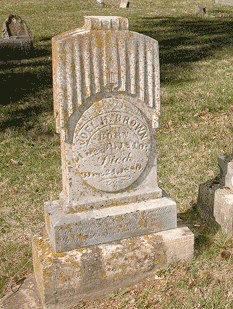
Joel H. Brown, the older brother of John Brown, was very briefly mentioned in Part I of this series. He was born in 1840, died in 1880 and was buried in the Hillsboro Cemetery beside his father, Joshua Brown, who built the house where his children grew up – and where I grew up.
Joel Brown was very briefly mentioned because other than the information on his tombstone and the location of his final resting place, I knew nothing about him – until I did some digging (no pun intended).
Like Marion Britton, Joel Brown and a couple of his brothers fought in the Civil War.
These days, there is much research regarding war veterans who suffer from post-traumatic stress disorder, a mental health condition that can cause major problems in a person’s life.
I have no way of knowing if Joel Brown, or Marion Britton, for that matter, were impacted by this condition as a result of their military service. However, the Civil War was America’s bloodiest conflict, where an estimated 620,000 men lost their lives in the line of duty and more than 800,000 were wounded, captured or were listed as missing.
According to some statistics, around one in four soldiers who went to war never returned home, and for every three soldiers killed in battle, five more died of disease during the Civil War.
Joel Brown returned to Highland County after the war, but a single sentence in a Nov. 4, 1880 newspaper edition stated that “Mr. Joel H. Brown, of Paint Township, was adjudged insane by the Probate Judge last Saturday and ordered sent to the asylum in Athens.”
Most of us have heard stories about the Athens asylum. According to Wikipedia, “The Ridges, formerly called the Athens Lunatic Asylum, was a mental hospital operated in Athens, Ohio from 1874 until 1993. During its operation, the hospital provided services to a variety of patients, including Civil War veterans, children and violent criminals suffering from various mental disabilities. … The former hospital is perhaps best known as a site of the infamous lobotomy procedure, as well as various supposed paranormal sightings.”
The Athens asylum opened just a few years before Joel Brown was sent there by a Highland County judge, and the facility remained in operation for more than a century, closing two years after I graduated from high school.
Joel Brown received “services” at the Athens asylum for just a couple of months. On Christmas Eve 1880, at the age of 40, he died in the asylum, and his body was returned to Highland County on Christmas Day.
Joel Brown returned home from the Civil War but couldn’t get out of the asylum alive.
A story in a Dec. 30, 1880 newspaper edition announced, “Mr. Joel Brown, a prominent citizen of Paint Township, died last Friday at the Athens Asylum, where he was sent by our Probate Court last October. He died of some brain disease, and his remains arrived in this city on Saturday. The funeral services were held at the residence of his brother-in-law, Mr. George W. Barrere on Sunday afternoon, Rev. Kendall officiating, and the remains were
interred in the Hillsboro Cemetery. Mr. Brown leaves a wife and several children to mourn his loss, who have the sympathy of the community.”
Joel Brown “died of some brain disease” … and a date with the asylum seems to be the best-case scenario for Marion Britton as he awaits a verdict from the jury in summer of 1889. The worst-case scenarios would be a date with a hangman’s noose if he’s found guilty of first-degree murder, followed closely by life in prison if he’s found guilty of second-degree murder.
As the jury continues deliberations, we’ll delve into more ghost stories from the place where I grew up next week.
Steve Roush is a vice president of an international media company and a columnist and contributing writer for The Highland County Press.