


Ghost stories from where I grew up, Part V
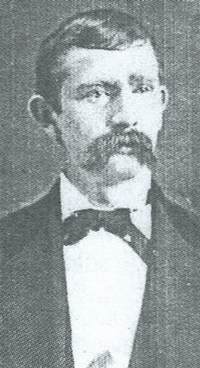
Ladies and gentlemen, as I write this, it’s the 126th anniversary of the day that John C. Brown was shot and mortally wounded at the Parker House in uptown Hillsboro.
He died 17 days later on Aug. 21, 1888. He was 36 years old. His funeral was held in the house where he grew up – and the house where I grew up.
In June of 1889, the state had wrapped up its case during the murder trial of Marion DeCalb Britton, John Brown’s brother-in-law.
Now, it was the defense’s turn to present its case at the Highland County Courthouse, located across the street from the Parker House. Britton was represented by Alphonso Hart, who had served as 11th lieutenant governor of Ohio from 1874-76 and later served as a U.S. representative in Washington.
Before a packed courtroom, the state had paraded out several eyewitnesses who testified that they saw Britton pull out a pistol and shoot John Brown.
The defense began by calling a number of witnesses from Union Township, who testified to the good character of Marion Britton as a neighbor and citizen.
After that, things began to get interesting.
[[In-content Ad]]
The defense didn’t dispute that Marion Britton shot John Brown; it argued that Britton was insane, and had shown signs of insanity for at least 22 years.
Oh, the irony...
As you probably recall in Part II of this series, in the spring of 1888, John Brown had filed an “affidavit of lunacy” against Britton after the heated argument that occurred after Brown’s sister, Mary, ended her engagement to Britton. A case was heard, and Britton was found to be sane.
Now, the defense is arguing otherwise on behalf of Britton.
According to newspaper reports, witnesses, mostly close relatives, testified to Britton’s actions at his home prior to the shooting of John Brown. Some testified that Britton would talk to the picture of his deceased wife, Susannah E. “Betty” Brown Britton, and referred to the photo as her.
Testimony was heard that Britton desired to “send a message to his dead wife by a neighborhood man who was lying at the point of death. (Britton) only desisted in sending this message … from the fact that he had no suitable message to send. It could only be one in reference to his troubles, and he did not feel like troubling his deceased wife with his present troubles.”
According to newspaper reports, others testified that Britton “was continually referring to the death of his wife and the actions and sayings of the Brown family about himself, children and deceased wife. This talk seems to have taken place about and after the time of the breaking off of the engagement between Mary Brown and himself, and that he (Britton) was a ruined man, from the fact that his children would be pointed at as the children of a man who had been charged as being a lunatic and that he himself had been broken in spirit by the charge that he had mistreated his first wife in having killed her by overwork and that he had buried her in a mud hole.”
A number of witnesses testified that Britton “had spoken of life as having no interest to him now,” and another testified that “Britton talked enough about the Browns to make a book…”
One witness, Joseph Powell said that Britton was “off,” while another, William Fields, said Britton was “off his pins.” Samuel Oldaker testified that he thought Britton was “slued.”
Three doctors, including the superintendent of the asylum at Athens, took the stand and testified that they were of the opinion that Britton was insane.
The defense then rested its case, and closing arguments were held in a courtroom that was “crowded almost to suffocation, the audience being mostly ladies.”
And we’ll also rest for now and delve into more ghost stories from the place where I grew up next week.
Steve Roush is a vice president of an international media company and a columnist and contributing writer for The Highland County Press.