


Ghost Stories: George Washington Barrere, a man of many hats
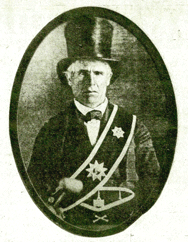
“Perseverance and spirit have done wonders in all ages.” – George Washington (1732-1799), the first president of the United States
Ladies and gentlemen, it’s been said that perseverance is the hard work you do after you get tired of the hard work you already did.
George Washington Barrere and his family left Clinton County in November of 1802 and settled in New Market in Highland County. By my math, that was a little more than 212 years ago.
Now, Highland County wasn’t founded until May 1, 1805. In fact, you might recall that Hillsboro (historically spelled Hillsborough) was not founded until 1807 – or at least remember the bicentennial celebration back in 2007.
Prior to 1807, New Market served as the county seat of Highland County. When Ohio became a state in 1803, George Washington Barrere was appointed as justice of the peace of New Market Township, according to research by longtime Highland County historian Jean Wallis. Barrere also served as postmaster in New Market, a position he held for many years.
Then, after the formation of Highland County in 1805, George Washington Barrere was elected State Senator. According to local historian Elsie Johnson Ayres, he served in the legislature of Ohio from 1808-1809, and from 1812-1816.
George Washington Barrere was captain of a company during the War of 1812, served as associate judge for 14 years, served as justice of the peace for many terms, plus operated a mercantile establishment (I had to look that one up, it basically means a general store) and a tavern, according to Ayres.
He also became the largest landowner in New Market. According to Mrs. Wallis, he purchased numerous lots at various times, most of which were sold due to delinquent taxes. Eventually, he owned approximately 127 lots, which was around a third of the lots in the entire village.
Yes, he was, indeed, a man of many hats.
According to Mrs. Wallis, during the War of 1812, Captain George Washington Barrere put on his war hat one more time and was with a company of men who served in the Second Regiment under the command of Col. James Findlay of Cincinnati.
If that name sounds familiar, James Findlay was mayor of Cincinnati from 1805-1806 and 1810-1811. After he became a major general, Findlay built Fort
Findlay at the site of present-day Findlay, Ohio. Findlay later became a member of the U.S. House of Representatives from 1825-1833, and died Dec. 28, 1835 at the age of 65. The Findlay Market in Cincinnati is built on land donated to the city by the estate of General James Findlay and Jane Irwin Findlay.
In the War of 1812, Barrere’s company rendezvoused at Dayton and marched north to Manardys Blockhouse and from there to Detroit, Michigan. Barrere and other Highland Countians witnessed the Surrender at Detroit, according to Mrs. Wallis.
According to historic accounts, the Siege of Detroit, also known as the Surrender of Detroit, was an early engagement in the War of 1812.
On Aug. 15 and 16, 1812, a British force under Major General Isaac Brock with Native American allies under the Shawnee leader, Tecumseh, used bluff and deception to intimidate the American Brigadier General William Hull into surrendering the fort and town of Detroit, Michigan, and a dispirited army which nevertheless outnumbered the victorious British and Native Americans. Seven Americans were killed and 2,493 were captured. Only two were wounded on the opposing side. Findlay, who marched with General Hull, opposed Hull’s
decision.
General Hull, who had been appointed by President Thomas Jefferson as governor of the Michigan Territory back in 1805, was tried by court martial and was sentenced to death for his conduct at the Surrender of Detroit. However, the sentence was commuted by President James Madison to dismissal from the Army, in recognition of Hull’s honorable service in the American Revolution. (Hull was nearly 60 years old at the time and lived the remainder of his life in Newton, Massachusetts and wrote two books attempting to clear his name. He died in 1825 at the age of 72.)
Being volunteers and not members of the regular army, Barrere and members of his company were allowed to return home, according to Mrs. Wallis.
As George Washington Barrere makes the journey back to his family in New Market, we’ll pause for now and continue next week.
Steve Roush is a vice president of an international media company and a columnist and contributing writer for The Highland County Press. He can be reached by email at roush_steve@msn.com.