


Ghost Stories: A chat with the good doctor, Part V
Lead Summary
By
Steve Roush-
Ladies and gentlemen, as the sun sinks in the western sky and I listen to sound of the train chugging along the tracks in the year of our Lord 1874, I realize my colloquy with Dr. Diocletian Lewis with respect to the Temperance Movement, like the sun of the day, is also reaching its ineluctable finale.
As I tarry momentarily to gaze at the stoic man with a long, silver beard, I ponder how the good doctor would be 193 years old if he were still alive in 2016 and wondered what he’d think if he saw the world we live in today.
When we spoke previously, Dr. Lewis pointed to a meeting on a cold night in Hillsboro, Ohio in 1873 as a pivotal point of the Temperance Crusade, and how the power of women’s prayer led to the movement’s great success in the ensuing months.
“Dr. Lewis,” I say, “I’d like to thank you for your time, and I will not take up much more of it. You had just said, ‘Thus, when it is claimed by Christians that the success of the Woman’s Temperance Movement is in answer to prayer, it must never be forgotten that the kind of prayer which has been followed by the great blessing is that uttered by this Ohio girl.’ Where do you envision this crusade going from here?”
The good doctor gives a warm smile and says, “This gives the keynote of the great campaign. That the Woman’s Temperance Movement is successful in villages and small towns no one doubts; but there is very considerable doubt about its success in large cities. For myself, I have not a shadow of a doubt that it will prove successful in the large cities, under the following management:
“First. Let each church organize a daily prayer meeting. From this prayer meeting, let committees of two or three women be sent out at once, and constantly visit the owners of real estate where drams are sold, and the private homes of those who keep saloons. They will plead with these persons to sign the pledge that they will do so no more. These small communities will report every day at the prayer meetings, and within a week, 10 or 15 of these small committees will have visited as many persons as they can undertake to labor with.
“Second. After one or two weeks, these church prayer meetings will send out committees of five women, to visit the dram sellers at their places of business, to quietly plead with them, and before they leave, kneel in a corner of the barroom for a few moments of silent prayer.
“Third. After one or two weeks of this labor, the women will generally conclude to send out larger parties, say 30 to 50, to hold religious exercises in some of the larger drinking places, with a distinct understanding that when a disturbance is threatened, they immediately resolve themselves into smaller committees of the second method, and do not gather again in large companies perhaps for that day, certainly not until they see an opportunity to work more effectively in large bodies.
“God is in the cities quite as much as in the country,” Dio Lewis continues, “The women of the cities are as intelligent and as sorrowful over the curse of dram shops as their sisters in the country; and if they manage in the way I have suggested, will as certainly succeed as the women of small towns…”
At this point, I realize the temperance train has stopped at the station and it is time to alight. I offer the good doctor my many thanks for his time and wish him the best in his future endeavors before bidding a fond farewell.
During the winter of 1873, Dr. Diocletian “Dio” Lewis urged women to take the snowy streets, and within three months of their first march, it’s been written that they had driven the liquor business out of 250 towns. By the time the marches ended, over 912 communities in 31 states and territories had experienced the crusades. It’s been said that it was and is still the largest mass movement of women to date. Frances Willard, the second national president of the Woman’s Christian Temperance Union, wrote later in her memoirs, that the crusade “was like the fires we used to kindle on the western prairies, a match and a wisp of grass were all that was needed, and behold the spectacle of a prairie on fire sweeping across the landscape, swift as a thousand untrained steeds and no more to be captured than a hurricane.”
Lewis claimed that, as a result of the Temperance Crusade, more than 17,000 drinking establishments were abandoned in Ohio alone in a period of two months.
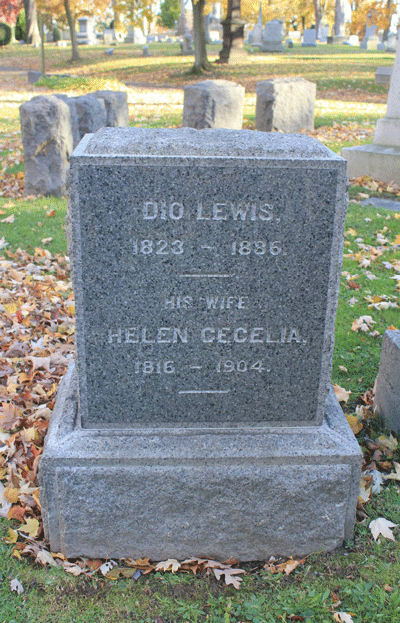
Dio Lewis passed away on May 21, 1886 at the age of 63 and is buried in the Forest Lawn Cemetery in Buffalo, New York beside his wife, Helen Cecelia Lewis, who died in 1904.
Let’s pause for now, and we’ll continue next week.
Steve Roush is a vice president of an international media company and a columnist and contributing writer for The Highland County Press. He can be reached by email at roush_steve@msn.com.
As I tarry momentarily to gaze at the stoic man with a long, silver beard, I ponder how the good doctor would be 193 years old if he were still alive in 2016 and wondered what he’d think if he saw the world we live in today.
When we spoke previously, Dr. Lewis pointed to a meeting on a cold night in Hillsboro, Ohio in 1873 as a pivotal point of the Temperance Crusade, and how the power of women’s prayer led to the movement’s great success in the ensuing months.
“Dr. Lewis,” I say, “I’d like to thank you for your time, and I will not take up much more of it. You had just said, ‘Thus, when it is claimed by Christians that the success of the Woman’s Temperance Movement is in answer to prayer, it must never be forgotten that the kind of prayer which has been followed by the great blessing is that uttered by this Ohio girl.’ Where do you envision this crusade going from here?”
The good doctor gives a warm smile and says, “This gives the keynote of the great campaign. That the Woman’s Temperance Movement is successful in villages and small towns no one doubts; but there is very considerable doubt about its success in large cities. For myself, I have not a shadow of a doubt that it will prove successful in the large cities, under the following management:
“First. Let each church organize a daily prayer meeting. From this prayer meeting, let committees of two or three women be sent out at once, and constantly visit the owners of real estate where drams are sold, and the private homes of those who keep saloons. They will plead with these persons to sign the pledge that they will do so no more. These small communities will report every day at the prayer meetings, and within a week, 10 or 15 of these small committees will have visited as many persons as they can undertake to labor with.
“Second. After one or two weeks, these church prayer meetings will send out committees of five women, to visit the dram sellers at their places of business, to quietly plead with them, and before they leave, kneel in a corner of the barroom for a few moments of silent prayer.
“Third. After one or two weeks of this labor, the women will generally conclude to send out larger parties, say 30 to 50, to hold religious exercises in some of the larger drinking places, with a distinct understanding that when a disturbance is threatened, they immediately resolve themselves into smaller committees of the second method, and do not gather again in large companies perhaps for that day, certainly not until they see an opportunity to work more effectively in large bodies.
“God is in the cities quite as much as in the country,” Dio Lewis continues, “The women of the cities are as intelligent and as sorrowful over the curse of dram shops as their sisters in the country; and if they manage in the way I have suggested, will as certainly succeed as the women of small towns…”
At this point, I realize the temperance train has stopped at the station and it is time to alight. I offer the good doctor my many thanks for his time and wish him the best in his future endeavors before bidding a fond farewell.
During the winter of 1873, Dr. Diocletian “Dio” Lewis urged women to take the snowy streets, and within three months of their first march, it’s been written that they had driven the liquor business out of 250 towns. By the time the marches ended, over 912 communities in 31 states and territories had experienced the crusades. It’s been said that it was and is still the largest mass movement of women to date. Frances Willard, the second national president of the Woman’s Christian Temperance Union, wrote later in her memoirs, that the crusade “was like the fires we used to kindle on the western prairies, a match and a wisp of grass were all that was needed, and behold the spectacle of a prairie on fire sweeping across the landscape, swift as a thousand untrained steeds and no more to be captured than a hurricane.”
Lewis claimed that, as a result of the Temperance Crusade, more than 17,000 drinking establishments were abandoned in Ohio alone in a period of two months.
Dio Lewis passed away on May 21, 1886 at the age of 63 and is buried in the Forest Lawn Cemetery in Buffalo, New York beside his wife, Helen Cecelia Lewis, who died in 1904.
Let’s pause for now, and we’ll continue next week.
Steve Roush is a vice president of an international media company and a columnist and contributing writer for The Highland County Press. He can be reached by email at roush_steve@msn.com.