


Ghost Stories: A chat with the good doctor, Part IV
Lead Summary
By
Steve Roush-
Ladies and gentlemen, as we chatted with Dr. Diocletian Lewis last week, he talked about how a temperance meeting on a cold December night in Hillsboro, fueled a fire that began to sweep through the state in year of our Lord 1874.
As the temperance train continues to chug along, let’s resume our tête-à-tête with the good doctor.
“Dr. Lewis, now that the temperance crusade is sweeping through the state of Ohio, can you talk a little bit about this ‘revolution?’” I ask.
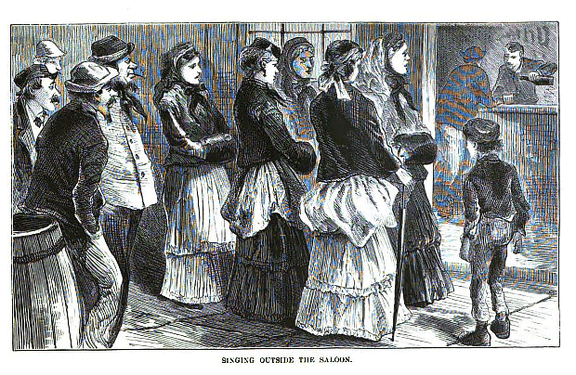
“The Woman’s Temperance Movement is one of the most profoundly religious revolutions the world has ever seen,” the doctor says matter-of-factly. “It is very simple; a prayer meeting from beginning to end. What seems a series of stages in the work is nothing but a change of place for the prayer meeting. First it is in the closet, then in the vestry of a church, then in the saloon, but it is nothing more nor less than a prayer meeting from beginning to end. And I notice that many clergymen and religious papers speak of it as illustrating the power of prayer … I am happy and grateful in the belief that this view is just; but I must take pains to say that I have not observed that prayer has served in this cause, unless it is of one particular kind.”
“And what particular kind is that?” I inquire.
He replies, “I have heard men pray, during the last few months, for the suppression of dram shops. I do not believe that their prayers have added to the success of the Woman’s Temperance Movement. Their prayers have been mostly from the base of their brains.”
“What do you mean?” I ask.
“Let me illustrate,” Dr. Lewis says. “Not long since, in Ohio, I heard a man pray in a gathering about a saloon. I recall distinctly certain sentences in his prayer, but I shall not be able to give you his manner; I can only say that his fists were closed, and he shook his head while he was praying. He cried out in a loud voice, ‘And now, Almighty God, wilt thou soften his hard heart; wilt thou, with thy own right arm, break his obdurate will,’ and so forth. Of course that prayer was not meant for God’s ear; it was designed for the chap inside of the saloon; but an eternity of such prayers, uttered by all the men on the globe, would not close one dram shop.”
“I see what you mean,” I say.
“Shortly after the man’s prayer was finished, a young girl prayed, and her prayer was the sort which has accomplished this great temperance revolution,” Dr. Lewis continues. “I recall some of the sentences which were uttered in a voice sweet and tender beyond my power of description. She said, ‘Father, we thank thee that we can do this; and if thou dost not give us the answers we ask, we are thankful just the same. Dear Father, we thank thee that we are permitted to do this work of love; we feel ourselves coming nearer and nearer to thee. Dear Father, the distance between thee and the best of us is so great, and the distance between the best of us and the worst of us is so small, that if thou canst be patient, loving and forgiving towards the best of us, we shall find it easy to be patient, loving and forgiving towards the worst of our fellows. Dear Father, fill our hearts with love; in all our thoughts, in all our words, that we may breathe only the spirit of Jesus.’
“Thus, when it is claimed by Christians that the success of the Woman’s Temperance Movement is in answer to prayer, it must never be forgotten that the kind of prayer which has been followed by the great blessing is that uttered by this Ohio girl…”
As the train continues down the tracks more than seven score years ago, let’s pause for now and we’ll continue next week.
Steve Roush is a vice president of an international media company and a columnist and contributing writer for The Highland County Press. He can be reached by email at roush_steve@msn.com.
As the temperance train continues to chug along, let’s resume our tête-à-tête with the good doctor.
“Dr. Lewis, now that the temperance crusade is sweeping through the state of Ohio, can you talk a little bit about this ‘revolution?’” I ask.
“The Woman’s Temperance Movement is one of the most profoundly religious revolutions the world has ever seen,” the doctor says matter-of-factly. “It is very simple; a prayer meeting from beginning to end. What seems a series of stages in the work is nothing but a change of place for the prayer meeting. First it is in the closet, then in the vestry of a church, then in the saloon, but it is nothing more nor less than a prayer meeting from beginning to end. And I notice that many clergymen and religious papers speak of it as illustrating the power of prayer … I am happy and grateful in the belief that this view is just; but I must take pains to say that I have not observed that prayer has served in this cause, unless it is of one particular kind.”
“And what particular kind is that?” I inquire.
He replies, “I have heard men pray, during the last few months, for the suppression of dram shops. I do not believe that their prayers have added to the success of the Woman’s Temperance Movement. Their prayers have been mostly from the base of their brains.”
“What do you mean?” I ask.
“Let me illustrate,” Dr. Lewis says. “Not long since, in Ohio, I heard a man pray in a gathering about a saloon. I recall distinctly certain sentences in his prayer, but I shall not be able to give you his manner; I can only say that his fists were closed, and he shook his head while he was praying. He cried out in a loud voice, ‘And now, Almighty God, wilt thou soften his hard heart; wilt thou, with thy own right arm, break his obdurate will,’ and so forth. Of course that prayer was not meant for God’s ear; it was designed for the chap inside of the saloon; but an eternity of such prayers, uttered by all the men on the globe, would not close one dram shop.”
“I see what you mean,” I say.
“Shortly after the man’s prayer was finished, a young girl prayed, and her prayer was the sort which has accomplished this great temperance revolution,” Dr. Lewis continues. “I recall some of the sentences which were uttered in a voice sweet and tender beyond my power of description. She said, ‘Father, we thank thee that we can do this; and if thou dost not give us the answers we ask, we are thankful just the same. Dear Father, we thank thee that we are permitted to do this work of love; we feel ourselves coming nearer and nearer to thee. Dear Father, the distance between thee and the best of us is so great, and the distance between the best of us and the worst of us is so small, that if thou canst be patient, loving and forgiving towards the best of us, we shall find it easy to be patient, loving and forgiving towards the worst of our fellows. Dear Father, fill our hearts with love; in all our thoughts, in all our words, that we may breathe only the spirit of Jesus.’
“Thus, when it is claimed by Christians that the success of the Woman’s Temperance Movement is in answer to prayer, it must never be forgotten that the kind of prayer which has been followed by the great blessing is that uttered by this Ohio girl…”
As the train continues down the tracks more than seven score years ago, let’s pause for now and we’ll continue next week.
Steve Roush is a vice president of an international media company and a columnist and contributing writer for The Highland County Press. He can be reached by email at roush_steve@msn.com.