


Ghost Stories: A chat with the good doctor, Part II
Lead Summary
By
Steve Roush-
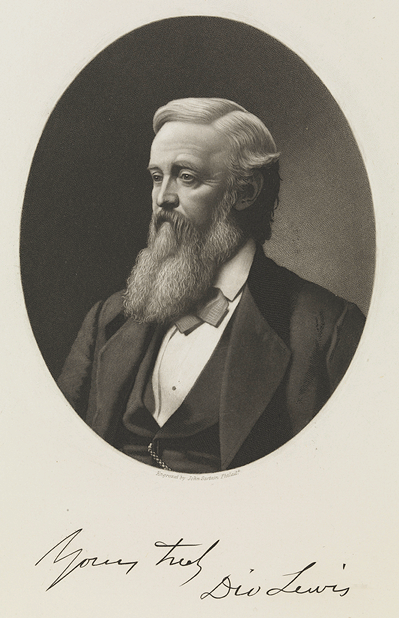
Ladies and gentlemen, now that Dr. Diocletian Lewis, ex-saloonkeeper John Calvin Van Pelt and the temperance troupe have finished a stop in Springfield, Ohio and have boarded the train to head on to Dayton, we can continue our conversation with the good doctor.
Last time, we chatted about how Dr. Lewis’ mother’s Christian demeanor, coupled with the abuse she took from her husband (Dio’s dad), inspired the man who inspired a movement that caught fire in Hillsboro in 1873-74 and began to sweep through the state of Ohio.
Before he stepped off of the train, he talked a bit about the early days where he delivered his “Address upon the Power of Woman’s Prayer in Grog Shops” in New York and Illinois, among other places, and had seen some success stories along the way.
Now, let’s resume our tête-à-tête.
“Dr. Lewis,” I begin, “you talked about success stories regarding temperance reform nearly two decades ago, and how 39 saloons in Dixon, Illinois were closed and not even a glass of beer could be purchased in the town. What happened after that?”
Dr. Lewis leans back, gives a small smile and says, “I left Dixon soon after, and went on my way, discussing and urging the cause of physical training for the young of our country, in which I was then, and, indeed, have ever since been, deeply interested. It is not improbable, if this movement had been pushed, and town after town enlisted in the good work, that the great revolution now going forward in the country might have been developed at that time; but I was then so deeply impressed with the vital importance of the educational work I had undertaken, that I thought even the temperance reform one of secondary importance.”
(As we discussed earlier, in addition to his fame as a temperance crusader, Dr. Lewis was also renowned as a physical education and exercise advocate and it’s been said that his influence had much to do with the establishment of the present system of physical culture in most of the institutions of learning in the United States.)
“So,” I say, “the temperance movement totally went on the back burner.”
“Not exactly,” he replies. “A few months later, the Woman’s Temperance Movement was inaugurated at Battle Creek, Michigan. The Rev. Charles Jones, congregational minister of that city, now residing at Saxonville, Massachusetts, and, indeed, all the clergymen of that city, including the Episcopal, responded to my suggestion for a union Sabbath evening temperance meeting in the large hall, dismissing the regular religious exercises in the churches, and bringing their congregations with them to the hall.
“The same steps were taken; a committee of five women to draft an appeal, and a committee of a hundred women to circulate it, with prepared pledges, were elected at the close of the meeting; and before noon of the following day, the committee of visitation, marching two by two, and extending more than two blocks, halted in front of the hotel where I was staying, to show me a large sign with the word ‘Saloon,’ which four of them were carrying, as the first trophy.”
“Sounds kind of familiar,” I laugh.
“Within two weeks, the 50 dram shops in town had been closed, with the exception of one, a large drinking, billiard and gambling institution, which held out for three weeks longer,” he recalled. “But even this marvelous success didn’t induce me to turn aside from the cause of physical education, and engage in the Woman’s Temperance Movement.
“Soon after that time, I went to Boston to establish the Normal Institute of Physical Education, to train teachers of the new gymnastics...”
“I just watched Olympic gymnastics last night for a while on TV,” I interrupted, forgetting for a moment where I was in time.
“You did what?” Dr. Lewis inquires.
“Never mind,” I say somewhat sheepishly. “Please proceed, sir.”
“For years I continued, body and soul, in that work; and then came that part of my history devoted to the establishment of the educational institution at Lexington, Kentucky, where I had hoped to illustrate the possibilities in the physical training of young women during the period of their school life,” he recalls. “During the four years given to the Lexington work, and up to the time that those magnificent buildings were destroyed by fire, I scarcely thought of anything outside.”
“It’s sad that so much work went up in flames,” I offer as I shake my head. “So what happened next?”
“I removed again to Boston, six years ago, with the intention of devoting the residue of my life to writing and lecturing upon the subject of education,” he said. “In one of my books published shortly thereafter, through the Harpers under the title of ‘Our Girls,’ I recurred to the Woman’s Temperance Movement, and published in that work the details of the attempts made years before to close the dram shops through the pleading, songs and prayer of women.
“I then seriously resolved to attempt the inauguration of a Woman’s Temperance Movement in New England, and selected Manchester, New Hampshire, for the first trial…”
As the train chugs down the tracks, let’s pause for now, and we’ll continue next week.
Steve Roush is a vice president of an international media company and a columnist and contributing writer for The Highland County Press. He can be reached by email at roush_steve@msn.com.
Last time, we chatted about how Dr. Lewis’ mother’s Christian demeanor, coupled with the abuse she took from her husband (Dio’s dad), inspired the man who inspired a movement that caught fire in Hillsboro in 1873-74 and began to sweep through the state of Ohio.
Before he stepped off of the train, he talked a bit about the early days where he delivered his “Address upon the Power of Woman’s Prayer in Grog Shops” in New York and Illinois, among other places, and had seen some success stories along the way.
Now, let’s resume our tête-à-tête.
“Dr. Lewis,” I begin, “you talked about success stories regarding temperance reform nearly two decades ago, and how 39 saloons in Dixon, Illinois were closed and not even a glass of beer could be purchased in the town. What happened after that?”
Dr. Lewis leans back, gives a small smile and says, “I left Dixon soon after, and went on my way, discussing and urging the cause of physical training for the young of our country, in which I was then, and, indeed, have ever since been, deeply interested. It is not improbable, if this movement had been pushed, and town after town enlisted in the good work, that the great revolution now going forward in the country might have been developed at that time; but I was then so deeply impressed with the vital importance of the educational work I had undertaken, that I thought even the temperance reform one of secondary importance.”
(As we discussed earlier, in addition to his fame as a temperance crusader, Dr. Lewis was also renowned as a physical education and exercise advocate and it’s been said that his influence had much to do with the establishment of the present system of physical culture in most of the institutions of learning in the United States.)
“So,” I say, “the temperance movement totally went on the back burner.”
“Not exactly,” he replies. “A few months later, the Woman’s Temperance Movement was inaugurated at Battle Creek, Michigan. The Rev. Charles Jones, congregational minister of that city, now residing at Saxonville, Massachusetts, and, indeed, all the clergymen of that city, including the Episcopal, responded to my suggestion for a union Sabbath evening temperance meeting in the large hall, dismissing the regular religious exercises in the churches, and bringing their congregations with them to the hall.
“The same steps were taken; a committee of five women to draft an appeal, and a committee of a hundred women to circulate it, with prepared pledges, were elected at the close of the meeting; and before noon of the following day, the committee of visitation, marching two by two, and extending more than two blocks, halted in front of the hotel where I was staying, to show me a large sign with the word ‘Saloon,’ which four of them were carrying, as the first trophy.”
“Sounds kind of familiar,” I laugh.
“Within two weeks, the 50 dram shops in town had been closed, with the exception of one, a large drinking, billiard and gambling institution, which held out for three weeks longer,” he recalled. “But even this marvelous success didn’t induce me to turn aside from the cause of physical education, and engage in the Woman’s Temperance Movement.
“Soon after that time, I went to Boston to establish the Normal Institute of Physical Education, to train teachers of the new gymnastics...”
“I just watched Olympic gymnastics last night for a while on TV,” I interrupted, forgetting for a moment where I was in time.
“You did what?” Dr. Lewis inquires.
“Never mind,” I say somewhat sheepishly. “Please proceed, sir.”
“For years I continued, body and soul, in that work; and then came that part of my history devoted to the establishment of the educational institution at Lexington, Kentucky, where I had hoped to illustrate the possibilities in the physical training of young women during the period of their school life,” he recalls. “During the four years given to the Lexington work, and up to the time that those magnificent buildings were destroyed by fire, I scarcely thought of anything outside.”
“It’s sad that so much work went up in flames,” I offer as I shake my head. “So what happened next?”
“I removed again to Boston, six years ago, with the intention of devoting the residue of my life to writing and lecturing upon the subject of education,” he said. “In one of my books published shortly thereafter, through the Harpers under the title of ‘Our Girls,’ I recurred to the Woman’s Temperance Movement, and published in that work the details of the attempts made years before to close the dram shops through the pleading, songs and prayer of women.
“I then seriously resolved to attempt the inauguration of a Woman’s Temperance Movement in New England, and selected Manchester, New Hampshire, for the first trial…”
As the train chugs down the tracks, let’s pause for now, and we’ll continue next week.
Steve Roush is a vice president of an international media company and a columnist and contributing writer for The Highland County Press. He can be reached by email at roush_steve@msn.com.