


Ghost Stories: A chat with the good doctor
Lead Summary
By
Steve Roush-
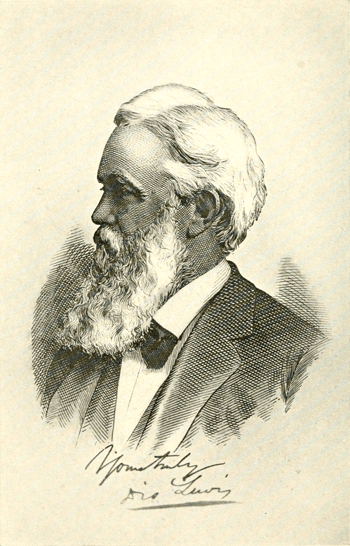
Ladies and gentlemen, as ex-saloon keeper John Calvin Van Pelt and Dr. Diocletian “Dio” Lewis board the temperance train and get set to leave Xenia, let’s take a seat next to the good doctor as the whistle blows and the train slowly leaves the depot.
After watching Dr. Lewis, Van Pelt, Mother Thompson and others embark on a historical crusade against booze in the year of our Lord 1874, I’d like to chat with the man who fired up the temperance movement in Hillsboro more than 142 years ago.
“Good morning, Dr. Lewis,” I say. “There has been a widespread interest in the women’s temperance movement of 1873-74, and you’ve have been called a ‘shining apostle’ in this crusade. What led you to be such a stalwart in this mission?”
Dr. Lewis leans forward and looks me in the eye. “When I was a boy, my father’s habitual intemperance kept our humble home in a deep shadow,” he recalls. “My mother was obliged to earn with her own hands the food for her five children, and then to cook it; she was obliged to earn the material for our clothing, and then to cut and make it; she was general provider, cook, housekeeper, nurse – in brief, she was everything to her family.”
“Wow,” I say, “she was a woman of many hats, to say the least…”
As Dr. Lewis nods his head slowly, he continues, “In addition to all of this, she was not unfrequently the victim of abuse and personal violence. But, a high-spirited woman, she refused to entertain the idea of separation, and bore all of her sorrows with Christian fortitude. But sometimes the trouble was more than she could bear, when she would burst into tears, and, leaving us, would climb up into the garret of our house to pray. We youngsters used to listen and hear her cry out in anguish, ‘Oh Lord, how long, how long, how long! Oh God, help me, help me, help me!’ Then she would be still for a while; and when she came down to us again, we noticed that although her eyes were red, her face shown like an angel’s.
“The day was never so dark at our house that my precious mother could not go up into the attic, open the cloud, and let in the light of heaven.”
“Yes, she certainly seems like a good, Christian woman, and it makes me sad that she and her children had to experience such an awful ordeal,” I say, shaking my head.
“I grew up with an exalted conception of the power of a woman’s prayer,” Dr. Lewis replies. “Even now, at the distance of more than 40 years from those dark days, I never think of any great evil or criminal, that my mind does not immediately busy itself with the thought, that, through woman’s prayer, all this might be cured.”
“So your mother and the power of her prayers so many years ago planted a seed that fueled this movement,” I say.
“About 20 years ago, I prepared with great interest an Address upon the Power of Woman’s Prayer in Grog Shops,” he recalls. “During these 20 years, I have delivered that address more than 340 times, and have constantly cherished a firm confidence that the time would come when through women’s prayer the dram shops of our country would be closed.
“About 19 years ago, the plan was tried in a small village in New York, with good results,” he continues. “About 15 years ago, while lecturing in the west on the subject of Physical Education, I proposed at Dixon, Illinois, to the Rev. Mr. Harsha and other clergymen in Dixon, to deliver my address on the subject of the Power of Woman’s Prayer in Grog Shops, if, on a certain Sunday evening, they would all forego their regular exercises, and
attend in the large hall. They expressed some doubt about the propriety of temperance lectures on the Sabbath day; but when I explained the general spirit and drift of my address, they consented. The hall was crowded, and at the close of the meeting a committee of three women was elected to prepare an appeal from the women of Dixon to the dealers in intoxicating drinks there, and a committee of 50 women to circulate that appeal among the dram sellers.”
“So how did that go?” I inquire.
“The next morning the visiting committee held a meeting, heard the appeal read, liked it, adopted it, and immediately started out with it and several pledges which had been prepared meantime,” Dr. Lewis answers. “They went from saloon to saloon, pleading, singing, praying. In one week their task was finished; 39 dram shops were closed, and the papers announced that not even a glass of beer could be purchased in town.”
As the train gets set to stop in Springfield, Ohio, let’s pause for now, and we’ll continue next week.
Steve Roush is a vice president of an international media company and a columnist and contributing writer for The Highland County Press. He can be reached by email at roush_steve@msn.com.
After watching Dr. Lewis, Van Pelt, Mother Thompson and others embark on a historical crusade against booze in the year of our Lord 1874, I’d like to chat with the man who fired up the temperance movement in Hillsboro more than 142 years ago.
“Good morning, Dr. Lewis,” I say. “There has been a widespread interest in the women’s temperance movement of 1873-74, and you’ve have been called a ‘shining apostle’ in this crusade. What led you to be such a stalwart in this mission?”
Dr. Lewis leans forward and looks me in the eye. “When I was a boy, my father’s habitual intemperance kept our humble home in a deep shadow,” he recalls. “My mother was obliged to earn with her own hands the food for her five children, and then to cook it; she was obliged to earn the material for our clothing, and then to cut and make it; she was general provider, cook, housekeeper, nurse – in brief, she was everything to her family.”
“Wow,” I say, “she was a woman of many hats, to say the least…”
As Dr. Lewis nods his head slowly, he continues, “In addition to all of this, she was not unfrequently the victim of abuse and personal violence. But, a high-spirited woman, she refused to entertain the idea of separation, and bore all of her sorrows with Christian fortitude. But sometimes the trouble was more than she could bear, when she would burst into tears, and, leaving us, would climb up into the garret of our house to pray. We youngsters used to listen and hear her cry out in anguish, ‘Oh Lord, how long, how long, how long! Oh God, help me, help me, help me!’ Then she would be still for a while; and when she came down to us again, we noticed that although her eyes were red, her face shown like an angel’s.
“The day was never so dark at our house that my precious mother could not go up into the attic, open the cloud, and let in the light of heaven.”
“Yes, she certainly seems like a good, Christian woman, and it makes me sad that she and her children had to experience such an awful ordeal,” I say, shaking my head.
“I grew up with an exalted conception of the power of a woman’s prayer,” Dr. Lewis replies. “Even now, at the distance of more than 40 years from those dark days, I never think of any great evil or criminal, that my mind does not immediately busy itself with the thought, that, through woman’s prayer, all this might be cured.”
“So your mother and the power of her prayers so many years ago planted a seed that fueled this movement,” I say.
“About 20 years ago, I prepared with great interest an Address upon the Power of Woman’s Prayer in Grog Shops,” he recalls. “During these 20 years, I have delivered that address more than 340 times, and have constantly cherished a firm confidence that the time would come when through women’s prayer the dram shops of our country would be closed.
“About 19 years ago, the plan was tried in a small village in New York, with good results,” he continues. “About 15 years ago, while lecturing in the west on the subject of Physical Education, I proposed at Dixon, Illinois, to the Rev. Mr. Harsha and other clergymen in Dixon, to deliver my address on the subject of the Power of Woman’s Prayer in Grog Shops, if, on a certain Sunday evening, they would all forego their regular exercises, and
attend in the large hall. They expressed some doubt about the propriety of temperance lectures on the Sabbath day; but when I explained the general spirit and drift of my address, they consented. The hall was crowded, and at the close of the meeting a committee of three women was elected to prepare an appeal from the women of Dixon to the dealers in intoxicating drinks there, and a committee of 50 women to circulate that appeal among the dram sellers.”
“So how did that go?” I inquire.
“The next morning the visiting committee held a meeting, heard the appeal read, liked it, adopted it, and immediately started out with it and several pledges which had been prepared meantime,” Dr. Lewis answers. “They went from saloon to saloon, pleading, singing, praying. In one week their task was finished; 39 dram shops were closed, and the papers announced that not even a glass of beer could be purchased in town.”
As the train gets set to stop in Springfield, Ohio, let’s pause for now, and we’ll continue next week.
Steve Roush is a vice president of an international media company and a columnist and contributing writer for The Highland County Press. He can be reached by email at roush_steve@msn.com.