


Caspar, the famous ghost, Part VI
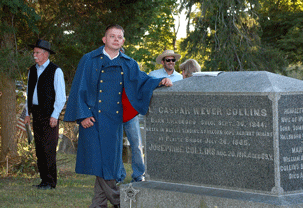
Ladies and gentlemen, General William Tecumseh Sherman once said, “I think I understand what military fame is; to be killed on the field of battle and have your name misspelled in the newspapers.”
It was 9:30 a.m. on July 26, 1845. Just two hours earlier, Lieutenant Caspar Wever Collins was dressed in his new uniform, smoking a cigar and riding off in a “jaunty and debonair” manner.
Now, the 20-year-old Hillsboro native was dead, and Platte Bridge Station commander Major Martin Anderson, who had ordered Collins and 25 men to ride off after Anderson had his morning breakfast, called an officers conference.
According to an account “Fighting the odds at Platte Bridge,” written by Doris Soule, Lieutenant Henry Clay Bretney, who was furious and grief-stricken over the death of his friend, came in yelling and throwing punches. When the air cleared, Captain Greer was down and Bretney was in the guardhouse.
Shortly, the unrelenting Bretney sent word to Anderson that he would take 75 men and the howitzer and go to the relief of 11th Kansas Cavalry Sergeant Amos J. Custard, who was escorting a wagon train back to the Platte Bridge Station. Anderson refused on grounds that they were needed to defend the fort.
Turns out, Custard and his 25 men were also attacked by the 1,000 to 3,000 Indians, and while they were able to hold them off for four hours, at the end of the day, 29 soldiers had been killed and 10 seriously wounded, and between 8 and 60 Indians lost their lives.
[[In-content Ad]]
Caspar Collins’ body was found two days later, and historian Alfred James Mokler wrote, “The remains of Lieutenant Collins, which had been carried nearly two miles to the north by his runaway horse, was stripped of its new uniform; a piece of telegraph wire had been twisted around the body and it had been dragged through the sagebrush and cactus for several hundred yards, evidently before his death…”
For those of you who don’t like graphic details, you might want to skip this next part. Mokler continued, “One hand and one foot had been hacked off, his heart had been cut out, powder had been placed in his mouth and exploded, and on the morning of the 28th, two days after the horrible butchery, the body was found by his comrades with two dozen arrows sticking in it. Although he had not been scalped, the mangled and mutilated body of the brave young soldier presented a ghastly appearance.”
Back in Hillsboro, the town’s newspaper gave the following report on Aug. 3, 1865:
The family of our fellow citizen, Col. Wm. O. Collins, late of the 11th O.V.C. were shocked on Thursday last, by the receipt of the following dispatch, conveying the melancholy intelligence of the death of Lieut. Caspar W. Collins, who was killed in battle with Indians on the day previous:
July 27, 1865
Hillsboro, Ohio
To Wm. O. Collins
Lieutenant Collins was killed yesterday, 26th, while leading twenty Kansas Volunteer Cavalry in charge against Indians. Will take his remains to Laramie to be forwarded if possible.
Very respectfully
H.C. Bretney
Co. G. 11th Ohio Cav.
Then in March of 1866, Caspar’s body was escorted to Fort Laramie and reburied there with full military honors at 10 a.m. on March 21.
Casper Mountain and Casper Creek were also named for the fallen Collins, among other places.
But while the Caspar Collins Days to be held July 24-26, 2015 is described as a three-day celebration, July 24, 1866 was a solemn time for the Collins family as Lieutenant Collin’s body arrived in Hillsboro, and at 4 p.m. that afternoon, his remains were laid at their final resting place in the family burial plot.