


Historical Society elects board, adopts new bylaws at annual meeting
Lead Summary
By
Caitlin Forsha-crforsha@gmail.com
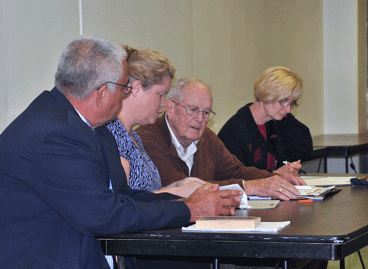
New light was shed on the organization's finances, a completely rewritten set of bylaws were adopted and a new 12-member board, along with a president and vice-president of the membership, were elected at the annual meeting of the Highland County Historical Society.
Robert Hodson, presiding officer for the society, introduced himself at the meeting's outset, informing those in attendance that all Historical Society members were mailed information on the meeting, as well as a copy of the new bylaws to review, 30 days in advance. He explained that the annual meeting was established "for the purpose of business" and that the major "business" of the 2013 meeting was the election of a board.
Hodson also introduced Jim Faust, a Historical Society member whom Hodson chose to serve as a parliamentarian for the meeting to ensure that everything was done according to Robert's Rules of Order; Betty Crum, who was chosen to write the minutes of the meeting and who presented the minutes of the July special meeting; and Karen Reno, the society's professional bookkeeper, who delivered the annual treasurer's report.
As he did at the July 15 special meeting of the membership, Hodson, who was the first president of the Highland County Historical Society, explained his history with the society, along with his role in the society's dealings of the past few months.
Hodson said that he is the only original board member still living.
"I keep thinking that I represent them [the original board] as well," Hodson said. "Some wonderful names, some wonderful people in our community that helped put this organization together. They did it with a dream, knowing that it was important to preserve the past, to preserve the present, for the future people."
Hodson said he was approached about six months ago to look into some society matters, and that at first he "declined to be involved" until he learned of trustees' resignations and determined that they were not adhering to their bylaws.
"If you don't follow the bylaws, how can you elect people?" Hodson asked. "How can you elect trustees if you don't meet? I found out the answer to that real quickly – the board was electing each other. That's not the way it operates. That doesn't operate in any organization. The members are the organization. They select the people who will be responsible."
Hodson said the July special meeting was necessary to address the issue, during which the existing six-member board was dissolved.
During that meeting, the museum director's position was also terminated, Hodson was elected presiding officer over the Historical Society until the annual meeting and there was to be "no functioning going on" at the museum or Scott House.
"I wasn't an officer, hadn't been for 40 years. I accepted the responsibility on July 15 to serve as the presiding officer until the next annual meeting, and good gracious. The annual meeting's here, and I'm glad, because when the annual meeting is over, I'm done," Hodson joked, drawing laughs from the crowd.
Hodson also announced the findings of Ohio Attorney General Mike DeWine's office in response to a filing against the society.
"Two people chose to make complaint against the society," Hodson said. "That complaint was made to the Attorney General, by two people ... one person named, another person hidden behind the word 'anonymous.'
"It created a problem. It created a big problem because we had to spend lots and lots of time, and we spent a lot of money because we had to get all the records, every bill that had been paid."
Hodson said that with assistance from Reno, the society sent a packet to the OAG's office.
"And by the way, there were a lot of things we couldn't find," Hodson said.
Hodson said they were asked to provide financial information for the past three years.
"That was kind of interesting because the three years they were investigating are the ones that was not from now on; it was the people who were already there," Hodson said. "Today, at 10 minutes after 5 [p.m.], I met the investigator who has been on this investigation for several weeks."
Hodson said that the investigator gave him a letter, which he read aloud to those in attendance.
The letter reads:
"Dear Principal Person, Trustees and Members of the Board,
Under statutory and common law, trustees and directors of charitable organizations have certain fiduciary obligations. The legal duties you have are separated into four categories: 1) the duty of care, 2) the duty of loyalty, 3) the duty to maintain accounts and 4) the duty of compliance.
After reviewing your organization, the Office believes you may have violated your fiduciary duties. Although our office will not be taking any action against your organization, it is important to keep in mind that board members can be held individually liable for breaches of fiduciary standards and breaches that may also result in fines."
"That's what we'd been hearing, there were problems," Hodson said. "Not only were there problems in not following the bylaws, but there were fiduciary problems within the organization. I was glad that to get that report. Are you glad?"
Many people in attendance responded "yes."
"I would think so, because we're moving forward now with a clean bill," Hodson said.
Reno further elaborated on the financial situation of the society in her treasurer's report.
"I do not handle any cash to the account," Reno said. "I handle all the checks that are written, so everything that I wrote and [have] done can always be traced back. We have receipts for everything that I've written because I always require them to go with my paperwork so that we can get them properly paid.
"I was kind of floored with where they thought there were inconsistencies and stuff before as far as credit card charges and stuff because I've always had receipts for everything, and in my professional business, if there was something I thought would need questioned, I wouldn't hesitate to question it."
Reno delivered the financial statement for January through September 2013 and announced that the society's checking account has $5,552.64 and that their investment account has $224,529.40.
"You guys are definitely not broke," Reno said.
Hodson asked Reno to repeat the total amount for everyone.
"Cost value, you have $230,082.04," Reno said.
"So the society is not broke," Hodson said. "Someone was asking me about that."
Hodson explained that the investment account was part of an endowment to the society and asked the audience for any questions.
"I saw written somewhere that the society had been running in the red," Harriet Fenner said.
"What it is, is the current financial statement in for the last couple years," Reno said. "If you take the income that they receive for the year, minus all the expenses, they have spent more money than they have collected for the last several years. We're not running in the red overall because they have used funds that they have in [the investment account] to cover any expenses that have been lost, so they're not in the red, but they did for those particular years."
Reno explained that in the January-September report, "you guys have spent $16,939 more than you have collected."
"Can you identify what basically caused that?" Hodson asked.
"You have had a loss on the Scott House of $9,400 and $7,500 on the historical society," Reno said. "On the Scott House, $2,800 of that is actual insurance on the building and liability, you have maintenance at $3,882 and utilities of $3,630. It has had expenses of $11,000, but you've only brought in $1,700 worth of income on the Scott House."
"So the majority of the negative balance is due to the Scott House?" Hodson asked.
"Yes," Reno said.
"Contrary, by the way – it has been reported about how it always loses money, or a negative balance," Hodson said. "That's not true. That's not true at all. There has been in the last few years, but it's not true as far as historically."
For the actual business of the meeting, Dwight Crum started the society's voting process by presenting a newly drafted set of bylaws.
Crum, chair of the bylaws committee, said that the committee determined that the previous bylaws established in 1992 needed to be completely rewritten. The bylaws are now nine pages long, compared to the previous three-page bylaws.
[[In-content Ad]]
Among the changes in the new bylaws, as outlined by Crum, are that the society needs two officers, a president and vice-president, to be elected for a one-year term at the annual meeting.
The president and vice president are to conduct business at the annual and special meetings of the society, and the president is to serve as "a member of the investigative committee of the board of trustees."
Crum said that this was necessary to avoid the illegal election of a board of trustees and explained how the board dissolved at the July meeting was determined illegal.
"The old board was an illegal body probably as far back as 2011, when a quorum of a legally elected board would not have existed. The term of the board members were three years.
"When we were putting together information for the Ohio Attorney General's office, I went all the way back to 2008 and have read every set of minutes for every board meeting. Way back, the board began replacing itself, and the bylaws of 1992 were very plain and very specific that the board members were to be nominated and elected by this body, not by the board.
"By 2011, we were already getting one or two people who were going off the board, and the new ones were not elected by this group, but reappointed by the board. In 2011, more. 2012, more. By the time we got to 2013, there were no board members that were really legal."
Crum blamed the issue on the fact that there was "no oversight of the board."
"The new bylaws provide for oversight," Crum said. "There is to be a president and a vice-president of this society. They will attend board meetings to make sure things are going as they should. They will conduct all special and annual meetings of the society."
Crum also provided background on the process of revising the bylaws.
"Midge Rose was elected president of your society, and she asked that I serve as chair to rewrite the 1992 bylaws, of which I accepted," Crum said.
Crum said that he requested and received copies of the bylaws of 10 southern Ohio historical societies as a reference "to begin rewriting a new set of bylaws." Crum said that the six members of the committee "spent over 40 hours over two months to write this new document."
"These were to be presented to the board for them to make changes, after which then they would have been brought to this society here tonight, and that is according to the old 1992 bylaws," Crum said. "Your board could not have amended the bylaws. The bylaws would have had to have come here, to the society, and been approved.
"But without seeing the document that for almost 40-some hours had been worked on, when we presented these to the board, two of the board members immediately got up and left the room, thereby not leaving a quorum on which to follow through."
Hodson reappointed Crum to work on the bylaws committee after the July 15 meeting.
Crum said that the new committee was made up of seven people: Jon Hapner, Don Fender, Caroyl Reid, Don Storer, Pamela Nickell, Hodson and himself.
Crum highlighted what he called "extremely important additions" to the bylaws, in addition to electing a president and vice-president.
"First, the Highland County Historical Society belongs to all members of the society," Crum said. "You are the historical society, if you are a member. The Highland County Historical Society does not belong to the board of trustees. The board of trustees serves at the will of the society."
Under the new bylaws, the members of the society "will also have final say in all purchase and selling of properties," and a "checks and balances" system will be implemented to "limit access to funds by committee chairs and members of the board," according to Crum.
"This vote on removing the current bylaws and adopting a new set of bylaws is extremely important to the future of this society," Crum said. "It puts control back in the hands of the membership."
Margaret Van Frank moved to suspend and terminate the 1992 bylaws and "all previous versions." Dr. Lawrence Dukes seconded the motion, and it was passed unanimously by the crowd.
Crum made the motion to adopt the new bylaws, which was accepted unanimously.
Hodson, who presided over the meeting, nominated Michael McCarty to serve as president and Arlene Huffman for vice-president, both of which were seconded by Jon Hapner. No other suggestions were made, and both of the nominations passed unanimously.
Under the new bylaws, the society was free to move into the election of a board of trustees.
Paulette Donley, chair of the nominating committee, presented a list of 12 candidates selected by the committee since the July special meeting.
Along with Donley, Anne Lerch, Anne Rhude, Arlene Huffman and Mike McCarty served on the committee.
"The committee met and spent several hours compiling names and phone numbers, with each member contacting potential candidates," Donley said. "Those candidates that assumed the responsibility of running for the office of trustee were added up, and now we believe that we have an outstanding slate of nominees for our consideration."
Donley presented the list of selected trustees, who stood and were applauded: for a one-year term, Kay Ayres, Dr. Lawrence Dukes, John Kellis and Caroyl Reid; for a two-year term, Vickie Knauff, Pamela Nickell, Michael Shanahan and Michelle Stratton; and for a three-year term, Avery Applegate, Lana Daniels, Rose Ryan and Jean Wallis.
No additional nominees were presented, and the members of the "slate" presented by the nominating committee were elected unanimously, after a motion by Dr. Bill Terrell and a second by Jeff McLaughlin.
Hodson said that the new board of trustees would establish committees at their next meeting and encouraged members to consider volunteering for committees that interest them.
Hodson announced that those elected to the board would be required to attend a governance training program provided by the Ohio Attorney General.
The meeting concluded with John Glaze, a former board member who runs the newsletter and website for the society, thanking Hodson for his assistance.
"I would like us all to thank Bob and those who have worked through the summer for what they have done," Glaze said to applause from the crowd.
Nickell also thanked former board director Midge Rose.
"It's just in my heart to thank Midge Rose and the effort she's made and what she's endured," Nickell said.
Faust also reminded the crowd that according to the new bylaws, an annual meeting will be scheduled for next October.
Robert Hodson, presiding officer for the society, introduced himself at the meeting's outset, informing those in attendance that all Historical Society members were mailed information on the meeting, as well as a copy of the new bylaws to review, 30 days in advance. He explained that the annual meeting was established "for the purpose of business" and that the major "business" of the 2013 meeting was the election of a board.
Hodson also introduced Jim Faust, a Historical Society member whom Hodson chose to serve as a parliamentarian for the meeting to ensure that everything was done according to Robert's Rules of Order; Betty Crum, who was chosen to write the minutes of the meeting and who presented the minutes of the July special meeting; and Karen Reno, the society's professional bookkeeper, who delivered the annual treasurer's report.
As he did at the July 15 special meeting of the membership, Hodson, who was the first president of the Highland County Historical Society, explained his history with the society, along with his role in the society's dealings of the past few months.
Hodson said that he is the only original board member still living.
"I keep thinking that I represent them [the original board] as well," Hodson said. "Some wonderful names, some wonderful people in our community that helped put this organization together. They did it with a dream, knowing that it was important to preserve the past, to preserve the present, for the future people."
Hodson said he was approached about six months ago to look into some society matters, and that at first he "declined to be involved" until he learned of trustees' resignations and determined that they were not adhering to their bylaws.
"If you don't follow the bylaws, how can you elect people?" Hodson asked. "How can you elect trustees if you don't meet? I found out the answer to that real quickly – the board was electing each other. That's not the way it operates. That doesn't operate in any organization. The members are the organization. They select the people who will be responsible."
Hodson said the July special meeting was necessary to address the issue, during which the existing six-member board was dissolved.
During that meeting, the museum director's position was also terminated, Hodson was elected presiding officer over the Historical Society until the annual meeting and there was to be "no functioning going on" at the museum or Scott House.
"I wasn't an officer, hadn't been for 40 years. I accepted the responsibility on July 15 to serve as the presiding officer until the next annual meeting, and good gracious. The annual meeting's here, and I'm glad, because when the annual meeting is over, I'm done," Hodson joked, drawing laughs from the crowd.
Hodson also announced the findings of Ohio Attorney General Mike DeWine's office in response to a filing against the society.
"Two people chose to make complaint against the society," Hodson said. "That complaint was made to the Attorney General, by two people ... one person named, another person hidden behind the word 'anonymous.'
"It created a problem. It created a big problem because we had to spend lots and lots of time, and we spent a lot of money because we had to get all the records, every bill that had been paid."
Hodson said that with assistance from Reno, the society sent a packet to the OAG's office.
"And by the way, there were a lot of things we couldn't find," Hodson said.
Hodson said they were asked to provide financial information for the past three years.
"That was kind of interesting because the three years they were investigating are the ones that was not from now on; it was the people who were already there," Hodson said. "Today, at 10 minutes after 5 [p.m.], I met the investigator who has been on this investigation for several weeks."
Hodson said that the investigator gave him a letter, which he read aloud to those in attendance.
The letter reads:
"Dear Principal Person, Trustees and Members of the Board,
Under statutory and common law, trustees and directors of charitable organizations have certain fiduciary obligations. The legal duties you have are separated into four categories: 1) the duty of care, 2) the duty of loyalty, 3) the duty to maintain accounts and 4) the duty of compliance.
After reviewing your organization, the Office believes you may have violated your fiduciary duties. Although our office will not be taking any action against your organization, it is important to keep in mind that board members can be held individually liable for breaches of fiduciary standards and breaches that may also result in fines."
"That's what we'd been hearing, there were problems," Hodson said. "Not only were there problems in not following the bylaws, but there were fiduciary problems within the organization. I was glad that to get that report. Are you glad?"
Many people in attendance responded "yes."
"I would think so, because we're moving forward now with a clean bill," Hodson said.
Reno further elaborated on the financial situation of the society in her treasurer's report.
"I do not handle any cash to the account," Reno said. "I handle all the checks that are written, so everything that I wrote and [have] done can always be traced back. We have receipts for everything that I've written because I always require them to go with my paperwork so that we can get them properly paid.
"I was kind of floored with where they thought there were inconsistencies and stuff before as far as credit card charges and stuff because I've always had receipts for everything, and in my professional business, if there was something I thought would need questioned, I wouldn't hesitate to question it."
Reno delivered the financial statement for January through September 2013 and announced that the society's checking account has $5,552.64 and that their investment account has $224,529.40.
"You guys are definitely not broke," Reno said.
Hodson asked Reno to repeat the total amount for everyone.
"Cost value, you have $230,082.04," Reno said.
"So the society is not broke," Hodson said. "Someone was asking me about that."
Hodson explained that the investment account was part of an endowment to the society and asked the audience for any questions.
"I saw written somewhere that the society had been running in the red," Harriet Fenner said.
"What it is, is the current financial statement in for the last couple years," Reno said. "If you take the income that they receive for the year, minus all the expenses, they have spent more money than they have collected for the last several years. We're not running in the red overall because they have used funds that they have in [the investment account] to cover any expenses that have been lost, so they're not in the red, but they did for those particular years."
Reno explained that in the January-September report, "you guys have spent $16,939 more than you have collected."
"Can you identify what basically caused that?" Hodson asked.
"You have had a loss on the Scott House of $9,400 and $7,500 on the historical society," Reno said. "On the Scott House, $2,800 of that is actual insurance on the building and liability, you have maintenance at $3,882 and utilities of $3,630. It has had expenses of $11,000, but you've only brought in $1,700 worth of income on the Scott House."
"So the majority of the negative balance is due to the Scott House?" Hodson asked.
"Yes," Reno said.
"Contrary, by the way – it has been reported about how it always loses money, or a negative balance," Hodson said. "That's not true. That's not true at all. There has been in the last few years, but it's not true as far as historically."
For the actual business of the meeting, Dwight Crum started the society's voting process by presenting a newly drafted set of bylaws.
Crum, chair of the bylaws committee, said that the committee determined that the previous bylaws established in 1992 needed to be completely rewritten. The bylaws are now nine pages long, compared to the previous three-page bylaws.
[[In-content Ad]]
Among the changes in the new bylaws, as outlined by Crum, are that the society needs two officers, a president and vice-president, to be elected for a one-year term at the annual meeting.
The president and vice president are to conduct business at the annual and special meetings of the society, and the president is to serve as "a member of the investigative committee of the board of trustees."
Crum said that this was necessary to avoid the illegal election of a board of trustees and explained how the board dissolved at the July meeting was determined illegal.
"The old board was an illegal body probably as far back as 2011, when a quorum of a legally elected board would not have existed. The term of the board members were three years.
"When we were putting together information for the Ohio Attorney General's office, I went all the way back to 2008 and have read every set of minutes for every board meeting. Way back, the board began replacing itself, and the bylaws of 1992 were very plain and very specific that the board members were to be nominated and elected by this body, not by the board.
"By 2011, we were already getting one or two people who were going off the board, and the new ones were not elected by this group, but reappointed by the board. In 2011, more. 2012, more. By the time we got to 2013, there were no board members that were really legal."
Crum blamed the issue on the fact that there was "no oversight of the board."
"The new bylaws provide for oversight," Crum said. "There is to be a president and a vice-president of this society. They will attend board meetings to make sure things are going as they should. They will conduct all special and annual meetings of the society."
Crum also provided background on the process of revising the bylaws.
"Midge Rose was elected president of your society, and she asked that I serve as chair to rewrite the 1992 bylaws, of which I accepted," Crum said.
Crum said that he requested and received copies of the bylaws of 10 southern Ohio historical societies as a reference "to begin rewriting a new set of bylaws." Crum said that the six members of the committee "spent over 40 hours over two months to write this new document."
"These were to be presented to the board for them to make changes, after which then they would have been brought to this society here tonight, and that is according to the old 1992 bylaws," Crum said. "Your board could not have amended the bylaws. The bylaws would have had to have come here, to the society, and been approved.
"But without seeing the document that for almost 40-some hours had been worked on, when we presented these to the board, two of the board members immediately got up and left the room, thereby not leaving a quorum on which to follow through."
Hodson reappointed Crum to work on the bylaws committee after the July 15 meeting.
Crum said that the new committee was made up of seven people: Jon Hapner, Don Fender, Caroyl Reid, Don Storer, Pamela Nickell, Hodson and himself.
Crum highlighted what he called "extremely important additions" to the bylaws, in addition to electing a president and vice-president.
"First, the Highland County Historical Society belongs to all members of the society," Crum said. "You are the historical society, if you are a member. The Highland County Historical Society does not belong to the board of trustees. The board of trustees serves at the will of the society."
Under the new bylaws, the members of the society "will also have final say in all purchase and selling of properties," and a "checks and balances" system will be implemented to "limit access to funds by committee chairs and members of the board," according to Crum.
"This vote on removing the current bylaws and adopting a new set of bylaws is extremely important to the future of this society," Crum said. "It puts control back in the hands of the membership."
Margaret Van Frank moved to suspend and terminate the 1992 bylaws and "all previous versions." Dr. Lawrence Dukes seconded the motion, and it was passed unanimously by the crowd.
Crum made the motion to adopt the new bylaws, which was accepted unanimously.
Hodson, who presided over the meeting, nominated Michael McCarty to serve as president and Arlene Huffman for vice-president, both of which were seconded by Jon Hapner. No other suggestions were made, and both of the nominations passed unanimously.
Under the new bylaws, the society was free to move into the election of a board of trustees.
Paulette Donley, chair of the nominating committee, presented a list of 12 candidates selected by the committee since the July special meeting.
Along with Donley, Anne Lerch, Anne Rhude, Arlene Huffman and Mike McCarty served on the committee.
"The committee met and spent several hours compiling names and phone numbers, with each member contacting potential candidates," Donley said. "Those candidates that assumed the responsibility of running for the office of trustee were added up, and now we believe that we have an outstanding slate of nominees for our consideration."
Donley presented the list of selected trustees, who stood and were applauded: for a one-year term, Kay Ayres, Dr. Lawrence Dukes, John Kellis and Caroyl Reid; for a two-year term, Vickie Knauff, Pamela Nickell, Michael Shanahan and Michelle Stratton; and for a three-year term, Avery Applegate, Lana Daniels, Rose Ryan and Jean Wallis.
No additional nominees were presented, and the members of the "slate" presented by the nominating committee were elected unanimously, after a motion by Dr. Bill Terrell and a second by Jeff McLaughlin.
Hodson said that the new board of trustees would establish committees at their next meeting and encouraged members to consider volunteering for committees that interest them.
Hodson announced that those elected to the board would be required to attend a governance training program provided by the Ohio Attorney General.
The meeting concluded with John Glaze, a former board member who runs the newsletter and website for the society, thanking Hodson for his assistance.
"I would like us all to thank Bob and those who have worked through the summer for what they have done," Glaze said to applause from the crowd.
Nickell also thanked former board director Midge Rose.
"It's just in my heart to thank Midge Rose and the effort she's made and what she's endured," Nickell said.
Faust also reminded the crowd that according to the new bylaws, an annual meeting will be scheduled for next October.