


Hillsboro City Council OKs 2025 budget ordinance, new TIF districts
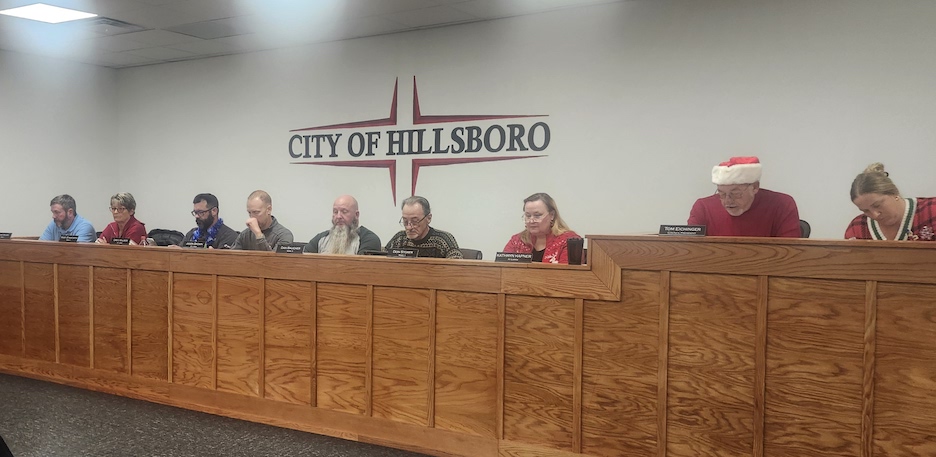
Pictured (l-r) are Hillsboro City Council members Adam Wilkin, Mary Stanforth, Greg Maurer, Jason Brown, Dan Baucher, Don Storer, Kathryn Hapner and Tom Eichinger and council clerk Lauren Walker. (HCP Photos/Caitlin Forsha)
Hillsboro City Council members approved the 2025 budget ordinance, a collective bargaining agreement for the police department and three tax increment financing (TIF) ordinances during their Monday, Dec. 23 meeting.
The meeting was pushed back from their regular Dec. 12 date due to timing requirements with the TIF district legislation following a public hearing Nov. 18. Instead of holding their regular meeting and another special meeting after Dec. 19, council members opted to hold one meeting.
The budget legislation, “an ordinance to make appropriations for current expenses and other expenditures of the City of Hillsboro during the fiscal year ending Dec. 31, 2025,” passed by a 7-0 vote.
The general fund budget is $14,501,289, with a total overall budget of $26,645,717 for 2025. As previously discussed, however, the numbers include the $5,204,536 Appalachian Community Grant received by the city for Crossroads Park.
The 2024 budget approved last December marked a $3.1 million increase in total appropriations with $19,899,599 budgeted for next year, up from $16,718,302 in 2023. Not counting the grant, city auditor Dawson Barreras told the finance committee that less money is budgeted for 2025.
“The budget went very smooth this year,” Barreras said at Monday’s council meeting. “I think we're in a pretty good spot. We’ve got a $1.2 million carryover, which I think is pretty impressive with all of the projects we had going on in 2024. I think we're in a good spot here as a city, and I think this is a very good budget to pass for next year.”
In her report, finance committee chair Mary Stanforth also discussed her committee’s review of the budget at their Nov. 25 meeting. Some of the other highlights explained by Stanforth were the impacts of personnel/wages and Shaffer Park on next year’s budget. (For more, see the story at: https://highlandcountypress.com/news/hillsboro-finance-committee-begins….)
Barreras said adjustments to the budget since that meeting have been “minimal,” primarily with adjustments to health insurance.
In related action, council approved the annual resolution for the transfer of various funds.
The payments in the legislation for fiscal year 2025 include a $1,840,000 transfer from the General Fund to the Street ($700,000), Police Pension ($140,000), Recreation ($700,000) and General Bond Retirement ($300,000) funds; a $385,000 transfer from the Water Revenue Fund to the Water Debt Retirement ($380,000) and Water Improvement ($5,000) funds; a $647,000 transfer from the Sewer Revenue Fund to the Sewer Replacement ($15,000), Sewer Improvement ($93,000), Sewer Debt Retirement ($472,000) and Storm Sewer M&R ($67,000) funds; and a $300,000 transfer from Sewer Improvement to the Sewer Debt Retirement fund.
A resolution approving the tentative collective bargaining agreement between the City of Hillsboro and the Fraternal Order of Police, Ohio Labor Council, Inc., representing dispatchers, patrol officers and sergeants in the City of Hillsboro Police Department, was also approved unanimously as an emergency.
The agreement is effective Jan. 1, 2025 through Dec. 31, 2027, the legislation says.
Along with these funding measures, three ordinances related to new Tax Increment Financing districts were approved as an emergency.
As previously reported, council approved a resolution for an economic development plan for the proposed “Fairground Road Incentive District” as an emergency at their Thursday, Oct. 17 meeting. According to the legislation, the district is being proposed to “host a mix of single-family attached, detached, multiple-family dwellings and commercial uses.
“The Incentive District will include single-family homes, multiple-family homes and two-family dwellings within the portion that is zoned Residential B,” the plan says. “The Incentive District will also include a commercial venue in the portion zoned Residential A, and the Business and Residential D portion can be a combination of permitted uses. It is expected the Incentive District will ultimately contain 50 to 60 homes.”
Council later hosted a public hearing to discuss the legislation Nov. 18.
For infrastructure improvements to this area, it is proposed that the “Incentive District” — which totals 24.3 acres — will be a 75-percent, 10-year TIF district.
The Ohio Department of Development defines a TIF as “an economic development mechanism available to local governments in Ohio to finance public infrastructure improvements and, in certain circumstances, residential rehabilitation. Payments derived from the increased assessed value of any improvement to real property beyond that amount are directed toward a separate fund to finance the construction of public infrastructure defined within the TIF legislation.” The city has utilized this for many developments in the past.
The ordinance creating the Fairground Road Tax Increment Financing plan pursuant to R.C. 5709.40(C) was approved by council Monday, with the attached exhibit sharing the same information authorized by council at their Oct. 17 meeting.
Also approved by emergency, each by a 7-0 vote after suspension of the three-reading rule, were two ordinances declaring improvements to parcels of real property located in Hillsboro to be a public purpose under section 5709.40(B) of the Ohio Revised Code, exempting such improvements from real property taxation, declaring certain public improvements to be necessary for the further development of those parcels and establishing a tax increment equivalent fund.
Both of these ordinances are in addition to the Fairground Road incentive district, as the parcels are outside that area (although they are nearby, also on the northwest side of the city). Each ordinance is creating a 30-year, 100-percent TIF.
The first ordinance “creates the ‘Crossroad TIF 1,’” the legislation says, and exempts Parcel 25-10-000-144.07, which is 13.238 acres on North West Street.
“Public improvements include improvements to Roberts Drive, Cross Road and additional roadway, sidewalk and utility infrastructure necessary for the development of the Property,” the legislation says.
The second ordinance is to establish the “211 TIF,” which affects Parcel 25-05-001-001.20, a 3.25-acre property on Harry Sauner Road.
“Public improvements include improvements to Harry Sauner Road and additional roadway, sidewalk and utility infrastructure necessary for the development of the property,” the legislation says.
In other approvals:
• Council voted 7-0 to suspend the three-reading rule and to approve and adopt a resolution to allow the mayor, safety and service director and economic development coordinator to execute documents for the aforementioned $5.2 million Appalachian Community Grant for Crossroads Park improvements.
In response to a question from council president Tom Eichinger, safety and service director Brianne Abbott confirmed that this resolution “covers the whole project to completion” for the city to execute “everything that is necessary to follow through with the project.”
• An ordinance authorizing the lease of real estate owned by the City of Hillsboro was approved, 7-0, following suspension of the three-reading rule. The ordinance is to “lease (cash rent) tillable ground located at Liberty Park not currently being utilized for park purposes,” according to the legislation, with the ground to be “leased for agricultural purposes.”
“This legislation will allow the city to put out for bid the lease of tillable ground at Liberty Park,” Abbott told council. “The legislation will also allow the city to accept the highest bidder. This is a three-year contract.
“It is farmed now. There's already a three-year contract in place. It's just up, so we need to put it back out for a new contract.”
• On its third reading, an ordinance vacating an unnamed alley between 134 East Pleasant Street and 126 East Pleasant Street was approved unanimously. According to Abbott, the legislation came about “by property owner application” and was recommended by the Hillsboro Planning Commission.
The legislation describes the area as an “unnamed and unused alley,” and according to Abbott, there is only one property owner affected. As noted by Eichinger, the city received “no questions or inputs” at any of the ordinance’s three readings.
In other discussion:
• In the safety and service director’s report, Abbott discussed several ongoing city projects, including the Roberts Lane extension, which she said is “nearing completion with the intersection widening and electrical work finishing up.”
Another infrastructure project — improvements to Beech and Railroad Street — has started, although Abbott said contractors will be off through the end of the year due to the holidays.
“They will resume a few weeks into the new year, and the roads will be open during that time,” she said.
Design plans are ongoing for Crossroads Park upgrades, Abbott said, and “preliminary plans are complete for the Rails to Trails project,” for which the city received a $1.44 million Transportation Alternatives Program (TAP) grant from the Ohio Department of Transportation for a walking and bicycling trail on an abandoned railroad bed.
Abbott also reported that the city’s building department issued three commercial and six residential building permits in November, while the Planning Commission “approved three commercial site plans, a conditional use permit and a temporary use permit at their November and December meetings.” The site plans included an application for a new Aldi in Hillsboro (which is also reportedly the location of the approved “211 TIF”), according to the Planning Commission’s November agenda.
For an update on local events, Abbott said the annual “Christmas tree lighting and parade were successful and very well attended.”
• Street and safety committee chair Adam Wilkin discussed his committee’s Nov. 18 meeting to discuss uptown parking and expanding the DORA.
According to Wilkin, the committee has proposed hourly parking restrictions for the 100 square block of uptown Hillsboro — including a recently approved, yet-to-be-constructed parking lot by the Armory — for weekdays, 9 a.m.-5 p.m. Proposed fines, escalating after additional violations, are $50, $100 and $150. There would be exemptions for jurors or out-of-town attorneys, Wilkin said.
Council member Jason Brown asked if “affected property owners will be receiving a notice” to inform them of the parking changes, if enacted.
“I don't know what our normal practice is on that, but we do need to properly communicate,” Eichinger said.
Wilkin pointed out that “it will go through three public hearings” with the legislation being read at city council meetings but agreed that he “would like to see the city make everyone very well aware” of the proposal.
“I just think there’s a couple, two to three, residential homes that may be affected, with pretty limited parking already,” Brown said. “As long as it's out in there where everybody knows to come and speak up, that would be my concern.”
Regarding the DORA expansion, Wilkin said his committee is recommending an expansion to “24 hours a day, seven days a week,” although it will remain dependent upon “the hours of operation of the businesses that will be serving the beverages.” Currently, the hours of the DORA are Thursday through Saturday from 3-10 p.m.
As previously reported, after nearly a year of planning, council voted — in a split decision, 4-3 — to approve the ordinance creating a Designated Outdoor Refreshment Area (DORA) in uptown Hillsboro in June 2023.
According to the Ohio Department of Commerce, “Per R.C. 4301.82, a Designated Outdoor Refreshment Area or ‘DORA’ (aka Outdoor Refreshment Area or ‘ORA’) is nothing more than a specified area of land that a local legislative authority has designated as exempt from certain open container provisions as defined within the legislative act that created the DORA.
“Thus, patrons within a DORA that purchase an alcoholic beverage for on-premises consumption from a DORA designated liquor permit holder can leave the permit premises with an opened alcoholic beverage container and continue consuming it within the DORA.”
Wilkin said the committee would also like to expand the area to include “the end of the 100 block of East Main Street” at the request of the Highland County Historical Society.
• Eichinger announced that current council clerk pro tempore Lauren Walker is being promoted to full-time clerk, after former clerk and city administrative assistant Whitney Aliff has accepted a different position with law director Randalyn Worley’s office. Aliff’s replacement, Megan Blackburn, will now be clerk pro tem, according to Eichinger.
“First of all, I'd like to thank [Aliff] for all that she's done the last several years,” Eichinger said. “It's been really good working with her, and I know she's worked well with all the council members.
“Lauren Walker will take over as clerk of council for the next year, and she's already been doing a great job filling in for Whitney.”
• The city received a notice from the Ohio Division of Liquor Control for a liquor license request from Maplecrest Meats & More LLC. With no opposition by council members, Eichinger said the city would “forward that back to the state.”
• Abbott said that the city and Health Department are collaborating on a National Fitness Campaign initiative to be presented in February and asked that the information “be placed into the appropriate committee for review prior to the presentation in February.”
As previously reported, in November council received a copy of a report from Highland County Health Commissioner Jared Warner stressing the need for physical activity to improve health outcomes in the county.
"I encourage the Hillsboro City Council to prioritize initiatives, such as the National Fitness Campaign project, that increase access to physical fitness opportunities,” Warner wrote. “This also includes supporting the development of local parks, walking trails and community fitness programs. By investing in such initiatives, the council can foster a healthier, more active community and address the growing health disparities faced by residents of Highland County.”
Eichinger assigned the matter to the community enhancement committee, which is chaired by council member Kathryn Hapner.
• In a brief report, Hillsboro Mayor Justin Harsha shared a holiday message to the community, while he also extended birthday wishes to Barreras.
“I just want to make sure I took the time to wish everybody a merry Christmas and a happy new year,” Harsha said. “I hope everybody enjoys their family and a little bit of downtime.
“We had an exciting year this year, a lot of stuff going on, and look forward to more of the same next year. We’ve got a lot of things coming. Thank you all for all you've done for the city of Hillsboro. And lastly, I just want to say happy birthday, Dawson.”
• Eichinger shared similar wishes at the conclusion of the meeting.
“I would first of all like to thank council for all the work you've done this year,” Eichinger said. “We worked very well with the city to get things handled.
“Merry Christmas and Happy New Year’s to everyone.”
Publisher's note: A free press is critical to having well-informed voters and citizens. While some news organizations opt for paid websites or costly paywalls, The Highland County Press has maintained a free newspaper and website for the last 25 years for our community. If you would like to contribute to this service, it would be greatly appreciated. Donations may be made to: The Highland County Press, P.O. Box 849, Hillsboro, Ohio 45133. Please include "for website" on the memo line.
Comment
Tax-Rate.Org
Highland County's property taxes are relatively high compared to other counties in Ohio. For 2025, Highland County ranks around 70th out of 88 counties in terms of property tax rates. The median property tax is $1,038 per year for a home valued at the median price of $106,200, which is about 0.98% of the home's value.
Dark side to TIF is "taxation without representation"
Is it devious how the TIF funds are collected from unenfranchised taxpayers outside of a city and are
then used to benefit few property owners within the established TIF districts in the city?
When TIF districts acquire, by redirection, the property taxes paid by their incremental (additional)
property valuations, they take not just city levied taxes, they take all levied property taxes, including
those by county government, by school district, and even by the state. These outside taxing
jurisdictions which have levied their taxes for other public purposes may be forced to increase their tax
levies on property owners in order to make up for the revenues lost from these TIF districts.
The scheme: All city, county, school, state property taxes are exempted on TIF districts incremental
properties, and TIF districts put a monetarily equal fee on those properties collected by county treasurer as a tax, that fee is then given to TIF district development boards to spend.