


Appellate judges hear arguments on corrupt activities cases WATCH THE VIDEO
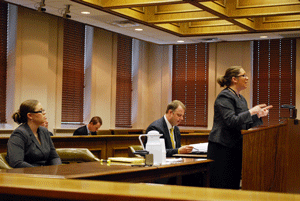
A three-judge panel of Ohio's Fourth District Court of Appeals heard oral arguments Thursday in two Highland County cases regarding engaging in a pattern of corrupt activities. The attorneys for the appellants questioned if the corrupt activities law should have been applied to the case, and if the local trial court should have allowed the net amount of money seized in the case to be applied to the individual defendants.
Highland County Prosecutor Anneka Collins argued on behalf of the state in the two separate cases against Zachary Bondurant and Jeffrey Stevens.
Judges William Harsha, Matthew McFarland and Peter Abele heard the arguments Thursday morning, held in Adams County Common Pleas Court.
Each attorney had 15 minutes to address the court, with the judges asking questions regarding the arguments or elements of the case.
Neither defendant/appellant was present during Thursday's arguments.
Bondurant and Stevens were arrested in April 2011, along with seven others, during a drug bust after a grand jury in Highland County Common Pleas Court handed down a 62-count indictment. There were a total of 153 indictments involving real estate, vehicles, cash and other assets connected to the alleged activity. The indictments were the result of a months-long covert drug investigation by detectives with the Highland County Sheriff's Office, U.S. 23 Major Crimes Task Force, Greenfield Police Department and the Clinton County Sheriff's Office into cocaine and heroin trafficking in Highland County and the surrounding area.
All other defendants subsequently entered into plea deals. Former co-defendants testified on behalf of the state, and one for the defense, during the trial. All but one defendant was sentenced to prison time.
Bondurant, of Bainbridge, was sentenced to 11 years in prison, as he was found guilty on 13 counts, including engaging in a pattern of corrupt activity, trafficking in drugs, trafficking drugs in a school zone and possession of drugs.
Stevens, of Wilmington, was sentenced to 13 years in prison. He was found guilty on all 17 counts against him, including engaging in a pattern of corrupt activity, trafficking in drugs and possession of drugs.
Attorney Eric Allen represented Bondurant during the appeal, and had alleged three assignments of error: the state failed to offer sufficient evidence to convict Bondurant of engaging in a pattern of corrupt activity, thus violating his right to due process; the conviction was against the manifest weight of the evidence that the alleged drug activity occurred within the vicinity of a school; and that he was denied effective assistance of counsel after trial counsel failed to move that the trial court for an order to sever his trial from his co-defendant.
While addressing all assignments of error, Allen's arguments focused on the corrupt activities convictions.
[[In-content Ad]]
Allen told the court that, "When you look at the record, it's somewhat unclear whether or not all these instances are connected. I would ask you reverse and remand this case for a new trial."
Referencing the state's discussion of the Racketeer Influenced and Corrupt Organizations (RICO) Act in its appellate brief, Allen said, "This certainly wasn't like the Gambino crime family. This wasn't like the Bonanno crime family."
Collins argued, "No, this isn't the Gambino family. This also isn't New York or Chicago. This is Highland County. When you put that into perspective, this was a huge group of drug traffickers that were removed from the streets. It has significantly affected the heroin production and sale in Highland County."
According to the state, approximately $36,000 was found in the trunk of a Jaguar belonging to "ringleader" Rodger Cassell. "Buy money" that was given to Bondurant in exchange for drugs, according to Allen, referencing the record of the trial court, was found in the Jaguar.
Cassell had been scheduled to stand trial along with Stevens and Bondurant, but days before the scheduled start of trial, he pleaded guilty to engaging in a pattern of corrupt activity, among other drug-related charges. He was sentenced to nine years in prison.
"There's the claim that part of this 'buy money' attributed to Mr. Bondurant is a part of this $36,000," Allen said. "But it's sort of unclear whether or not you can attribute the entire $36,000 to Mr. Bondurant and Mr. Stevens. That's the nature of these corrupt activities cases, the RICO case that are argued in federal court, if these people are involved in some vast conspiracy and therefore everything they do is attributed to every member, or whether or not they're just guilty by association."
Judge Harsha asked what separated a corrupt activities operation from a person who commits 10 different offenses.
"Doesn't there have to be some type of connectivity?" Harsha asked.
Allen said the federal law, which the state law is patterned after, requires there be a "hierarchy" and "an obvious connection between these people and a desire to commit criminal activity."
Harsha said the state had alleged that there was an organized hierarchy, and Collins later submitted that the state had proved that criminal organization. Harsha questioned that if the defendants were indeed an enterprise, why wouldn't the dollar amount seized be attributed to the entire enterprise and all its members.
"You seem to be saying there was no connection between Cassell and your client," Harsha said. "Yet you admit money that was delivered to your client ends up in Cassell's possession. Now, that's a connection."
Allen said, "That's what's in the record. Whether or not that's true, I don't know."
Harsha indicated that the court does rely on the record of the trial court.
Through the testimony of the former co-defendants charged in the case, Collins said the state established that there was an organized ring. Individuals had roles they played in the operation, she said, from driving to Dayton to pick up drugs, to delivering the drugs to people in Greenfield who would sell them, and then other people who would deliver the money.
"It was a dynamic group," Collins said. "They took care of each other. (The profits from the drug activity) bought cars, it bought homes. None of these people had jobs. This is how they supported their entire life. It was $36,000 in the back of a Jaguar. We seized 11 acres and a house that was completely paid for."
Allen said that if the intent of the law actually was to net even the smallest participant in a crime ring, "That seems to be a massive waste of resources, to try and get low-level dealers as part of some massive conspiracy when the head of this conspiracy is allowed to plea and testify against people who may or may not have been working for him."
In the second case, Bryan Hicks, the appellate attorney for Jeffrey Stevens, had alleged three different assignments of error: The trial court improperly interpreted the law when it aggregated the values of the contraband of all the defendants in meeting the $500 threshold for the engaging in a pattern of corrupt activities charge; "the trial court improperly convicted of a first degree felony"; and the sentence on engaging in a pattern of corrupt activity was improperly mandatory.
The issue of the aggregate value of the alleged enterprise had been subject to extensive arguments during the trial in Highland County Common Pleas Court in August 2011. During trial, Highland County Common Pleas Court Judge Rocky Coss had said that he was trying to "apply logic and common sense" regarding the interpretation of the statute. He said that the state failed to show that the aggregate offenses for each defendant exceeded $500. The issue though, Coss said, was whether or not the $500 amount written in the law was in reference to each defendant or the enterprise as a whole.
During those arguments at trial, Collins had said that she interpreted the statute to read the enterprise as a whole had to involve more than $500 and noted that more than $35,000 was seized from a location during the course of the investigation. The defense attorneys had argued that the $500 amount should be applied to the individuals and that the charge should be dismissed.
Coss ruled in favor of the state.
Hicks argued on Thursday that whenever there is a reasonable argument regarding ambiguity in the law, the court is supposed "to rule in favor of the liberty of the defendant.
"When you look at the statute, it's a web of definitions," Hicks said. "(Coss said during the trial) all along that it's unclear. Yet he ruled against the defendant. I think the stronger argument, frankly, is the state's. I'll concede that. But it's not the only argument. And that's the standard: Can you make more than one reasonable argument?"
Harsha said, "I find it interesting that the federal court has never addressed this, with all their RICO cases."
Hicks said that he "suspects that most RICO charges don't have the under $500 issue. RICO was designed because it was a big problem, and we had massive enterprises engaging in highly diversified operations. Congress said, 'You need another tool because you're dealing with something that's too big for the existing law. This is perhaps one of those quirks that the Legislature didn't think through."
Judge Abele, referencing Collins' earlier statement, said, "Isn't this all relative? Hillsboro isn't Chicago or New York."
Hicks said, "Even in Highland County, the evidence established at trial was that (Stevens) made less than five transactions total. We're talking about a really bit player. (Collins) has her theories about maybe (his role) was bigger. The jury didn't find any of that."
The judges commended the attorneys on their work, with Abele saying, "the case was well-argued."
A judgment on the cases will be issued by the court of appeals in the coming months.