


Appellate court upholds sentencing in local case
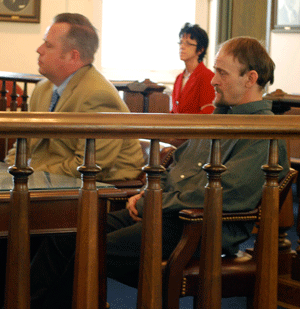
The Fourth District Court of Appeals of the State of Ohio has upheld the decision of a local trial court, after he alleged the court erred in sentencing him to the maximum of five years, and permitted testimony from a witness not on the disclosed witness list.
In April 2011, Gilbert Stonerock, 35, of Washington C.H., was convicted by a jury in Highland County Common Pleas Court of unlawful sexual conduct with a minor, a felony of the third degree. Prior to trial, Stonerock had entered a guilty plea in the case, but withdrew it after the state and the defense were unable to agree on a sentencing recommendation.
During trial, the state was represented by the Highland County Prosecutor's Office and Stonerock was represented by Hillsboro attorney Lee Koogler.
The state called seven witnesses, including the victim, who was 14-years-old at the time of the crime, medical personnel, investigators with the Greenfield Police Department and personnel from Highland County Children Services. Stonerock took the stand in his own defense.
In a judgment filed by the court of appeals last week, "Stonerock's sentence is not clearly and convincingly and contrary to law, and we find nothing arbitrary, unreasonable or unconscionable about a five-year prison term. Accordingly, we overrule Stonerock's assignment of error and affirm the judgment of the trial court."
In his appeal, Stonerock was represented by attorney Eric Allen, and submitted two assignments of error. Stonerock alleged that, "The trial court erred in allowing the testimony of Greenfield Police Chief Tim Hester when he was not listed as a state witness, as well as a DNA sample of (Stonerock) not listed as an exhibit," and that "the trial court abused its discretion in sentencing the defendant to the maximum sentence of five years for unlawful sexual conduct with a minor."
It was noted in the appeal, and at trial, that the victim has developmental disabilities.
According to the judgment, "DNA testing revealed that Stonerock's DNA was found inside (the victim's clothing)." Those items were discovered during the compliance with the request for discovery. The state also disclosed that it would call forensic lab technician Shawn Weiss of LabCorp of America, and that the items allegedly containing the DNA would be submitted into evidence, along with the test results from LabCorp of America.
[[In-content Ad]]
"During Stonerock's trial, the state called Weiss to testify. The state, however, had failed to bring Stonerock's DNA swab to the courtroom," according to the judgment. "Accordingly, before Weiss could testify, the trial court judge held a bend conference," during which Highland County Common Pleas Court Judge Rocky Coss said that the defendant's DNA evidence had to be presented in order for the court to allow testimony on the DNA.
"Eventually, Greenfield Chief of Police Tim Hester brought Stonerock's DNA swab to the courtroom," according to the judgment. "At that point, the state called Chief Hester to testify."
Defense counsel objected, saying that Hester was not listed as a witness. The state argued that Hester was being called only for the purpose of verifying the chain of custody, saying, "It's an omission from the state, but it's not a surprise." Coss ultimately approved the witness and evidence, calling it "a building block."
The court of appeals ruled that the state had disclosed the physical evidence, and that the test results would be used at trial, along with the technician's testimony.
"As a result, Stonerock's counsel knew that the DNA evidence would be a major part of the state's case and could have anticipated that the state would call a witness to testify about the chain of custody of the DNA evidence," according to the court. "Stonerock has not demonstrated how he would have benefited from knowing that Chief Hester, in particular, would testify about chain-of-custody issues. Therefore ... we cannot find that Stonerock was prejudiced by the state's failure to disclose Chief Hester as a witness."
The first assignment of error was overruled.
Regarding the second assignment of error, the court wrote, "We find that the trial court did not abuse its discretion in imposing Stonerock's prison sentence. Stonerock argues ... that his sentence appears arbitrary ... But we have reviewed the record, and we find nothing arbitrary, unreasonable, or unconscionable about Stonerock's sentence. In our view, several factor's support the trial court's selection of the five-year prison term, including the victim's developmental disabilities and Stonerock's position of trust (with the victim)."