


Hillsboro man sentenced to life without parole in child rape case
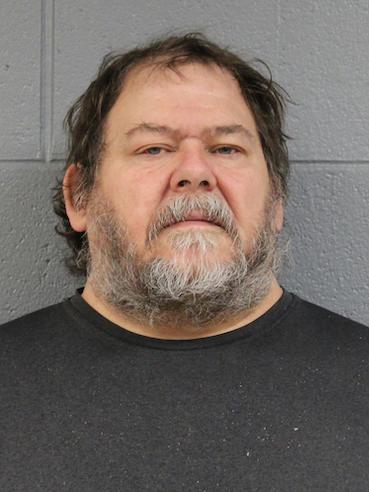
Robert Keith Taylor. (Highland County Sheriff's Office photo)
A Hillsboro man has been sentenced to life in prison without parole, after a jury seated in Highland County Common Pleas Court convicted him of three counts of rape in a case involving two child victims.
After approximately two hours of deliberations Tuesday, Aug. 15, the jury found Robert Keith Taylor, 51, of three first-degree felony charges of rape, with an additional finding of guilty for each charge stipulating that the victim was under 10 years of age at the time of the commission of the offense.
Highland County Common Pleas Court Judge Rocky Coss proceeded to sentence Taylor to life in prison without parole Tuesday night.
The indictment filed May 2 included allegations of two counts of rape against Victim 1 (“V1”), both from the period of 2011-14, and one count of rape against Victim 2 (“V2”), from a period between 2015-17.
In her opening statements, Highland County Prosecutor Anneka Collins told the jury that the case involved “various types of sexual assaults” committed against the two victims. During the trial, it was brought out that various forms of sexual intercourse, as well as groping and other types of sexual activity, were committed against the victims.
Collins said law enforcement was made aware of the case earlier this year when a lesson in science class triggered one of the victims, who began crying. The victim’s teacher — who testified at trial — discreetly took the victim into the hallway, and the victim reported being raped by Taylor at a young age. School officials notified the proper authorities, and the other victim also came forward.
Defense attorney Kathryn Hapner told the jury that throughout the investigation, Taylor has “adamantly denied all of these charges,” and pointed out that children are “not 100-percent truthful all the time” in her opening statement. She also pointed out, during cross examination, that the teacher had “no verification,” just the word of the student, to go by in reporting the alleged incident.
The jury heard testimony from both victims, with V2 testifying about being raped in a tent at a younger age. The victim indicated not wanting to report the incident because of a fear of “trouble” with Child Protective Services.
V1 testified about a number of incidents, including being forced to watch pornography with Taylor and being forced to engage in numerous types of sexual acts with the defendant, in several different locations.
In the afternoon, social worker Emily Harman of the Mayerson Center for Safe & Healthy Children, who specializes in child abuse cases, testified for nearly two hours, which also included the state playing excerpts of her interviews with both victims.
V1 was particularly forthcoming in the interview with Harman, giving many graphic details. The victim indicated plans to eventually disclose the assaults after turning 18, and spoke about writing out “everything [Taylor] did” in a notebook in the past. As was the case with V2, V1 indicated not wanting Child Protective Services intervening.
Detective Sergeant Vincent Antinore was the state’s final witness, as he testified about the investigation and interviewing Taylor.
Under cross examination, Hapner said asked if Antinore would agree that Taylor had been “quite cooperative” with the investigation. Antinore said that was “open to interpretation” and that he felt Taylor had lied to him. Hapner pointed out that Antinore’s report never indicated that Taylor had admitted to the crimes or lying.
The state rested at 3:10 p.m., with Taylor taking the stand in his own defense as the sole witness.
Taylor said he was “pretty upset” at the allegations and that he was “sick” when he read the discovery packet for the case. Hapner asked him his response to the allegations, and Taylor said, “They’re false, unequivocally, all the way.”
After about 30 minutes, the defense rested. Other family members of Taylor had been subpoenaed to testify at trial. According to comments made among counsel without jurors present, several of the would-be witnesses for the defense had been watching the trial on YouTube despite having been instructed not to and were not permitted to testify. Another individual had been subpoenaed but failed to appear, Hapner said.
At the lunch break, Hapner made a motion for a mistrial due to not being able to present their full defense, which Coss denied.
In her closing arguments, Hapner said she wanted to “point out inconsistencies” in the testimony presented. She said that V2 was “inconsistent” in detailing being raped, not knowing when it occurred. “It calls into question whether any of this really happened,” she said.
Hapner argued that V1 had many opportunities to report the assaults and “never once did,” because “it just didn’t occur.” She called V1’s interview with Harman an “elaborate story.”
“When you’re thinking about this case, don’t be overwhelmed by something that at first glance seems so horrible, unthinkable,” Hapner said. “Think about what was actually said. Think about the behaviors. Think about some of these explanations.
“These things simply didn’t happen.”
The defense attorney also asked the jury not to hold the fact that “four other witnesses couldn’t testify” against Taylor, saying it wasn’t his “fault.”
Collins refuted Hapner’s closing argument, saying that V2 remembered the time of year and age at the time of the rape. She said there is “no benefit to them making this up” and going through “personal and embarrassing” details “repeatedly.”
Collins said the victims were “super vulnerable kids” who “believed” that they would be separated if CPS found out about the incidents.
“They kept this secret to avoid the system that would have protected them,” Collins said.
The prosecutor also reminded the jury that unlike the victims, Taylor had “the most reason to lie” at trial.
“This case is about one thing and one thing only — the sexual abuse that these two [victims] has suffered,” Collins told the jury. “Those that hunt and prey, they do so on the weakest of us — on our children. Put a stop to this abuse now and find this man guilty of all counts.”
The jury received the case at 4:45 p.m., and after an hour of deliberating, they sent a message to the judge asking to read a copy of Antinore’s report on his interview with Taylor. The report was neither “offered nor admitted as evidence,” Coss said, so he denied their request.
At 6:52 p.m., the court returned on the record with Clerk of Courts Ike Hodson reading the verdicts. Coss thanked the jury for their “long day” in a “difficult” case.
After the jury was excused, Coss pointed out that there were “mandatory sentences” involved and would proceed with sentencing.
Coss first explained that Taylor will be classified as a tier III sex offender, requiring registration every 90 days for life, before hearing from counsel.
“This defendant picked two of the most vulnerable victims,” Collins told the judge. “He preyed upon the idea that they knew if they told, they would be removed [from their home], and the fear of that is a very real fear that a lot of kids unfortunately face.”
Hapner asked for “a sentence on the lower end,” arguing that Taylor had “no prior criminal record.”
“We certainly believe that the minimum sentences in each case would be more than sufficient,” Hapner said. “That would be a minimum of 45 years, and quite honestly, that’s a life sentence for Mr. Taylor.”
Coss responded that rape of a victim under 10 is “actually more horrible than, in some cases, murder.”
“The sentence that the victims have is to live hopefully long lives, but unfortunately, often, lives that have heavy burdens in dealing with the abuse that they suffered,” the judge said. “I do note that you don’t have a previous record, but that doesn’t excuse and doesn’t really amount to much, in my judgment.
“I think it’s necessary to protect the public because unfortunately, experience shows us that most sex offenders don’t stop with one victim or even two victims. They’re always committing new crimes.”
To protect society from that possible “danger,” Coss said, he imposed a sentence of life without parole on count one, count two and count three, to run concurrently.